

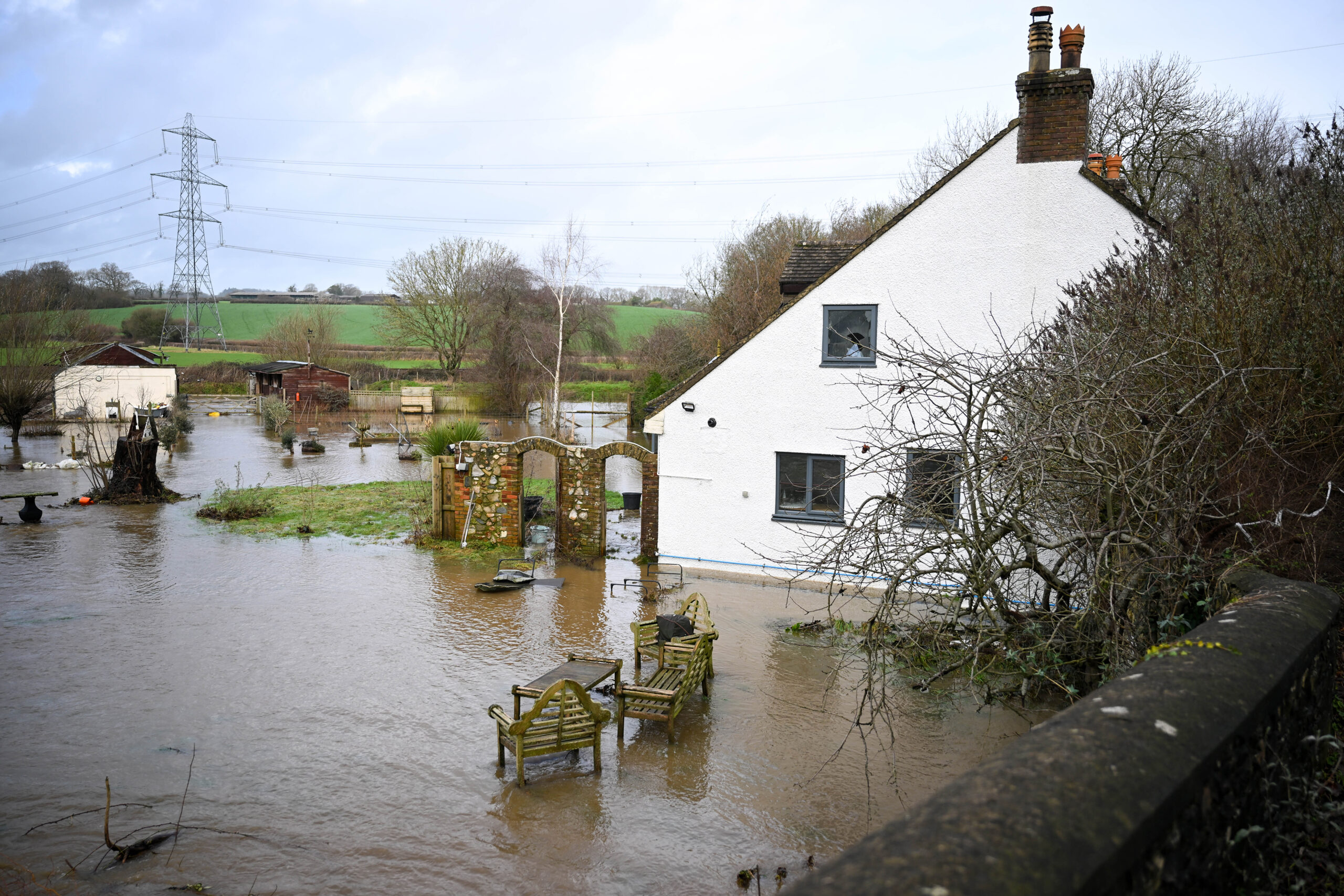
As the prospect of flood damage haunts an ever larger number of UK homes, the country’s banks are under growing pressure to prove they’re not underestimating the risk in their mortgage books.
Nationwide Building Society — once seen as an outlier after saying in 2024 it had stopped making loans to some homes at risk of flooding — has emerged as a prescient first-mover amid growing banker anxiety, according to Mark Cunningham, managing director at PriceHubble, a property data company.
The risk is that a bank is “going to end up with mortgage prisoners” if it’s the only institution “lending to stuff which everyone else says is flooding,” Cunningham says. As a bank in that scenario, “you’re stuffed, and your customers aren’t going to be able to re-mortgage.”
“There’s still a fundamental ‘asymmetry’ between how banks and insurers are approaching the issue of flood damage. And that creates ‘a very significant risk for the banks’ ” — Adair Turner, the former head of the UK’s banking regulator and current non-executive chairman of insurance group Chubb Ltd.’s European business.
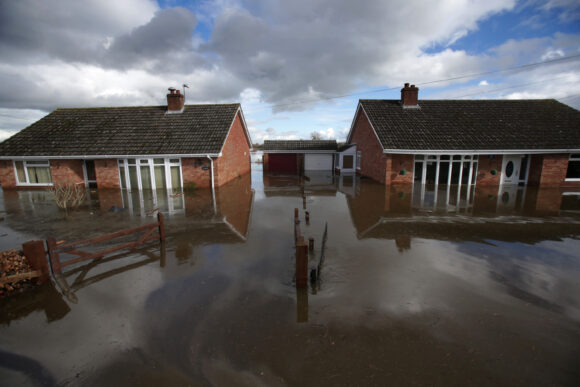
In England, there are already 6.3 million properties in areas at risk of flooding from surface water, coastal swells and overflowing rivers, according to the government’s Environment Agency. At the same time, more properties are being built on flood-prone land, with the insurer Aviva estimating that roughly 11% of new homes built between 2022 and 2024 are in areas facing medium to high flood risks, compared to 8% over the previous decade.
Adair Turner, the former head of the UK’s banking regulator and current non-executive chairman of insurance group Chubb Ltd.’s European business, says, there’s still a fundamental “asymmetry” between how banks and insurers are approaching the issue of flood damage. And that creates “a very significant risk for the banks,” he said in an interview.
The new reality is largely down to climate change, exacerbated by urban landscapes that often prevent excess water from draining away. This year, floods have already wreaked havoc in Britain’s southwest, with Cornwall experiencing its wettest January on record.
The development threatens to upend the dynamics around real estate in Britain, not just environmentally but also financially. Banks risk seeing property values take a hit as the homes they’re financing get damaged in more frequent and destructive floods. Homeowners affected by floods, meanwhile, often get inundated by additional costs that make it harder for them to meet mortgage payments.
UK banks are already trying to identify the corners of their loan portfolios that are most at risk. Barclays Plc says 2.6% of its UK mortgage book is in areas of high flood risk, with a further 1.2% in the very high risk band. And an expected increase in flooding in the coming years “has the potential to impact the valuation of properties directly, as well as indirectly, where areas may become high risk and property demand falls,” Barclays said on Feb. 10.
NatWest Group Plc says 3.4% of assessed UK home loans — including those provided via its private banking division — are already at high flood risk, with a further 1.3% at very high risk. It limits loans for flats, new builds and buy-to-let properties at high or very high risk of flooding, and says it “continually” reviews its lending policies to reflect new flood-risk data.
Lloyds Banking Group plc, Britain’s biggest mortgage provider, says one in six properties on its books is at risk of flooding, with climate change set to raise the likelihood and severity of flood events. Lloyds already conducts physical inspections of properties exposed to increased flood risk, and won’t provide mortgages if a property is found to be “unsuitable collateral,” the bank said this month.
HSBC Holdings Plc, which is due to publish its 2025 report on Feb. 25, has previously cited similar flood-risk figures to its UK peers. The bank has also noted that “flooding has the potential to be the peril having the largest impact on our portfolio.”
In general, UK banks identify London, Eastern England, Yorkshire and Humberside as the main risk areas.
In December, the UK’s Prudential Regulation Authority introduced more stringent rules requiring banks to ensure that such risks are reflected in credit assessments. Banks have since realized that “actually, we probably need to take another look at that decision,” says Hannah Cool, a climate risk consultant.
And with lenders now required to conduct such analyses, “it becomes a part of investment decision making,” says Claudine Blamey, Aviva’s chief sustainability officer.
Insurers
Property and casualty insurers typically provide coverage on a one-year basis and have the flexibility to increase their prices or withdraw from regions; banks, meanwhile, typically provide loans for 20 years or more, extending credit into a future in which Britain will be much wetter and hotter.
“As a property and casualty insurer, I don’t need to think about what the probability of floods are in 2035 or 2040. I can both raise my premium next year, and I can also just declare that there are parts of the country where I’m unwilling to insure,” Turner said. “The people who are in a different position are banks and in particular mortgage banks.”
Edward Burgess, strategic relationship manager at Rightmove, says banks are now trying to “look at those areas where the situation right now might be okay, but actually in 10 years time, 15 years time, over the lifetime of that mortgage,” the worry is whether that area “could change in terms of its risk profile,” he said. It’s about pinpointing that “tipping point,” Burgess said.
There’s a “trade-off” between serving customers while continuing “to protect ourselves from risks and not create unintended consequences,” said Graeme McRitchie, director of risk and compliance at Leeds Building Society. “We are aware there are lots of potential tipping points and if insurance becomes unavailable in an area that would drive decisions anyway.”
A decade ago, the UK government established Flood Re, a reinsurance plan that allows homeowners to access affordable insurance even if their property is at risk of flooding. With an expiry date set for 2039, Flood Re was designed to cushion the blow to private insurers while the government invests in improving the country’s flood defenses.
But the UK isn’t on track to be fully flood-resilient by 2039, a parliamentary watchdog found at the end of last year. Flood Re is also taking on a rising number of properties, in part because of extreme weather events, including severe surface water flooding in London in 2021.
What’s more, homes built after 2009 aren’t eligible for Flood Re. Banks have started running scenarios to see what would happen if Flood Re isn’t extended at the end of the coming decade. NatWest says that “a key conclusion” from an analysis of the potential impacts on its residential mortgage portfolio from flood and windstorm events is that Flood Re is crucial when it comes to keeping a lid on impairment rates.
There may still be need for Flood Re even if the government delivers on its promise to improve flood-resistance infrastructure, Aviva’s Blamey said. Not extending Flood Re depends on Britain’s ability to adequately flood-proof the country, she added.
But “I think if we’re going to need Flood Re to really continue and continue in a really significant way, then we haven’t done our job.”
Top photograph: A house affected by flooding in the hamlet of Weycroft, England, on Jan. 27, 2026; photo credit: Finnbarr Webster/Getty Images Europe
Related:
Copyright 2026 Bloomberg.
Topics
Flood
