

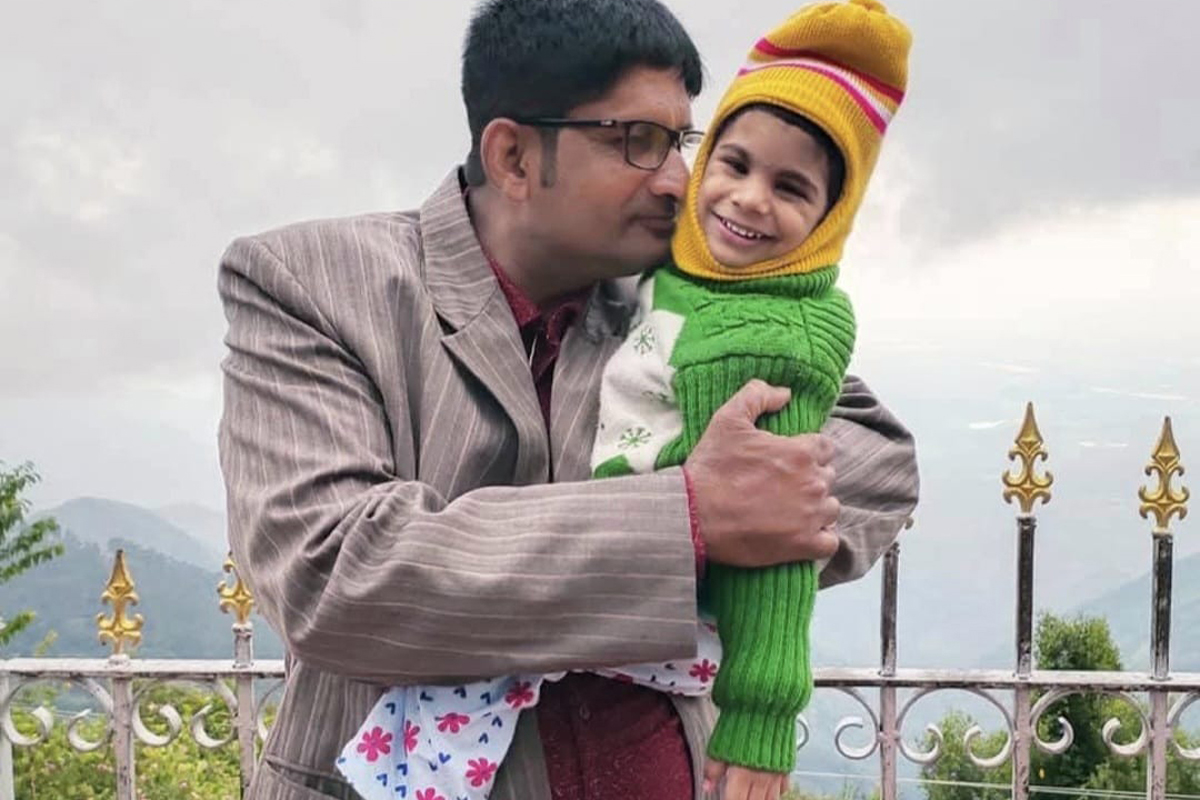
The first sign came when Deepanwita Dasgupta was 5 and started stumbling more while playing at her home in Bangalore in southern India. The girl was always up to something, so her parents figured extra bumps and bruises were just symptoms of an active childhood. Maybe, they thought, it was ill-fitting shoes.
Relatives described the unicorn-loving child as smart, affectionate, and occasionally rascally. Before she learned the alphabet, she had figured out how to find her favorite show, Blippi, on a phone. She was known to sneak butter from the fridge to enjoy a few finger licks.
But then her limbs started jerking. A spinal tap revealed measles in her cerebrospinal fluid. The virus she probably had as an infant had secretly made its way to her brain. Now 8 years old, Deepanwita is paralyzed, unable to talk.
Measles causes complications — ranging from diarrhea to death — in 3 in 10 infected people, according to the Infectious Diseases Society of America. Some are immediate, while others take weeks or months to appear. The one Deepanwita is experiencing, subacute sclerosing panencephalitis, or SSPE, typically takes years to rear its head.
“People think, ‘Oh, you know, if we get measles, then we’ll be fine, because I know my neighbor had it and they’re fine,’” said Yasmin Khakoo, who leads the national Child Neurology Society but spoke to KFF Health News in her capacity as a New York City doctor with expertise in neurologic conditions.
Measles, though, can be dangerous: A 7-year-old in South Carolina will have to relearn how to walk after enduring one of the more immediate complications, brain swelling. And every so often, the virus plants a ticking time bomb in the nervous system. A person can recover from measles and continue life as usual, no longer contagious and without any identifiable symptoms — sometimes for a decade or more — before problems appear. While some patients end up severely disabled for a while, Khakoo said, the condition is almost always fatal.
Before the advent of widespread and effective vaccines, the complication occurred enough in the U.S. that in the 1960s a doctor created a national registry of SSPE patients. Researchers now estimate about 1 in 10,000 people who get measles will develop SSPE, but the risk is significantly higher for those who contract measles before age 5. Populous nations where the virus is endemic, including India, see cases routinely.
Now, doctors and researchers fear that as vaccination rates drop and measles spreads in the U.S., cases of this debilitating complication will also rise here. Since the start of 2025, the Centers for Disease Control and Prevention has recorded over 3,500 measles cases — more than in the entire preceding decade — mostly people who were unvaccinated. Many were children. Last year, Connecticut doctors diagnosed a 6-year-old with SSPE, and in California, a school-age child who’d had measles as an infant died of it.
“We are likely to see SSPE cases going forward, especially if we don’t get this under control,” said Adam Ratner, a member of the American Academy of Pediatrics’ Committee on Infectious Diseases and author of the book Booster Shots.
Concern about SSPE was great enough that in January, the Child Neurology Society published a video to educate U.S. clinicians about the condition, and doctors who have seen such cases are warning their peers.
“We don’t have a way of knowing who’s going to get it, and we don’t have a way of very effectively treating it,” said Aaron Nelson, a professor of neurology with the New York University Grossman School of Medicine. “The one best thing that we can do, ideally, is to prevent children from having to go through it in the first place.”
The recommended two-dose measles vaccine slashes an exposed person’s risk of getting the contagious virus from 90% to 3% — and thus reduces the chance of SSPE. The vaccines carry small risks of febrile seizure and a bleeding condition, but measles itself has a higher risk of causing both.
Cases in the U.S.
A 2017 study of California children who developed SSPE after a measles outbreak there years ago determined that 1 case is diagnosed for about every 1,400 known cases of measles in children under age 5, and 1 for every 600 infected babies.
The researchers also found that, over the years, doctors had missed some cases among patients who had died with undiagnosed neurologic illness.
The possibility that future cases could go undiagnosed spurred Nava Yeganeh and her colleagues to publish a news release in September when a Los Angeles County child died of SSPE.
“We’ve had very few cases of measles in the last 25 years in this country,” said Yeganeh, who is the medical director with the Vaccine Preventable Disease Control Program at the Los Angeles County public health department and has had two patients with SSPE. “Unfortunately, that’s changing, and so we wanted to make sure that everyone was aware of this long-term complication.”
The California child who died had gotten measles as an infant, Yeganeh said, before the child could receive the vaccine. Measles is highly contagious, so at least 95% of the population must be immune to it to protect vulnerable people — including babies too young to vaccinate and people who are immunocompromised — from infection.
“This is an example of someone who did everything right, wanted to protect their child against this infection, and unfortunately ended up losing their child because we didn’t have herd immunity for them,” Yeganeh said.
Shortly after Yeganeh’s group published the news release in California, Nelson was working to get the word out, too.
He had recently seen a 5-year-old whose family had traveled to the U.S. for medical care after the child started stumbling, jerking, hallucinating about bugs and animals, and having seizures. The child had contracted measles as an infant and had been too young to be vaccinated. Nelson diagnosed the child with SSPE.
“Imagine that: Having a child who is healthy and happy, moving to talking less and less, eventually not able to walk,” Nelson said. “It’s a very sad thing.”
He thought he would encounter the condition only in medical school textbooks, as a relic of the past. Instead, in October he found himself presenting the case at the Child Neurology Society’s national conference and participating in the society’s video about the condition. “I’ve now seen something I shouldn’t have ideally seen ever in my career,” he said.
Warning Signs From India
Globally, the number of measles outbreaks has increased in recent years, and physicians in places including the U.K. and Italy have recently seen clusters of SSPE.
The high human cost of measles’ spread is especially evident in India. While total cases aren’t tracked, about 200 families caring for people with SSPE, including Deepanwita’s, are in a single chat group in the Bangalore area.
In New Delhi, Sheffali Gulati studies SSPE and sees about 10 new patients a year with the condition, what she calls the “delayed echo” of measles outbreaks. The youngest she has seen was 3 years old.
“The ages are coming down, and a death or a vegetative state can develop as soon as in six months to five years of onset,” said Gulati, who leads the pediatric neurology program at the All India Institute of Medical Sciences and until recently led India’s Association of Child Neurology.
Gulati hasn’t found any treatments that reverse SSPE’s course, only some that slow its progress. She’s found herself counseling parents: It’s catastrophic, it’s not their fault, and they can do nothing but accept it.
Deepanwita’s relatives try to find joy where they can. They think they noticed the girl smiling when her favorite cousin called recently. Anindita Dasgupta, her mother, said Deepanwita moves her hands and feet on her own and sometimes turns her head, especially when her father enters the room. The girl communicates with her parents through her eyes and a few sounds.
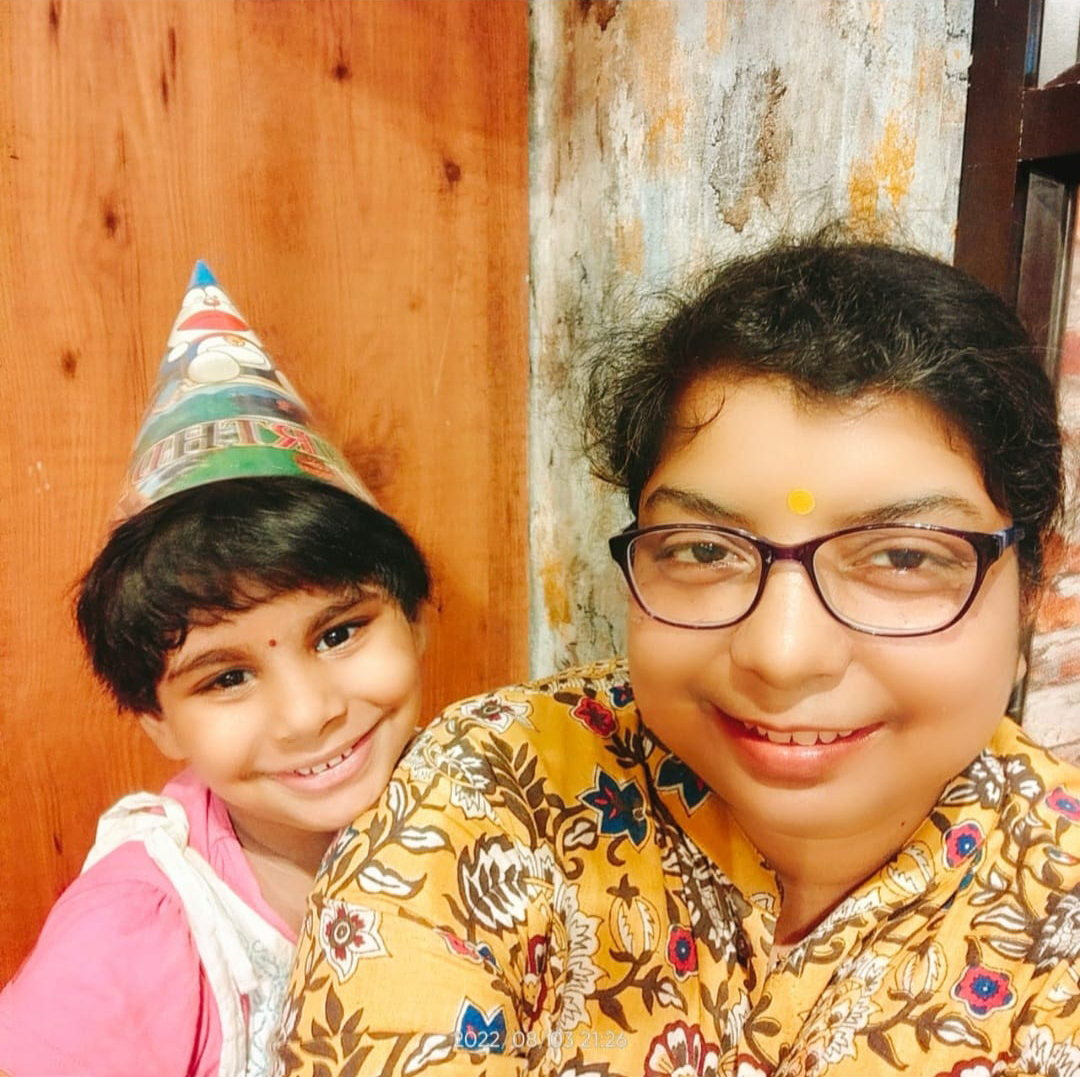
But it’s far from where she was in 2022: At a cousin’s birthday, a few months before noticeable symptoms started, Deepanwita started the birthday song and sang the loudest.
At her own 8th-birthday gathering last year, Deepanwita, wearing a pink eyelet dress and a nasal tube, could only blink and move her eyes as she sat propped up before two cakes that she would not be able to eat. She can no longer swallow, so her mom dabbed a bit of icing on her tongue.
Research That Shouldn’t Be Needed
Roberto Cattaneo, a molecular biologist at the Mayo Clinic in Rochester, Minnesota, has been studying SSPE for years. He recently used postmortem brain tissue to map how the measles virus can spread from the frontal cortex to colonize the entire brain. Still, he said it’s a “black box” what exactly measles is doing in those dormant years between the initial infection and when the symptoms of neurologic damage crop up.
It’s possible the virus replicates in the brain that whole time, undetected, killing off neurons. But with so many neurons in the human brain — 10 times as many as people living on the planet — the brain may find a way to adjust, Cattaneo said, until finally it can’t anymore.
He’s applying for funding to continue research on the disease and possible treatments, though ultimately, he wishes he didn’t have to. The tools to obliterate the condition already exist.
“The problem could be solved with vaccination,” Cattaneo said. The U.S. should have no cases of SSPE, he said. “It’s just painful.”
