

The Supreme Court of Maryland has thrown out climate change lawsuits filed by Baltimore, Annapolis and Anne Arundel County against 26 fossil fuel companies, finding that the Clean Air Act along with U.S. Supreme Court rulings make it clear that the federal government, not local governments, has sole authority to regulate emissions.
The local jurisdictions had argued that their lawsuits were about state law claims and deceptive marketing by the energy firms, not about emissions regulation. They sought damages for five causes of action arising under Maryland law against the energy firms: public nuisance; private nuisance; trespass; negligent failure to warn; and strict liability failure to warn.
But the state’s high court, upholding dismissals by lower courts, held that through their state law claims, the local governments were attempting to regulate air emissions. The court noted that, for over a century, the U.S. Supreme Court has held that cases involving regulations of interstate pollution arise under federal law.
The Maryland Supreme Court further held that, even if the local governments’ state law claims were not preempted by federal law, the local governments failed to state legally cognizable claims under state law for public nuisance, private nuisance, trespass, and negligent and strict liability failure to warn.
“Although we are required to view the local governments’ allegations in the light most favorable to them, we are not required to defer to their characterization of the nature of their claims. No amount of creative pleading can masquerade the fact that the local governments are attempting to utilize state law to regulate global conduct that is purportedly causing global harm,” wrote Justice Brynja Booth for the majority.
The Maryland ruling is at odds with a Colorado Supreme Court ruling last May that found federal law does not preempt similar climate change claims by the city and county of Boulder against fossil fuel companies. Last month, the U.S. Supreme court agreed to hear the companies’ appeal of that state ruling.
The Maryland localities maintain that the 26 energy firms are responsible for producing and marketing fossil fuel products, the intended use of which has led to the emission of a substantial percentage of the total volume of greenhouse gases released into the atmosphere for over 50 years. They contend that the companies deceived consumers and the public about the dangers associated with their fossil fuel products when they knew of a direct link between their products and climate change threats, causing rising sea levels and other physical and environmental impacts affecting local governments’ property and citizens.
The state high court said what the localities are really saying is that the fossil fuel companies have engaged in worldwide deception and caused worldwide injuries. “We determine that the duty the local governments seek to impose is, indeed, a duty to warn the entire human race of the effects of climate change. We have resisted efforts to find such a duty under our common law and continue to do so here. Finding such a duty would stretch tort law beyond any manageable bounds,” the majority concluded.
In an ardent dissent of 75 pages, Justice Peter K. Killough disagreed with most of the majority opinion, maintaining that the high court simply bought the energy firms’ characterization of the suits without doing its own analysis.
“The duty alleged here is not a duty to reduce emissions. It is a duty not to deceive. Plaintiffs do not ask this Court to order Defendants to emit less, to comply with a different standard, or to alter their operations in any way. They ask for damages for an alleged decades-long campaign of misrepresentation about what Defendants knew and when they knew it. Properly framed, the question before us is this: does the Clean Air Act preempt state law claims for deceptive marketing? The answer to that question is no,” Killough wrote.
Killough said the claims should be allowed to proceed past the motion to dismiss stage to be resolved on a developed factual record.
The Circuit Court for Baltimore City and the Circuit Court for Anne Arundel County granted the energy firms’ motions to dismiss. After an appeal to the Appellate Court of Maryland, where the cases were consolidated, the Supreme Court stepped in to determine whether Maryland local governments may bring the state common law tort claims against the companies.
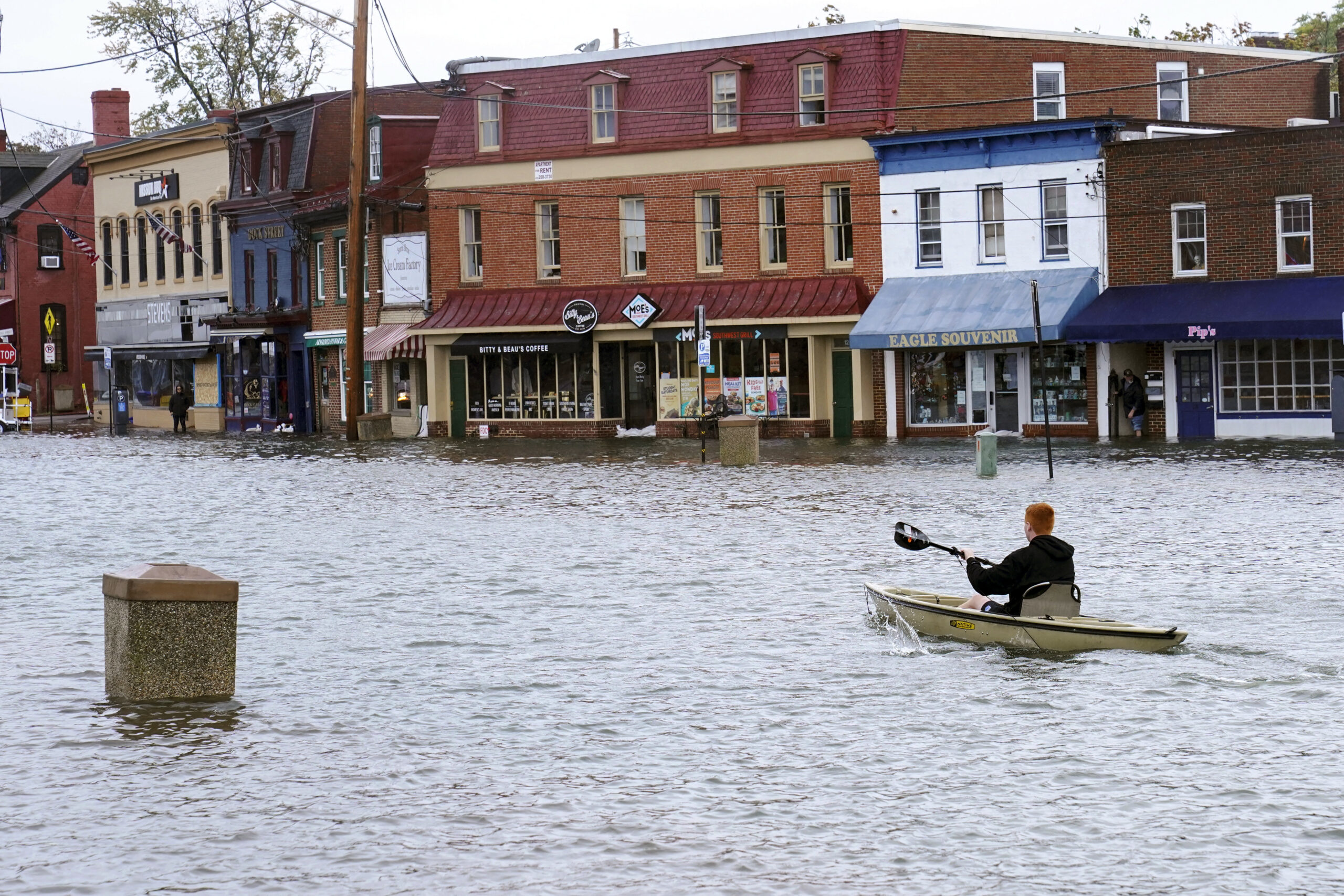
Photo: A person paddles their boat through a parking lot as they survey the flooding in downtown Annapolis, Md., Friday, Oct. 29, 2021. (AP Photo/Susan Walsh, File)
Topics
Lawsuits
Maryland
Climate Change
Interested in Climate Change?
Get automatic alerts for this topic.
