

Connecticut lawmakers are considering placing a 5% surcharge on commercial property/casualty insurance policies for fossil fuels-related companies at a time when rising insurance premiums and utility bills are concerns.
The surcharge is intended help fund local communities’ efforts to fortify their infrastructure against damage from climate change.
The measure (SB 453) would levy the surcharge on policies covering fossil fuel infrastructure, including pipelines, refineries, terminals, and other related facilities, with the exception of home fuel delivery vehicles.
In addition to funding grants to local communities, the resulting “climate resilience account” would be charged with disseminating flood risk data to communities throughout the state and improving public awareness in communities with high flood risk.
The Environment Committee passed the bill and it has since been submitted for a fiscal analysis. Sponsors of the bill include Representatives Nick Gauthier and Anne Hughes, both Democrats.
Leveraging Insurance
Rebuild by Design, a group that works with localities on policies to address climate challenges, is an advocate of “leveraging” insurance to support infrastructure.
“Insurance has long served as a risk transfer mechanism, allowing households to transfer the risk of losses to insurance companies in exchange for monthly payments, or premiums,” the group argues. “Now, as risk increases, we must mobilize insurance as a risk reduction mechanism – for the safety and wellbeing of communities, and for the sustainability of the industry.”
Rebuild by Design estimates that a 2% surcharge on certain lines of property/casualty insurance in all states could support $287 billion of funding for infrastructure enhancements. A 2% surcharge in Connecticut alone could generate $3.7 billion.
According to the Connecticut Council of Environmental Quality, climate change is resulting in more precipitation and an increase in sea levels in the state and will continue to adversely impact the natural and built environment and the quality of life.
Surcharge Testimony
In testimony on the 5% surcharge before a March legislative hearing, and in other public statements, environmental and consumer groups backing the measure have said they see it as an investment in a home risk reduction grant program for vulnerable communities. Ultimately, they argue, lowering disaster damages, clean up costs, and economic losses will also lower insurance costs.
Samantha Dynowski, of the environmental group Sierra Club, maintained that right now, Connecticut residents and communities “bear the full financial burden of climate-related disasters” like flooding, heat waves and sea level rise “while the companies driving these risks are largely shielded from the costs.”
Rick Morris of Public Citizen said the state is facing a home insurance affordability crisis because of climate change and should act now to protect homes. While there are proven ways to lower costs by building resilience, many households need upfront financial support, he told lawmakers.
“Major insurance companies have repeatedly cited the climate crisis as the reason they want to raise rates on homeowners. Yet, as these companies hike premiums, they continue to invest in, and reap profits from, the fossil fuel industry,” said Morris.
Passing Costs to Buyers
However, insurance organizations including the Connecticut Business & Industry Association, along with energy firms including Eversource, have warned that the costs of the surcharge would end up being passed to consumers and businesses in higher energy costs at a time when electric and natural gas utility bills are rising.
The American Property Casualty Insurance Association (APCIA) argued the bill could even be unconstitutional as a violation of due process since it would surcharge insurers licensed in Connecticut for risks that might be located outside of the state.
Sean McLaughlin, of the National Association of Mutual Insurance Companies (NAMIC), told lawmakers that a surcharge could have “unintended consequences” with Connecticut domiciled insurers that do business in other states ending up being hit with additional retaliatory taxes by other states.
Representatives for energy supplier Eversource offered that the bill’s application of the surcharge to any insurance policy concerning “any other infrastructure related to such activities” is very broad and will generate problems. They said the phrasing should be changed to clarify that it does not apply to electric and natural gas utility companies that are regulated by the Connecticut Public Utilities Regulatory Authority. State law authorizes electric and natural gas utilities to recover in the rates they charge consumers “their operating costs” of running the utility company which includes their cost of insurance, Eversource reminded lawmakers.
The Connecticut Growers Association also suggested the bill’s definition of “fossil fuel infrastructure” needs to be narrowed. CGA argued that as written it could potentially impact agricultural vehicles and greenhouses.
John Daniels, manager at his family-owned Daniels Energy, agreed that while the bill won’t impose the surcharge on home fuel delivery vehicles, it will create additional costs for suppliers that will pass along the costs to local companies and ultimately consumers.
According to the Connecticut Energy Marketers Association (CEMA), bioheat fuel and propane retailers that distribute fuel to convenience stores, if faced with a 5% surcharge on their insurance, will “unquestionably” pass on the cost to retailers. In turn, these family‐owned retail businesses will ultimately pass the cost on to consumers, resulting in higher prices at the gas pump and higher heating costs for homes and businesses.
The Connecticut Department of Energy and Environmental Protection (DEEP) already administers a Climate Resilience Fund. In 2025, this fund began making available $33 million in state funds and $11.8 million in federal funds for local community projects that address energy as well as infrastructure resilience. Projects that qualify include flood control projects, climate-smart improvements to energy infrastructure, wildfire prevention strategies, nature-based solutions for cooling urban centers, and energy resilience measures.
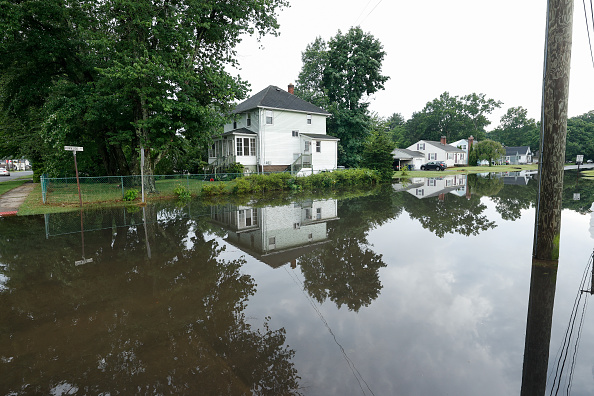
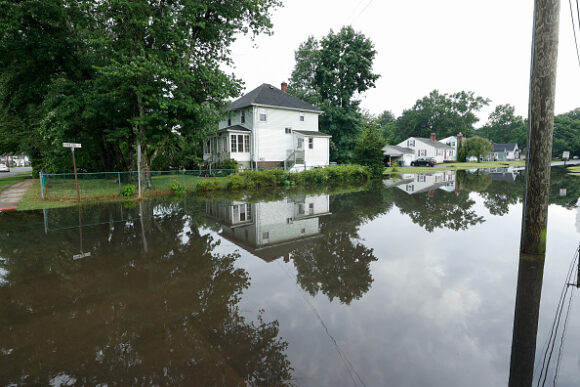
PHOTO: A view of the flooded area after the severe thunderstorm in Connecticut, United States on June 30, 2024.
Topics
Property Casualty
Connecticut
