

Local, state and federal officials were aware of the dangers posed by the Cheboygan Lock and Dam for years before floodwaters pushed it to the brink of collapse, records show.
Yet they failed to compel private owners to repair the nonfunctional hydro plant connected to the publicly-owned dam — a critical piece of its ability to pass floodwaters downstream.
The facility that houses the plant, once a Charmin toilet paper mill, changed hands repeatedly over decades as it fell into disrepair.
Now taxpayers are helping bankroll a desperate effort to bring the plant back online before the dam fails and sends a wall of water toward downtown Cheboygan.
“I’m very concerned that this was not handled properly,” said Richard Sangster, a Cheboygan County commissioner and former Cheboygan mayor, about federal regulatory actions over several years.
The property is now owned by Hom Paper XI, LLC, a business controlled by former NFL linebacker Thomas Homco. He did not return voicemails left by Bridge Michigan.
State and local officials did what they could, Cheboygan County Sheriff Todd Ross said Thursday.
“We didn’t wait ’til the last minute,” Ross said. “It’s privately owned. There’s only so much we can do.”
A public tally of taxpayer costs associated with the round-the-clock repair wasn’t available Thursday, but estimates from a few years ago indicated the plant needed at least $1 million in repairs.
‘Safety concerns have been raised many times’
Records show the agency that primarily regulates hydropower dams, the Federal Energy Regulatory Commission, sent warning letters for years to a shifting cast of owners while granting multiple extensions.
Among the issues they cited: missing inspection records and malfunctioning equipment that was crucial to passing water in the event of a flood.
As far back as 2019, regulars warned about cracked concrete and damaged retaining walls and gates that could help the dam manage flooding, records show.
In 2021, FERC told the plant’s then owners that “multiple items are overdue and completion dates are rapidly approaching.”
The plant was cited 16 times in 10 months for safety violations by Occupational Safety and Health Administration before a fire closed it altogether in September 2023, records indicate.
That prompted more orders for repairs and more extensions from FERC. Records indicate state officials said they were aware of the issues but had no role in enforcement.
“Safety concerns have been raised many times,” Sangster said, adding “you wouldn’t even be able to measure how detrimental” a dam failure would be.
“In my eyes, it appears like total neglect on their behalf,” he added about FERC.
‘No simple answer’
FERC spokesperson Celeste Miller did not respond to detailed questions from Bridge about oversight of the hydro plant property and instead put out a statement noting the agency’s role in the ongoing emergency response in Cheboygan.
“Above all, our priority is to coordinate with all involved partners to safeguard both the community and the environment,” Miller wrote.
The crisis comes six years after the privately-owned Midland dams failed following a similar pattern of regulatory delay. Michigan legislators vowed to make dam safety a priority after Midland, but ultimately didn’t act on proposed reforms.
A solution “keeps getting kicked down the road … now we’ve got a whole community in peril because it was mismanaged by (private owners),” state Sen. John Damoose, R-Harbor Springs, said after touring the dam with Gov. Gretchen Whitmer.
“This is a problem that could happen all over the state,” Damoose said. “‘It got our attention a few years ago in Midland, but now we’re seeing that it was not an isolated thing and we need to take some serious looks at how we allow this to go on.”
Whitmer said “there’s no simple answer” due to a “complicated web of privately owned and publicly owned (dams.)”
“We have made some long overdue investments in some of our infrastructure,” she said.
Complicated history
Like many dams in Michigan, the Cheboygan complex was once owned by utilities to generate power for the region.
By 1967, when Consumers Energy sold it to the state of Michigan for $1, it was no longer generating power but the deeper Cheboygan River created by the dam had become a valued link between Lake Huron and the Inland Waterway, a 40-mile-long network of popular rivers and lakes.
In 1983, Procter & Gamble took over the hydroelectric side of the facility, securing a licensing exemption from FERC and striking a deal to give the state some continued say over water flows through the now-privatized portion of the complex.
But soon after pouring millions into upgrading the hydro facility, the company shuttered its Cheboygan operation in 1990, eliminating 300 jobs and commencing the slow decline of the historic mill.
Eventually, a company named Great Lakes Tissue bought the plant and was urged by FERC for years to make repairs.
It sold the business before a June 2022 deadline to ensure the gates that allowed water to flow through the hydro plant were functioning properly.
It’s not clear whether the work was ever completed. Nor is it clear whether federal regulators were aware of subsequent ownership changes.
Great Lakes Tissue Company was still the listed owner on FERC’s license exemption well into 2025.
Tug-of-war
While the hydro side of the dam complex sat idle following the fire, state Department of Natural Resources officials in charge of the rest of the dam publicly warned its closure would make it hard to manage water levels in the Cheboygan River.
The plant had accounted for about 30% of the river’s flow to Lake Huron, they said.
“Boaters and residents … may experience larger water level fluctuations,” stated a 2024 agency announcement.
Bridge Michigan was not able to discern what steps, if any, DNR officials took to try to compel action.
Agency spokesperson Ed Golder said he was not able to immediately answer related questions from Bridge Michigan while the agency deals with emergency response in Cheboygan.
Josef Greenberg, a spokesperson for the Michigan Department of Environment, Great Lakes and Energy, which regulates dams in the state that are not regulated by FERC, said state officials had communicated with federal counterparts about the issues at the dam, but did not play a regulatory role.
In the fire’s aftermath, federal officials continued issuing letters flagging unresolved safety issues at the hydro plant, some of them dating back years.
They pressed current and past owners for clarity about who was in charge, a process complicated by a flurry of legal disputes between parties with a stake in the floundering business.
Eventually, Hom Paper emerged as the rightful owner in FERC’s eyes, and the agency ordered the company to either restore the hydro plant to working condition or risk losing the license exemption that allows it to generate hydropower.
Company lawyer Tyler Tennent initially responded that doing so was no longer economically feasible: “Hom Paper XI, LLC no longer intends or desires to operate the hydroelectric machinery,” Tennent wrote in August 2025.
Then Hom Paper found a potential buyer, asking FERC for repeated extensions of time to repower the plant while it worked to finalize the deal.
The would-be buyer: HydroMine Cheboygan LLC, a Wyoming-based corporation spearheaded by Roy Davis, a self-proclaimed “blue-collar mechanic that fixes things,” who has restarted power operations at other aging dams in Eaton Rapids and Hubbardston.
“Hom Paper and HydroMine are very near to having a signed agreement,” Hom’s lawyer, Tyler Tennent, wrote to FERC in January.
Tennent told regulators HydroMine was negotiating water management agreements with the DNR and working with Consumers Energy to repower the site.
“We appreciate FERC’s continued patience,” he wrote.
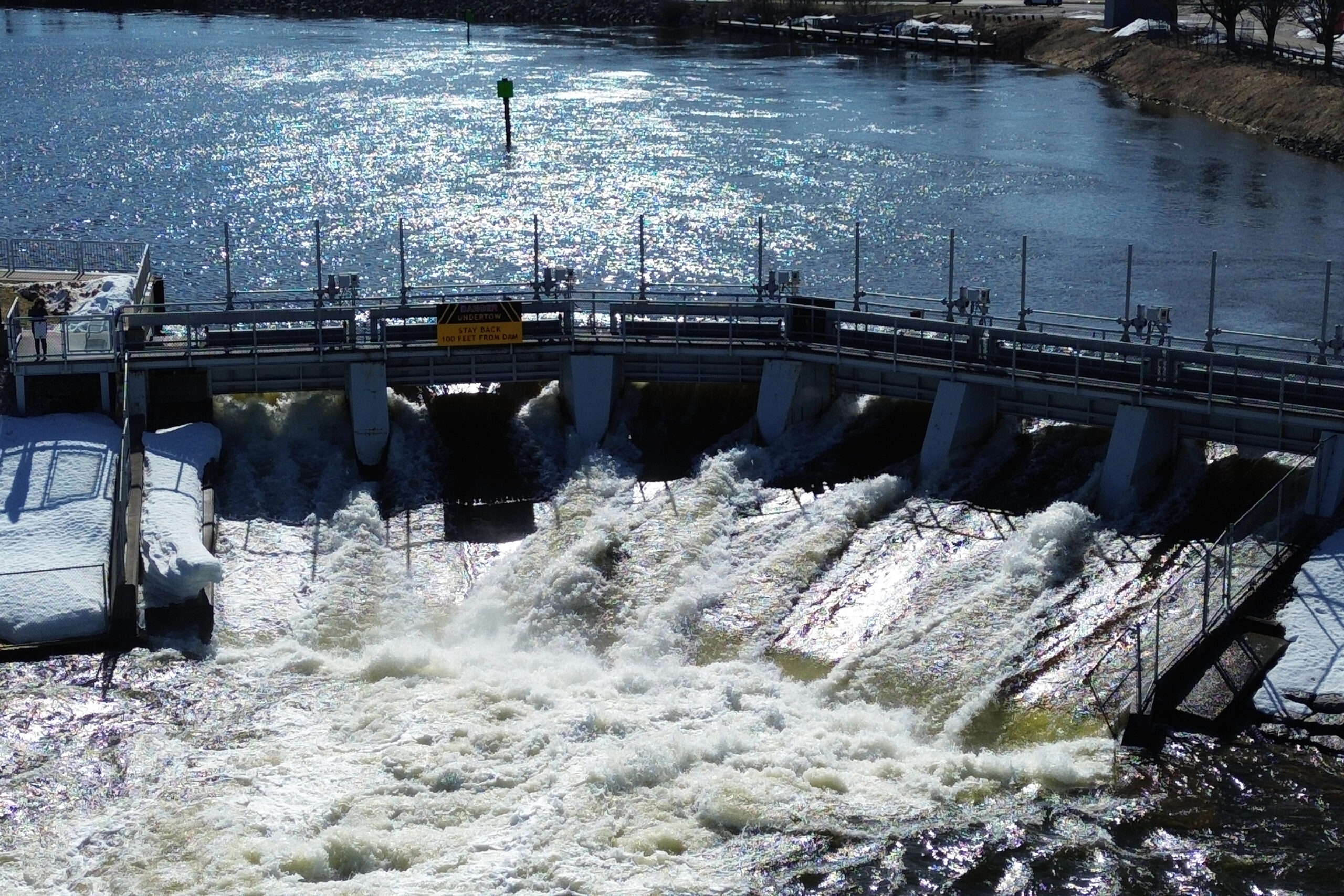
Three months later, the plant remained nonfunctional Thursday night, reducing the Cheboygan dam’s ability to pass floodwater that had climbed within five inches of its crest.
Residents in the floodzone have been urged to prepare for evacuation in case of dam failure.
Looking ahead
An estimated 75 Consumers Energy workers have been at the dam to get the privately owned hydroelectric power plant running, Michigan State Police said Thursday.
By Thursday evening, signs pointed that restoration would be imminent, said Bruce Straub, Consumers’ incident commander.
Preserving dam integrity across northern Michigan will be important to the region once the crisis abates, said Sharen Lange, a Cheboygan business owner active in economic development, including on Cheboygan Commons.
Many in the area keep talking about who should own the hydro plant, Lange said. Others are saying that the city or county could take action.
“We know that it being in private hands has produced a really bad result,” Lange said.
___
This story was originally published by Bridge Michigan and distributed through a partnership with The Associated Press.
Photo: This photo provided by the Michigan Department of Natural Resources shows water flowing through the Cheboygan Dam April, 2026, in Cheboygan, Mich. (Michigan Department of Natural Resources via AP)
Topics
Michigan
