

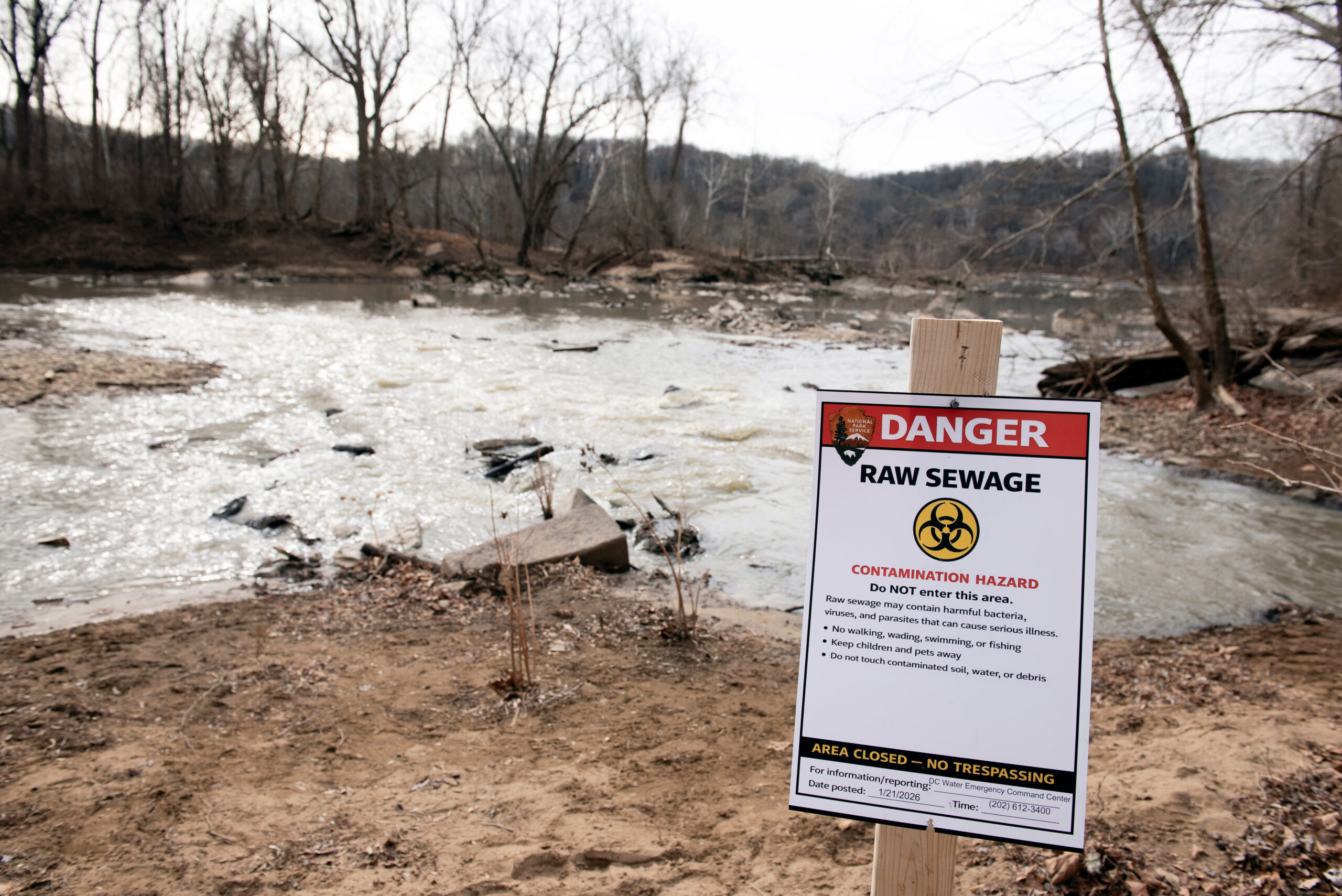
The state of Maryland and the federal government have filed separate civil lawsuits over the rupture of the sanitary pipeline known as the Potomac Interceptor that spilled more than 200 million gallons of untreated sewage into the Potomac River in January.
Maryland Attorney General Anthony G. Brown and the Maryland Department of the Environment are suing DC Water, the utility that operates the pipeline, seeking penalties and damages for costs associated with the contamination and a court order requiring full restoration of the site. The suit alleges that DC Water violated state pollution laws because it was “aware that the over half-century-old Potomac Interceptor showed signs of corrosion yet failed to properly assess the risks and delayed initiating capital improvements.”
The U.S. Department of Justice, on behalf of the Environmental Protection Agency (EPA), is suing DC Water and the District of Columbia for alleged violations of the federal Clean Water Act due to incident. The complaint alleges that DC Water failed to properly operate and maintain its sewer system in a manner that keeps untreated sewage out of the Potomac River and its tributaries, and other areas with risk of human contact.
The 72-inch diameter Potomac Interceptor conveys an average of up to 60 million gallons a day of sewage from parts of northern Virginia, the District of Columbia, and Maryland to a pump station in Washington, D.C. The Potomac Interceptor was placed in service in 1964.
Penalties
The Maryland complaint asks the court to impose civil penalties of up to $10,000 per day for each violation, order DC Water to pay for all environmental testing and cleanup costs, cover damages for the lost value of the state’s natural resources, and issue an order to permanently stop any future unauthorized sewage discharges.
“Millions of gallons of raw sewage in the Potomac River does not just disappear, it damages ecosystems and harms communities, and it demands accountability,” said Brown. “DC Water knew this aging infrastructure was corroding, yet it delayed repairs and failed in its duty to protect this treasured waterway, failures that we allege constitute gross negligence. We are going to court to make sure they make it right for Marylanders.”
Federal Caee
The federal DOJ complaint seeks financial penalties, sewer assessment and rehabilitation projects, and pollutant mitigation work to remedy DC Water’s failure to operate its sewer system in compliance with the Clean Water Act and its permits. The complaint also seeks an order for DC Water to develop an enhanced operations and maintenance plan for all its sewer lines.
“As cities grow and infrastructure ages, cities must invest in their wastewater system to prevent such catastrophes. This complaint seeks to secure DC Water’s commitment to properly maintain its foundational sewage infrastructure,” said Deputy Assistant Attorney General Adam Gustafson.
Meanwhile, in its press release, the EPA also pointed a finger at Maryland, which it says “disclaimed any responsibility and refused to hold DC Water accountable” even though the collapse was on federal land in the state and Maryland “has taken federal primacy for implementation” of the Clean Water Act. As a condition of taking the federal authority to issue CWA permits, the state has agreed to enforce the CWA within its boundaries by taking action against violators, and it has full authority to do so, according to the EPA.
DC Water Response
In a statement in response to the lawsuits, DC Water said it “is fully committed to the long-term rehabilitation of the Potomac Interceptor. Although the lawsuits are still under review, they underscore our commitment to advance the planned repairs for the entire 54-mile pipeline, including the impacted segment.”
DC Water also suggested the federal government had delayed repairs. The utility stated that the lead regulatory agency for the federal land (the C&O Canal National Historical Park) in the area of the pipeline is the National Park Service (NPS) and it has worked with NPS since 2018 on site assessments, environmental reviews, and emergency repairs on portions of the pipeline to ensure environmental protection and public safety. DC Water said in the past it requested streamlined environmental reviews to “allow rehabilitation of the interceptor to move forward more quickly” but its request was not approved.
On January 19, a portion of the Potomac Interceptor collapsed where it passes through the C&O Canal National Historic Park in Montgomery County, Maryland. Between Jan. 21 and 24 DC Water crews worked to install diversion pumps to route wastewater around the failed section and used a portion of the C&O Canal to contain the bypassed flow until it could re-enter the Potomac Interceptor downstream of the collapse. On Feb. 8, DC Water reported that an estimated 500,000 gallons of sewage was discharged to the Potomac River when multiple pumps had to be shut down due to clogging with rags and wipes.
After the District of Columbia requested federal assistance, the Army Corp of Engineers began to assist with mitigation efforts around February 21.
Repairs Completed
DC Water said it was able to stop all discharges within 21 days with the bypass, and on March 14, after 55 days of mitigation, DC Water reported that repairs had been completed and the Potomac Interceptor returned to operation.
The governments are not the only parties suing DC Water. A Virginia boater also filed a negligence suit seeking compensation for people “whose property interests in and use and enjoyment of the Potomac River have been impaired” by the spill.
Photo: A warning sign is seen at the sight of a massive pipe rupture, as sewage flows into the Potomac River, right, in Glen Echo, Md., Jan. 23, 2026. (AP Photo/Cliff Owen, FiLe)
Topics
Lawsuits
Interested in Lawsuits?
Get automatic alerts for this topic.
