

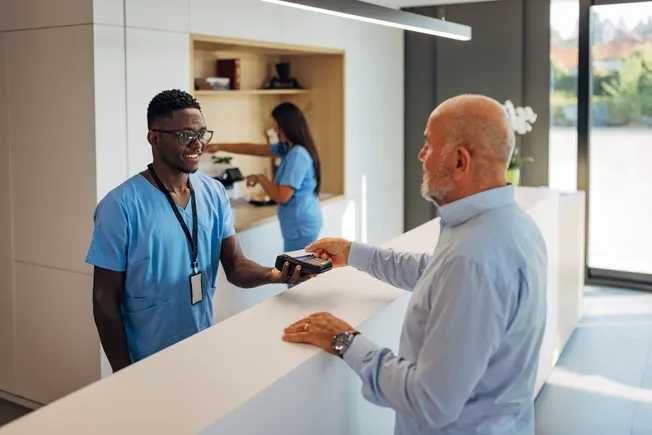
In a world where rising costs, flat or declining reimbursement and staffing shortages threaten the viability of small and independent medical practices, those seeking to stay profitable and relevant can learn valuable lessons from the retail industry.
Today’s patients have been conditioned by companies like Apple and Amazon to expect personalization, convenience and price transparency. They now want their healthcare experiences to mirror what they’ve become accustomed to as consumers.
Even through periods of slow economic growth and temporary sales dips, global retail sales have trended upwards for decades. One of the primary reasons for this ongoing increase is that retailers have mastered the art of persuading people to buy more products, more often.
Retail-style recurring payment options are a particularly important example for healthcare payment processing. As enrollment in high-deductible health plans (HDHPs) climbs and self-pay volumes continue to increase, practices are gathering more of their net revenue directly from patients. Those who are accustomed to collecting primarily from payers may recover only a fraction of their self-pay balances, while those that invest in building out retail-like payment options stand to strengthen their financial health and operational resilience.
Making healthcare payments as easy as checkout
Whether consumers are shopping online or in-store, leading retailers strive to make checkout as fast and simple as possible. They know that customers are likely to abandon purchases when their preferred payment method isn’t accepted, so coverage of the five major credit card networks (Visa, Mastercard, American Express and Discover) is ubiquitous. Digital wallets like Apple Pay and Google Pay have become increasingly popular, especially among younger consumers, and these options make payment faster, which can improve conversion rates. In addition, healthcare providers should accept flexible spending account (FSA) and health savings account (HSA) debit cards.
Online payment portals, where patients can handle an outstanding balance at any time, add convenience, as do options like text-to-pay. If a practice can store payment card information on file in a secure vault, it becomes effortless to collect co-pays as soon as visits are completed. Practices also have the option of automatically billing for no-shows, decreasing last-minute cancellations.
“In the most successful practices, leaders understand that their patients are diverse,” says Misty Meraz, Vice President of Healthcare and Public Sector Sales at Elavon, Inc. “We all have different needs and preferences. Some people prefer to pay via text message, some would rather go online and others would prefer to mail a check. Part of patient-centricity is meeting all of these patients where they’re at.”
Embedding payments into the care journey
Retailers clearly display prices for each item that’s for sale, while healthcare billing is often perceived as complex and opaque. Providing patients with easy-to-understand responsibility estimates early in the care journey removes the confusion that’s long been associated with healthcare billing. Giving patients the option to pay prior to the visit reduces no-shows and non-payments.
Scheduled recurring payment options are increasingly popular among eCommerce merchants and are beginning to gain traction for in-store purchases. With scheduled recurring payments, the full cost of a purchase is split into smaller, interest-free payments to be paid over time. Offering healthcare payment options that follow a similar model can reduce patient stress and anxiety while improving collection rates and making cash flow more predictable.
Automatically posting payments to the practice management system (PMS) or electronic medical records (EMR) system not only saves time and administrative effort, but it reduces human error. Few things are more frustrating than receiving a bill for a healthcare visit copay that you’ve already paid. Eliminating workflows where these types of mistakes can occur leads to a holistic improvement in the patient experience.
“A patient’s experience of an episode of care doesn’t end with the treatment, it ends with billing, Meraz explains. “If a practice hasn’t modernized their billing practices, this will affect how patients perceive the care they received there.”
Innovative strategies for increasing care access
Growing numbers of primary care practices as well as specialty clinics and veterinary hospitals are now offering subscription-style payment options, in which members are charged a flat monthly or annual fee for access to routine preventative care services such as wellness exams and lab tests. Models such as direct primary care (DPC) and concierge care offer an alternative to fee-for-service insurance billing, simplifying a practice’s revenue structure and reducing administrative overhead. These models encourage healthcare consumers to think of medical services as something to be paid for in advance, a major shift from yesterday’s practice of mailing out paper statements weeks or even months after an appointment.
While not all practices would benefit from transitioning to the DPC model, most stand to gain from implementing the payment processes that subscription-style membership requires. To collect balances on a regular schedule, practices should be able to store payment card information securely, process recurring payments automatically and provide patients with digital receipts. These capabilities improve the accuracy and efficiency of billing while improving both cash flow and patient experience—a win for everyone involved.
The growing consumerization of healthcare will compel practices to make changes to their operations, technology strategies and relationships with patients. Ultimately, healthcare is—and should always be—about improving people’s lives and experiences. Modernizing billing makes it possible to extend patient-centricity far beyond the clinical encounter.
As self-pay continues to grow, practices don’t have to guess where to start. Explore how retail-inspired payment strategies can help make billing easier for patients and more predictable for your practice.
