

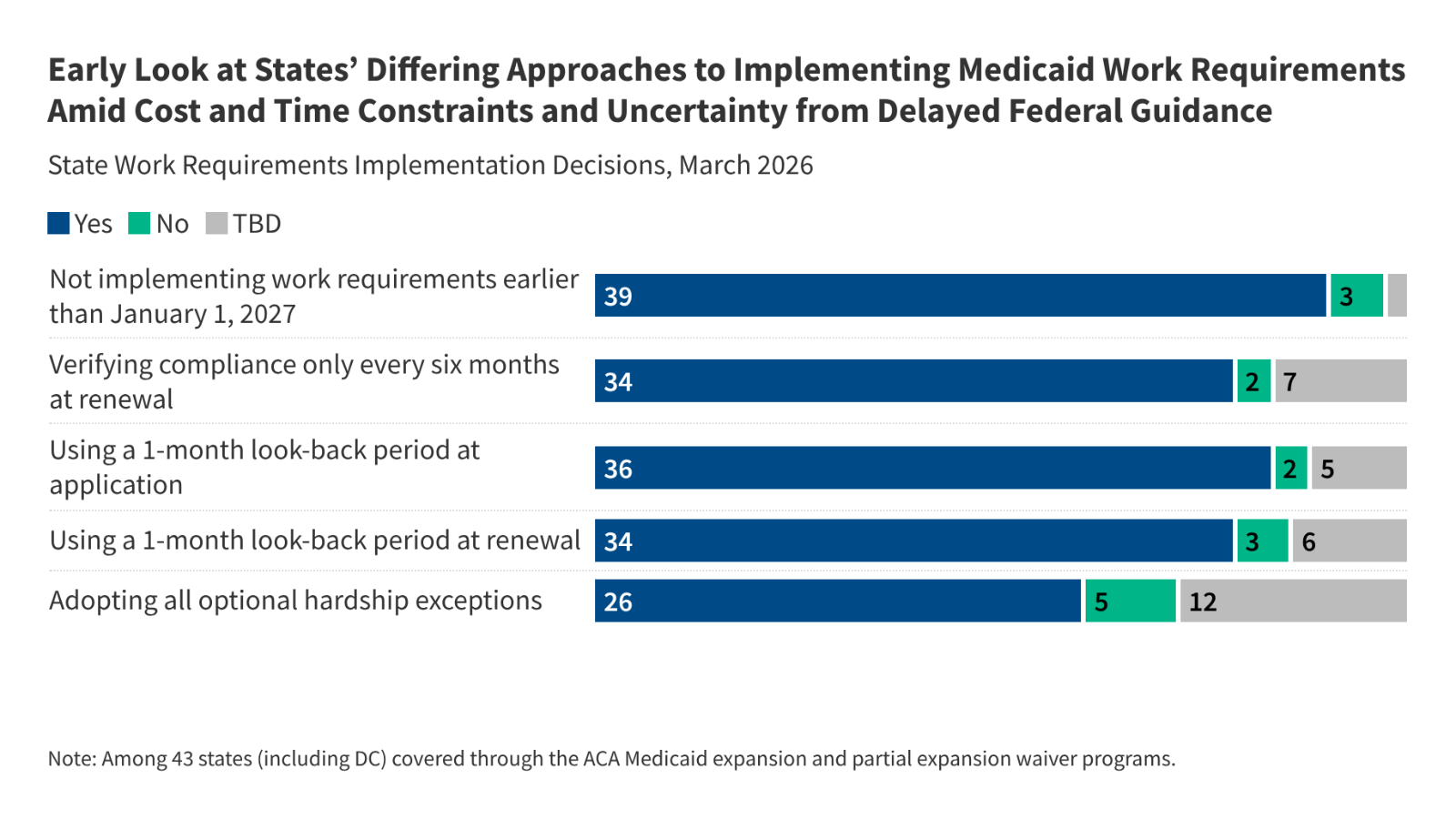
A new KFF survey of state Medicaid officials and focus groups in eight states captures the different choices states are making about how to implement Medicaid work requirements, with seven states planning for a more restrictive approach to verifying work or exemption status or to implement work requirements early. These implementation plans are taking shape as states encounter time, cost, and other constraints as well as uncertainty about how to define and verify certain exemptions due to delayed federal guidance.
The 2025 reconciliation law requires adults in the 43 states (including DC) covered through the Affordable Care Act (ACA) Medicaid expansion and partial expansion waiver programs (Georgia and Wisconsin) to meet work requirements starting January 1, 2027.
Though planning for the implementation of work requirements continues, states have reported making several important policy choices—all of which can affect the level of burden placed on Medicaid enrollees and applicants as well as Medicaid staff capacity:
- Additional verification: Four states (Arkansas, Idaho, Indiana, and New Hampshire) currently plan to adopt more restrictive compliance verification policies than required by law by applying longer look-back periods at application or renewal. Two of these states (Indiana and New Hampshire) will also conduct more frequent (quarterly) compliance checks.
- Early implementation: Three states report plans to implement work requirements earlier than required by law (January 2027): Iowa, Montana, and Nebraska. Arkansas says it will launch a “soft implementation” of work requirements in 2026, with no disenrollments occurring until the official start in January 2027.
- Automating verification: Eighteen states say they will use new data sources to further automate verification of work requirements and non-medical exemptions, including data sources to verify school attendance, community service, and exemptions for veterans and individuals recently released from incarceration, while half of states have not yet made a decision. States are also exploring ways to verify who is medically frail and exempt from work requirements, with most indicating they will use Medicaid claims data and other data sources to automate the process. Many would also like to allow “self-attestation” from enrollees and applicants. States will not be able to implement the exemption until they have a detailed federal definition of who qualifies as medically frail and whether statements that attest to medical frailty (known as “self-attestation”) will be allowed under federal rules.
- Hardship exceptions: Twenty-nine states plan to adopt at least one of four types of hardship exception for individuals facing extenuating circumstances, including exemptions for individuals who live in high-unemployment areas or areas experiencing a natural disaster, individuals receiving care in a hospital or nursing facility, and those who must travel for medical care. Only two states (Iowa and Indiana) do not plan to adopt any hardship exceptions.
Amid these early implementation decisions and plans, states face a variety of challenges and uncertainties:
- Resource constraints: To reduce Medicaid enrollee and administrative burden, states are required to use data from available and reliable sources to check for compliance with or exemption from work requirements. However, states say their efforts to leverage new data to automate verification processes are constrained by time, costs, staff capacity, and other limitations.
- Federal guidance: States are waiting for federal guidance about how to define certain exemptions as well as community engagement activities and what verification methods will be accepted. In particular, states would like more federal guidance on who qualifies as medically frail and as a caregiver as well as how to define caregiving. Even as they move forward with new systems and other changes, states expressed concerns about the risks and added costs of making decisions before guidance has been finalized.
In addition to information on work requirements, KFF’s survey collected information on a wide range of eligibility, enrollment, and renewal policies, some of which may affect how states implement work requirements. Those findings are included in a related report, some of which are highlighted below:
- Artificial intelligence: Six states (Arkansas, California, Maryland, Missouri, New Mexico, and Oklahoma) say they are using artificial intelligence (AI) to assist with implementing work requirements, while most other states are still exploring options. A small but growing number of state Medicaid programs are also using AI to support consumer assistance, most often through a chatbot to answer questions or by assisting enrollees in updating their contact information, saving eligibility or call center workers time in manually collecting and updating the information.
- SNAP data: Fifteen states use verified income data from the Supplemental Nutrition Assistance Program (SNAP) to enroll individuals into or renew enrollees’ Medicaid coverage. SNAP data can also be used to verify compliance with work requirements or exemptions.
A companion survey from KFF provides a baseline for Medicaid eligibility, enrollment, and renewal policies for seniors and people with disabilities ahead of potential changes to the program stemming from the 2025 reconciliation law.
The 24th annual survey of state Medicaid and Children’s Health Insurance (CHIP) program officials was conducted between January and March 2026 by KFF and the Georgetown University Center for Children and Families. The Survey of Medicaid Financial Eligibility for Older Adults & People with Disabilities was conducted in March 2026 by KFF and Watts Health Policy Consulting. Overall, 49 states and the District of Columbia responded to both surveys. (Florida was the only state that did not respond).
For the latest and most comprehensive information on Medicaid work requirements, visit KFF’s interactive tracker, which includes state-level data on Medicaid enrollment and renewal outcomes as well as current state enrollment and renewal policies. KFF’s tracker also offers the latest federal guidance, key policy and operational questions, and information on current 1115 work requirements waiver requests and approvals.
