


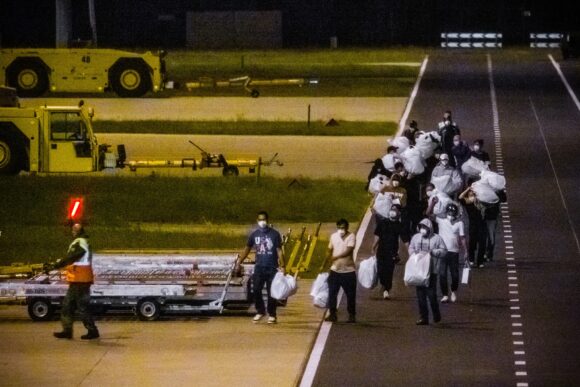
Passengers from the Hondius cruise ship are being repatriated under a patchwork of measures that reflect uncertainty over how this strain of hantavirus spreads, complicating efforts to contain the deadly outbreak.
Some passengers are being placed in biocontainment units, notably in France, for at least two weeks. Australia plans to quarantine passengers in a purpose-built facility outside Perth. But in the Netherlands, most are being asked to self-isolate for six weeks, with short outdoor walks permitted under masking and distancing rules.
The divergent responses come as health officials stress that the risk to the broader public remains low and that hantavirus doesn’t spread between people as easily as COVID-19. But exactly how contagious the Andes strain is across a crowded room, for instance, and whether people are infectious before developing symptoms, remains unclear.
“The reality is we don’t have a lot of experience with this virus,” said Joseph Allen, professor of exposure assessment science at the Harvard T.H. Chan School of Public Health in Boston, in an interview. “The data we do have suggests that it doesn’t just require this close contact.”
Allen pointed to conditions on the expedition vessel, where the virus initially spread between a Dutch couple and the ship’s doctor before appearing to involve a broader group, as well as to an outbreak in Argentina in 2018 where transmission occurred in crowded indoor settings. Multiple people fell ill weeks later after being close to an infected, symptomatic man for 90 minutes at a birthday party. One case was traced to someone simply saying “hello” to him as they crossed paths.
“I actually don’t think there’s harm in being straightforward with the public about what we know and don’t know,” Allen said. “And pairing it with the message that the risk is low to the general public.”
Transmission Uncertainty
Without clear answers about how the virus spreads, it becomes harder to define who may have been exposed, raising the risk that some cases could be missed. That’s forcing authorities to make judgment calls in the absence of clear evidence, echoing early uncertainty about transmission seen in outbreaks such as COVID-19.
Officials at the World Health Organization say the uncertainty extends to exactly when people become infectious.
“There’s not a great wealth of information,” said WHO epidemiologist Olivier le Polain during a public briefing Monday. “We don’t know how much it might spread just before people develop symptoms.”
Most hantavirus infections are linked to contact with rodents or their droppings. The Andes strain, found in South America, is the only known variant capable of spreading between people, and even then, such transmission is considered uncommon.
Decades of experience in South America have shown the virus to be associated with “rare human-to-human transmission after close and prolonged contact with a sick, infected person,” Erica Pan, California’s public health officer, told reporters Monday.
But the available evidence is limited.
“We don’t have enough data points from what we’ve seen in the past to say things quite so definitively,” said Jennifer Nuzzo, director of Brown University’s Pandemic Center in Providence, Rhode Island.
Outbreaks can behave differently as they play out in new settings or larger populations, she said. “We know what we’ve seen, but we don’t know what we’ve not seen.”
That’s shaping the response. In the Netherlands, 12 staff members at a hospital in Nijmegen were placed in preventive quarantine after laboratory samples from an infected patient were not initially handled under the strictest protocols, even as authorities said the infection risk was low.
Close Contacts
Health agencies still rely on operational thresholds to guide contact tracing. The WHO, for example, defines close contact as being within 2 meters (6.6 feet) of an infected person for more than 15 minutes.
US guidance uses similar criteria but notes that “these thresholds are not absolute” and should be interpreted based on the setting of the interaction. In practice, authorities have often gone further, with US officials treating all passengers aboard the ship during the exposure period as high-risk contacts.
Still, some experts say official guidance may not capture the full range of exposures. “Application of arbitrary definitions about what is close and what duration is required are difficult to support based on available evidence,” said Donald Milton, a professor at the University of Maryland.
Research has also highlighted gaps in understanding how the virus spreads. A 2024 study in The Lancet Infectious Diseases detected Andes virus RNA in body fluids including saliva and respiratory secretions, suggesting potential routes of transmission in confined settings.
The virus has also been detected in blood before symptoms appear, though it remains unclear how much transmission may occur before people become ill.
That lack of clarity is already playing out. A case reported in France this week involved a passenger who developed symptoms during a flight home and is now in critical condition, and health officials warn more cases could emerge as monitoring continues.
Some of those cases are likely to reflect exposures that occurred before preventive measures were put in place, when passengers were still interacting normally, WHO Director-General Tedros Adhanom Ghebreyesus said Tuesday.
Officials are responding with extended quarantine and monitoring even as they stress the broader risk remains low — a reflection of the limits of what is known. The WHO has recommended a 42-day quarantine period, reflecting the virus’s long incubation and uncertainty around when people may become infectious, Tedros said.
While the WHO issues guidance, countries ultimately decide how to apply it, Tedros said, helping explain why responses have varied.
Photograph: Passengers on a third evacuation flight from Tenerife arrive at Eindhoven Air Base in Eindhoven, Netherlands on May 12, 2026; photo credit: Rob Engelaar/AFP/Getty Images
Related:
Copyright 2026 Bloomberg.
