


Eric Andersen landed a job that most insurance executives would have long considered too good to be true: leading a strong AIG.
Thanks to a dramatic turnaround under his predecessor, Peter Zaffino, American International Group Inc. is no longer battling the regulatory headwinds and financial woes that tarnished the firm’s reputation earlier in the century.
But as Andersen, 61, takes over as chief executive officer Monday, he faces a different challenge: a bruised corporate culture.
Lauded in the industry for a hard-working ethos and attention to detail, Zaffino, 59, has also perturbed senior executives during his five-year tenure. While some long-time associates joined AIG because they believed he could rebuild the firm, his demanding approach also prompted others to leave, according to people familiar with the company, who asked not to be identified discussing internal matters.
Nine of the 14 people who made up Zaffino’s bench of top deputies just over two years ago are no longer on the executive leadership team. The company has also cycled through four chief financial officers since the start of 2023.
Some of the people familiar with the matter described a top-down culture where Zaffino pits deputies against one another and employees are reluctant to speak in meetings. While one of the people said some senior leaders are comfortable challenging Zaffino and that he invites contradicting views, they said he will often trust his own instincts.
And while his intense focus on expenses helped restore AIG’s finances, Zaffino remained minutely involved in his deputies’ day-to-day affairs, some of the people said. The executive approved the size of AIG’s intern corps when he was chief operating officer, one of the people said, and still vets new open roles across the firm, including for accountants and secretaries. Remote-work agreements have to be thoroughly argued for and approved by top management, and Zaffino keeps track of those, people said.
Vermont Charges
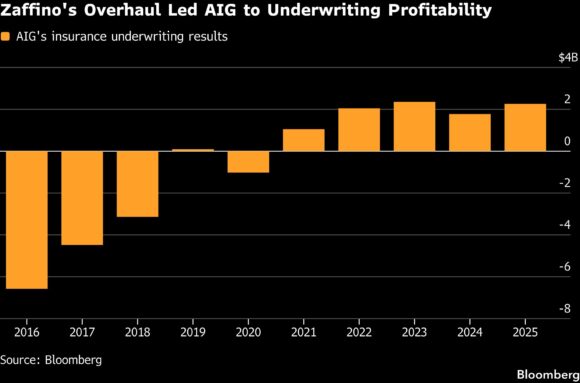
Zaffino’s transition to executive chair, which isn’t expected to affect the vesting of a $50 million equity award next year, follows a sharp recovery for the insurance giant. Under Zaffino, underwriting profits steadily improved and the stock climbed 69%.
While that shows AIG has come a long way since receiving a $182.3 billion taxpayer bailout during the 2008 financial crisis, alleged misconduct by some of the firm’s most senior personnel have clouded Zaffino’s final years as CEO.
The company is facing scrutiny following accusations against former executive David McElroy and John Neal, whose appointment as AIG president was derailed before he could even start the job.
In 2024, prosecutors in Vermont charged McElroy, then-chairman of the company’s general insurance business, with three counts of sexual assault and one count of lewd and lascivious conduct against a woman who attended an AIG conference at a ski resort that March.
A month later, AIG announced that McElroy intended to “accelerate his retirement date for personal reasons,” without making any public statements about the allegations. AIG later said that Vermont authorities instructed the firm to keep the matter confidential.
Prosecutors dropped the charges late last year, saying in a court document dismissing the case that the plaintiff was suffering from “ongoing trauma which prevents her from fully participating in the criminal case at the present time.”
In November, AIG rescinded its offer to hire Neal as president, after learning that Lloyd’s of London, where he was previously the CEO, was investigating his conduct related to an alleged office romance with a subordinate. Earlier, when Neal was CEO of QBE Insurance Group Ltd., his failure to disclose a relationship with a subordinate cost him part of his bonus.
“From a professional standpoint, you can’t have that in your organization,” Meyer Shields, a Keefe Bruyette & Woods analyst who covers AIG, said in an interview.
Neal didn’t respond to a request for comment. A lawyer for McElroy said “the criminal case has been dismissed and the parties have otherwise resolved any disputes between them.”
‘Death’s Door’
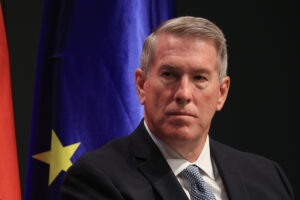
Zaffino, who joined AIG in 2017 and took over as CEO four years later, is the scion of an industry dynasty. His late father, Salvatore Zaffino, was the longtime chairman of Marsh & McLennan’s Guy Carpenter reinsurance brokerage. Peter Zaffino joined that firm in 2001, rising through the ranks to become CEO of Guy Carpenter and later Marsh.
When Zaffino took the reins at AIG, the firm’s historic strategy of taking larger bets had backfired, and outsize expenses dented the insurer’s profitability.
“Peter was involved in taking two companies from death’s door and making them popular organizations — and that’s Marsh and AIG,” Shields said. “AIG was much more difficult.”
After drastically overhauling AIG’s underwriting team, the CEO shifted toward a more selective strategy, pruning its portfolio. That approach helped AIG cut the payable amounts under its commercial policies by almost half, from $2.7 trillion at the end of 2018 to $1.4 trillion six years later, all while reaping more premiums.
The strategy, combined with a better use of reinsurance, paid off. AIG, which hadn’t been able to turn an underwriting profit for a decade following its US bailout, has managed to post gains every year since 2021.
“He kind of saved the company,” said Paul Newsome, an analyst at Piper Sandler Cos. “The underwriting performance is completely turned around. It’s been quite a transformation.”
Zaffino’s decision to offload Corebridge was also a historic step. Life insurance had long been a key business for AIG, but it offered limited synergies with the rest of the company and added a different type of risk to its books, complicating the picture for shareholders, according to analysts.
“Cleaving off its life business simplified the value proposition,” said CFRA analyst Cathy Seifert.
More recently, Zaffino deployed the firm’s excess capital into strategic deals.
Last year, AIG agreed to buy renewal rights for a $2 billion-premium retail insurance book from Everest Group Ltd. and struck a deal to buy a stake in specialty insurer Convex Group that included a quota-share agreement.
The transactions helped AIG post a first-quarter profit that beat Wall Street estimates, providing Andersen a strong starting point.
Andersen, an insurance industry veteran, joined Aon Plc in 1997 as part of an acquisition, and then climbed the ranks of the broker to become president. In that role, he helped CEO Greg Case bring together the firm’s various units.
While brokerage and underwriting require different skill sets, Andersen benefits from the successes of his predecessor, also a broker by training.
He has also Zaffino’s trust. After Andersen joined AIG in February, Zaffino has given him free rein, and the incoming CEO has met independently with executives, board members and clients, according to one person familiar with the matter.
The leadership change is fueling optimism among former and current AIG personnel. Andersen, who’s taking the helm during a cycle of soft premium growth, something that typically prompts insurers to pursue mergers and acquisitions, could help drive a new phase of expansion for the company.
“They’ve put in a CEO who is both young enough and strong enough to be a leader in a go-forward business,” Shields said. “I think at some point in time you’ll see AIG make acquisitions. It’s a smaller company than it had been. There are opportunities for it to add skills.”
Top photo: Zaffino. (Christopher Goodney/Bloomberg)
Copyright 2026 Bloomberg.
Topics
Leadership
AIG
