
Close Menu
  • Home
  • Life Insurance
  • Auto Insurance
  • Home Insurance
  • Health Insurance
  • Business Insurance
  • Travel Insurance
  • Specialized Insurance
  • Insurance Tips & Guides
Facebook X (Twitter) Instagram
Insure GenZInsure GenZ Friday, May 15
  • About Us
  • Contact Us
  • Disclaimer
  • Terms & Conditions
  • Privacy Policy
Facebook X (Twitter) Instagram
Subscribe
  • Home
  • Life Insurance
  • Auto Insurance
  • Home Insurance
  • Health Insurance
  • Business Insurance
  • Travel Insurance
  • Specialized Insurance
  • Insurance Tips & Guides
Insure GenZInsure GenZ
Home»Health Insurance»Global Health Funding in the FY 2026 National Security, Department of State and Related Programs (NSRP) Conference Bill & Explanatory Statement
Health Insurance

Global Health Funding in the FY 2026 National Security, Department of State and Related Programs (NSRP) Conference Bill & Explanatory Statement

AwaisBy AwaisFebruary 5, 2026No Comments3 Mins Read5 Views
Facebook Twitter Pinterest Telegram LinkedIn Tumblr Copy Link Email
Follow Us
Google News Flipboard
Global Health Funding in the FY 2026 National Security, Department of State and Related Programs (NSRP) Conference Bill & Explanatory Statement
Share
Facebook Twitter LinkedIn Pinterest Email Copy Link

Update: On February 3, 2026, the President signed the “Consolidated Appropriations Act, 2026” which includes funding provided in the FY 2026 National Security, Department of State and Related Programs (NSRP) appropriations bill and accompanying explanatory statement detailed below. This resource was originally published on January 14, 2026.

On January 11, 2026, the Appropriations Committee released the FY 2026 National Security, Department of State and Related Programs (NSRP) (formerly State, Foreign Operations, and Related Programs [SFOPs]) appropriations bill and accompanying explanatory statement. The bill and explanatory statement include funding for U.S. global health programs at the State Department. Funding for global health programs at the State Department through the Global Health Programs (GHP) account, which represents the bulk of global health assistance, totals $9.4 billion, which is a decrease of $615 million (-6%) compared to the FY25 level ($10 billion). All program areas either decreased or remained flat as follows:

  • Decreased: Funding for the Global Fund to Fight AIDS, Tuberculosis and Malaria (Global Fund), bilateral HIV, tuberculosis (TB), global health security, neglected tropical diseases (NTDs), and vulnerable children declined; while the Global Fund accounted for the largest decrease (-$400 million or -24%), this funding supports the administration’s pledge of $4.6 billion for the eighth replenishment and serves as the first installment of that pledge. In addition, the explanatory statement accompanying the bill states that there are also “sufficient unobligated balances” from prior Acts “to fulfill the United States pledge for the seventh replenishment.”
  • Remained Flat: Funding for malaria, maternal and child health (MCH), nutrition, and family planning and reproductive health (FP/RH) remained flat.

In addition, the bill included provisions that either impact or provide direction on global health funding including:

  • Program Area Amounts: Funding for many of the global health program areas is specified in the explanatory statement (rather than the bill). Unlike prior years, this bill specifically states that funding “shall be made available at not less than the amounts specifically designated in the respective tables included in the explanatory statement” ensuring that the administration is required to provide the amounts for the areas specified. The bill also prohibits the administration from deviating from the global health amounts in the bill and explanatory statement.
  • Funding Availability Timeframe: PEPFAR funding (bilateral HIV and the contribution to the Global Fund) is available for five years. Funding for most other program areas is provided for two years, with the exception of funding for Gavi, the Vaccine Alliance and the Coalition for Epidemic Preparedness Innovations (CEPI), which is provided for one year.
  • Reports/Briefings: The bill requires the administration to provide updates (via reports or briefings) on numerous global health areas including (but not limited to) the PEPFAR Transition Strategy, Market Access Strategy, bilateral health agreements, multilateral health engagement, the development of an Innovation Fund, and the status of available funding (i.e. apportionment, allocations, obligations, and disbursements).
  • Additional Requirements: The bill requires coordination with the Centers for Disease Control and Prevention (CDC) on global health activities and establishes the Prevention, Treatment, and Response Initiative, which supports “research, development, and delivery of vaccines and other prevention technologies”.

See the table below for additional detail on global health funding. See other budget summaries and the KFF budget tracker for details on historical annual appropriations for global health programs.
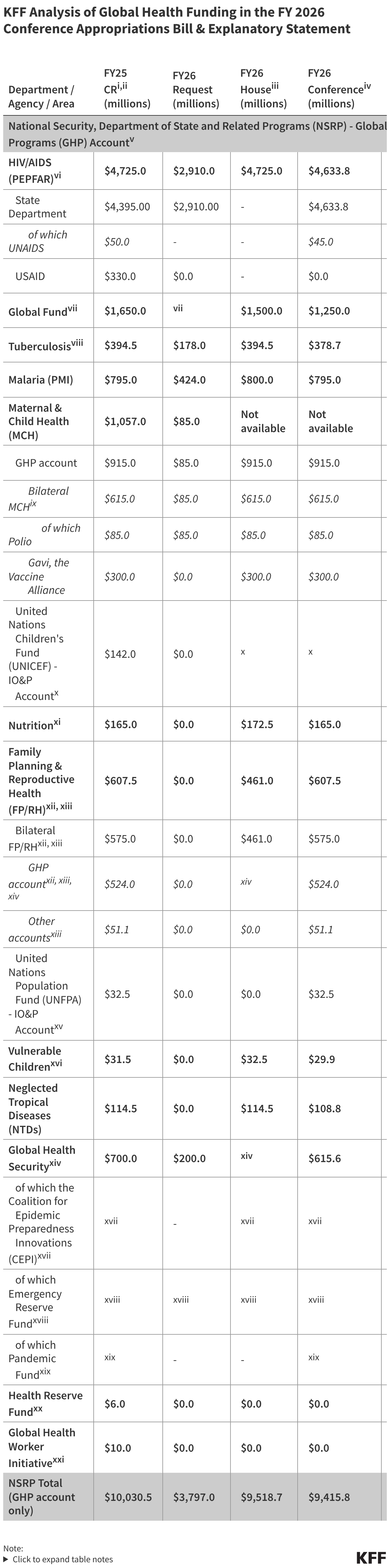
KFF Analysis of Global Health Funding in the FY 2026 Conference Appropriations Bill & Explanatory Statement

bill Conference Department Explanatory Funding Global Health National NSRP Programs Related Security state Statement
Follow on Google News Follow on Flipboard
Share. Facebook Twitter Pinterest LinkedIn Telegram Email Copy Link
Awais
  • Website

Related Posts

Mollyann Brodie Receives AAPOR Award for Exceptionally Distinguished Achievement

May 15, 2026

NH House Passes Self-Insurance for Childcare, Behavioral Health Businesses

May 15, 2026

Kennedy, Balancing MAHA and White House, Says He Won’t Run for President in 2028

May 15, 2026
Leave A Reply Cancel Reply

Our Latest Blogs

For Carriers, AI Can Now Mean Hyper-Personalized Customer Service, Leaders Say

May 15, 2026

Women’s Board Representation Slips Below 30% as Momentum Stalls

May 15, 2026

Mollyann Brodie Receives AAPOR Award for Exceptionally Distinguished Achievement

May 15, 2026

Stomach Bugs, Not Hantavirus, Are the Bigger Threat on Cruises

May 15, 2026
Recent Posts
  • For Carriers, AI Can Now Mean Hyper-Personalized Customer Service, Leaders Say
  • Women’s Board Representation Slips Below 30% as Momentum Stalls
  • Mollyann Brodie Receives AAPOR Award for Exceptionally Distinguished Achievement
  • Stomach Bugs, Not Hantavirus, Are the Bigger Threat on Cruises
  • NH House Passes Self-Insurance for Childcare, Behavioral Health Businesses

Subscribe to Updates

Insure Genz is a modern insurance blog built for the next generation. Subscribe it for more updates.

Insure Genz is a modern insurance blog built for the next generation. We break down complex topics across categories like Auto, Health, Business, Life, and Travel Insurance — making them simple, useful, and easy to understand. Whether you're just getting started or looking for expert tips and guides, we've got you covered with clear, reliable content.

Our Picks

For Carriers, AI Can Now Mean Hyper-Personalized Customer Service, Leaders Say

May 15, 2026

Women’s Board Representation Slips Below 30% as Momentum Stalls

May 15, 2026

Mollyann Brodie Receives AAPOR Award for Exceptionally Distinguished Achievement

May 15, 2026

Stomach Bugs, Not Hantavirus, Are the Bigger Threat on Cruises

May 15, 2026
Most Popular

For Carriers, AI Can Now Mean Hyper-Personalized Customer Service, Leaders Say

May 15, 2026

Women’s Board Representation Slips Below 30% as Momentum Stalls

May 15, 2026

Mollyann Brodie Receives AAPOR Award for Exceptionally Distinguished Achievement

May 15, 2026

Stomach Bugs, Not Hantavirus, Are the Bigger Threat on Cruises

May 15, 2026
  • About Us
  • Contact Us
  • Disclaimer
  • Terms & Conditions
  • Privacy Policy
© 2026 Insure GenZ. Designed by Insure GenZ.

Type above and press Enter to search. Press Esc to cancel.