


In the buildup to 2016’s Brexit referendum, JPMorgan CEO Jamie Dimon said the U.S. bank could shift 4,000 jobs from Britain, joining a chorus of executives who warned a vote to leave the European Union would ravage the country’s finance industry.
A decade later, the Wall Street giant plans to build a tower in London’s Canary Wharf that it says could house up to 12,000 employees – a commitment hailed as “a multi-billion pound vote of confidence” by finance minister Rachel Reeves.
Other signs too suggest the British financial industry has weathered Brexit better than many expected: employment in the City of London financial district is near an all-time high, and banks are posting record profits.
Read more: New UK Referendum Would Flip Brexit Result of a Decade Ago, Poll Finds
But interviews with executives and data reviewed by Reuters paint a more nuanced picture, of Britain as a financial center whose dominance has been eroded while the country itself has become less attractive for some investors.
“Brexit undeniably weakened the City’s position,” said Michael Mainelli, who led the financial district as Lord Mayor in 2023 and 2024, citing relocation of jobs from London to cities like Paris and Dublin.
“Yet Europe too is weaker. Both the EU and the UK have been losing out to the enormous growth in Asian financial markets.”
To keep serving clients across the 27-country EU, British firms that lost so-called passporting arrangements moved about 40,000 jobs to European financial hubs, according to estimates from the City of London Corporation, the municipal body for the “Square Mile,” which speaks for the sector more broadly.
Read more: City of London Chief Says Brexit ‘Disaster’ Cost 40,000 Finance Jobs
Britain remains second only to the United States as a destination for foreign capital, hosting more than £12 trillion ($16 trillion) in foreign direct investment, portfolio investment and cross-border deposits at the end of 2025 according to IMF data cited by Barclays.
Its share has declined, however, from 8.6% in 2015 to 7% in 2025. In the same period, the U.S. share of foreign capital has increased to 25% from around 20%, thanks mainly to demand for U.S. stocks.
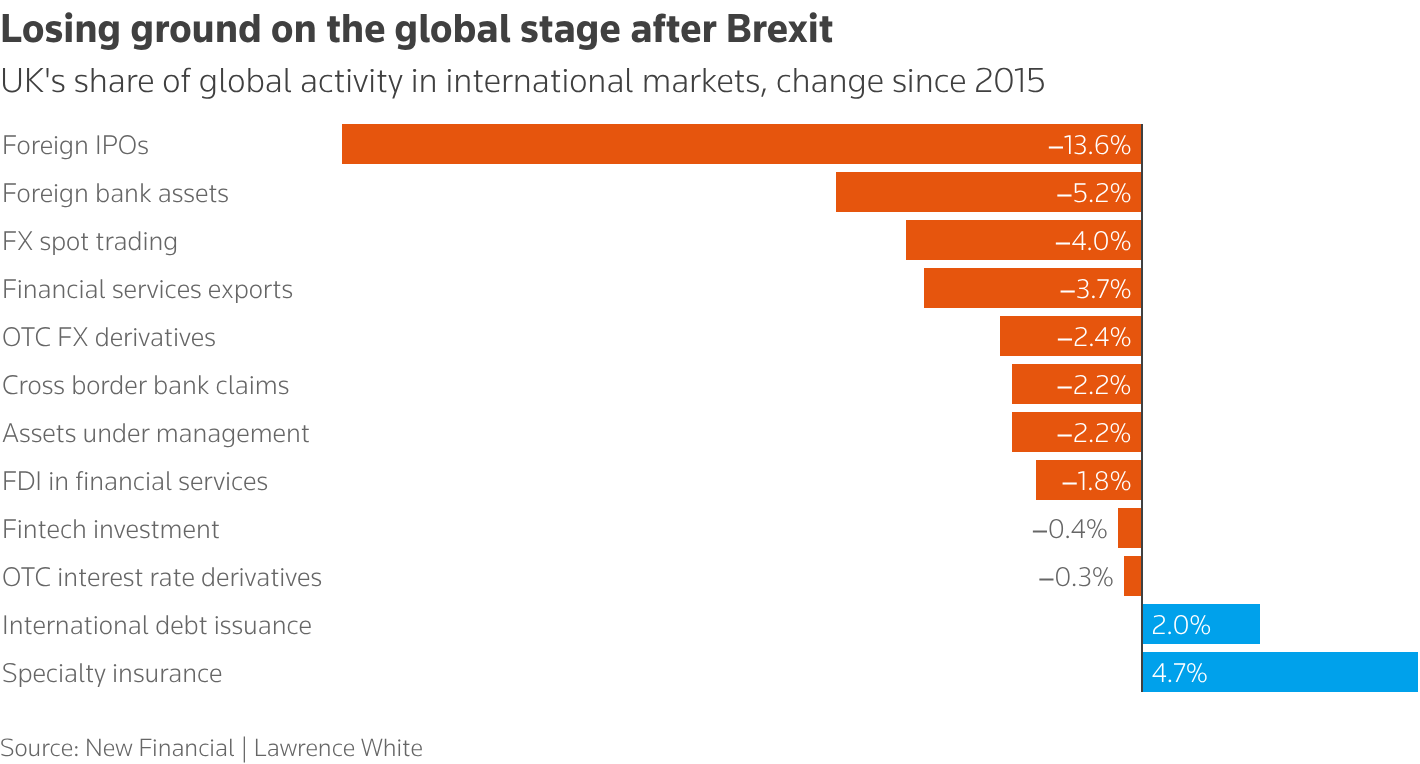
Since 2015 Britain has lost market share in 10 out of 12 categories of international finance, including foreign exchange trading, stock offerings and assets under management, according to research company New Financial.
“The impact of Brexit on the City has been like the UK breaking its own arm – it has not been fatal but nor has it been great, and there was a degree of self-injury,” New Financial’s founder William Wright said.
Rising Rates, Deregulation Helped Underpin Financial Sector
This month, Dimon said JPMorgan will extend its $1.5 trillion Security and Resiliency Initiative to Britain, helping companies in critical industries raise money.
As well as a landmark new London HQ, the bank is expanding its campus in Bournemouth on England’s south coast at a cost of £300 million to £350 million. Citigroup has likewise said it is investing £1.1 billion in its UK operations.
Across town from Canary Wharf, the British capital’s centuries-old financial heart appears thriving: according to the Corporation, there are 676,000 workers in the City of London, up more than 25% since 2019.
“I did believe the City would have another life after Brexit, but I didn’t know it would be so quick and so strong,” said Soren Jessen, whose 1 Lombard Street restaurant faces the Bank of England. Sales are better than ever, he said.
Britain formally left the EU on January 31, 2020, just weeks before COVID-19 lockdowns began. The pandemic and a string of tumultuous events since – including the Ukraine and Middle East wars and U.S. President Donald Trump’s upending of trade and security arrangements – make Brexit impacts hard to isolate.
While rival hubs have chipped away at London’s market share, global and national developments have helped underpin the financial services sector.
A post-COVID inflation spike prompted the BoE and other central banks to hike interest rates, turbocharging the returns to banks from lending.
After winning power in 2024, the Labour Party government accelerated deregulation, arguing that rules put in place after the 2007-2008 global financial crisis had stifled growth. Charged by Reeves with supporting the government’s growth agenda, banks also swerved fresh taxes and won concessions from regulators on capital requirements.
Britain’s freedom to tweak the EU’s Solvency II rules by cutting administrative costs and easing capital constraints such as the buffers insurers must keep against losses has meanwhile boosted the insurance sector. According to the London Market Group of insurers, gross written premiums have doubled in the last decade, to $187 billion.
London has become a center for financial technology, too: digital bank Revolut is now Europe’s most valuable fintech firm, valued at $75 billion in a November share sale.
Britain May Be Less Attractive Place to Invest
The broader economy has struggled to grow, however, lagging the United States, where consumer spending and a tech-sector boom have driven growth, and even the sluggish euro zone.
Britain’s long-run economic productivity will be 4% lower after Brexit than if the country had stayed in the EU, with much of the damage done already, the government’s budget forecasters have estimated.
“You can point to the day in June 2016 where the UK became, in reality, a less attractive place to invest,” said Premier Miton CIO Neil Birrell, who has significant UK holdings but has been reducing them.
Britain’s bond yields are now among the highest of major advanced economies, not helped by political instability that has seen six prime ministers in the decade since the Brexit vote. Higher government borrowing costs in turn push up the price of credit for businesses and households.
Lending to small businesses as a share of GDP has fallen from just above 8% in 2016 to 6.5% in the year to date, BoE data shows. A recent Boston Consulting Group report identified “a self-reinforcing credit trap” where businesses don’t seek credit because they expect to be rejected and lenders pull back because they see insufficient demand.
Reforms to boost investment by domestic pension funds in British growth stocks from just 0.1% of their assets could help Britain prosper in the next decade, New Financial’s Wright said, as could more participation by retail investors.
Brexit has increased administrative burdens such as customs paperwork for businesses and disrupted supply chains.
The current Lord Mayor has nevertheless argued against a return to regulatory alignment with the EU, which could give greater access to its single market over time.
Former City of London chief Mainelli said the EU itself had failed to take advantage of Brexit opportunities in finance, noting that plans to unify an untidy patchwork of national markets remain unrealized, holding back the bloc’s growth.
“As the EU … hasn’t moved forward much in the past decade, the UK hasn’t lost much,” Mainelli said. “The City remains the capital markets gateway to Europe.”
($1 = 0.7462 pounds)
