
On June 9, 2026, the Medicare Trustees issued the annual report on the financial status of the Medicare program for 2026. The Trustees highlighted that the Medicare Part A trust fund is projected to be depleted in 2033, the same year but one quarter earlier than last year’s projection. In addition to discussing the status of the Part A trust fund, the report also provides substantial additional details on federal spending for Medicare Part B and Part D benefits, the distribution of spending for traditional Medicare and Medicare Advantage, and revenue sources for Medicare, along with updated spending and revenue projections and a detailed discussion of factors that have contributed to changes in the program’s financial outlook. This brief provides an overview of key trends in Medicare spending and spending growth, as well as the impact of these trends on out-of-pocket costs for Medicare beneficiaries and Medicare program solvency, as projected by the Medicare Trustees.
Physician Services and Other Outpatient Services Account for Roughly Half of Total Medicare Benefits Spending
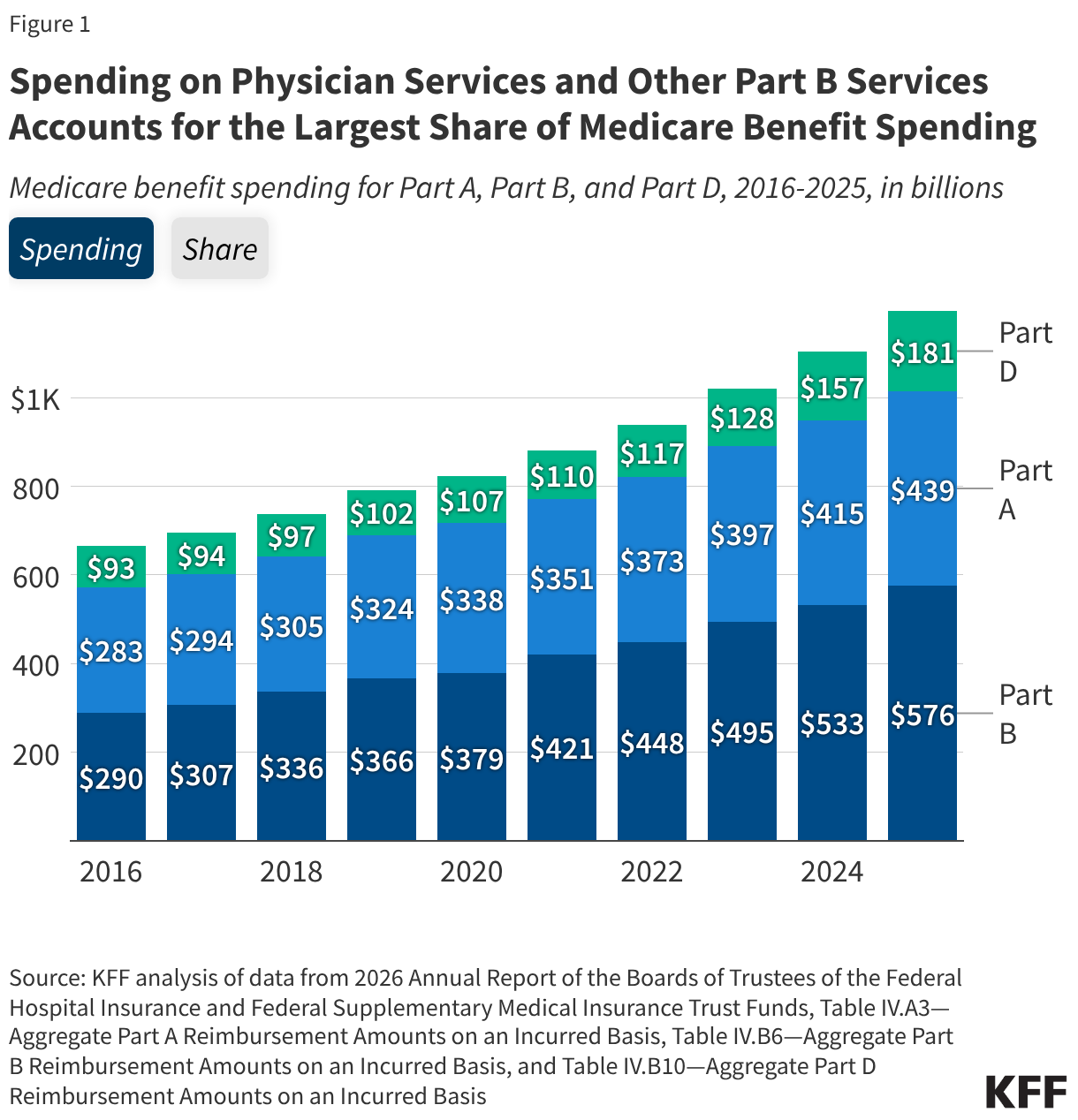
In 2025, Medicare benefit payments totaled $1.2 trillion, up from $666 billion a decade earlier (Figure 1). Spending on Part B services (including physician services, outpatient services, and physician-administered drugs) accounts for the largest share of Medicare benefit spending (48% in 2025), as it has since 2015. In contrast, spending on Part A services (including inpatient hospital services, skilled nursing facility services, and hospice care) has declined as a share of Medicare benefit spending (from 43% in 2016 to 37% in 2025). Over time, this decline has been driven in part by a shift of some services from inpatient to outpatient settings reflecting changes in practice patterns, along with increases in spending on services covered under Part B, including high-cost physician-administered drugs. Spending on Part D prescription drugs has accounted for a relatively constant share of Medicare benefit spending for much of the past decade (12-13%) but rose to 15% in 2025 and is projected to continue growing in the coming years.
Spending on Part A and Part B Benefits in Traditional Medicare Was $481 Billion in 2025
Looking at spending by type of service in traditional Medicare, the single largest category of benefit spending in 2025 was for inpatient hospital services covered under Part A (spending by type of service for Medicare Advantage enrollees is unavailable). Although a relatively small share of beneficiaries use inpatient hospital services, these services accounted for roughly one-third of total benefit spending in traditional Medicare ($159 billion or 33%), followed by outpatient hospital services covered under Part B ($76 billion or 16%) (Figure 2). This means that combined spending on hospital services (both inpatient and outpatient) accounted for nearly half of spending on Part A and Part B benefits in traditional Medicare in 2025. Services covered under the Medicare Part B physician fee schedule accounted for $71 billion (15%), and the remaining $174 billion (36%) consisted of payments for all other Part A and Part B services, including physician-administered drugs (8%), skilled nursing facility services (6%), and hospice care (6%), among others.
Spending on the Medicare Part D Prescription Drug Benefit is Projected to be Significantly Higher Over the Coming Decade Compared to Last Year’s Projections
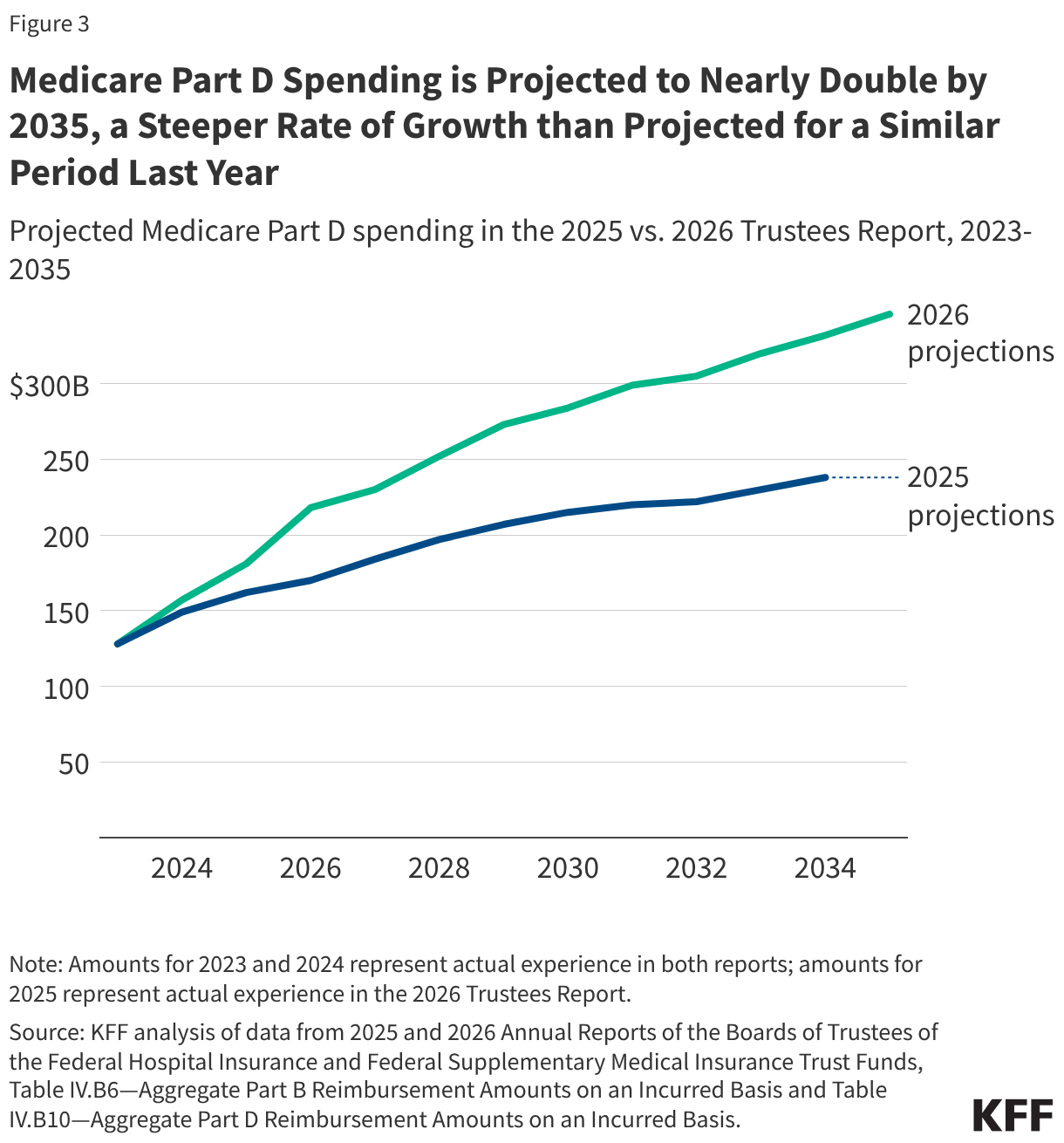
The Medicare Trustees currently project that Medicare Part D spending will nearly double from 2025 ($181 billion) to 2035 ($346 billion), representing an average annual growth rate of 6.7% compared to the 4.8% that was projected for a similar period last year (Figure 3). The Trustees indicate that higher spending projections for Part D in the 2026 report are due to increased use of GLP-1s and other high-cost specialty drugs. The Trustees also point to other factors that have contributed to changes in Part D spending in recent years, including the pharmacy price concessions policy that lowers point-of-sale prices for beneficiaries but reduces rebate revenue to Part D plans, which leads to higher federal Part D spending; the exemption of more orphan drugs from drug price negotiation in the 2025 budget reconciliation bill (H.R. 1), which will lower federal savings from negotiation; and the redesigned Part D benefit that improved the generosity of coverage while shifting more liability onto plans and increased the level of federal subsidies for coverage. These higher spending trends are offset somewhat by the effect of drug price negotiations and inflation rebates established by the Inflation Reduction Act.
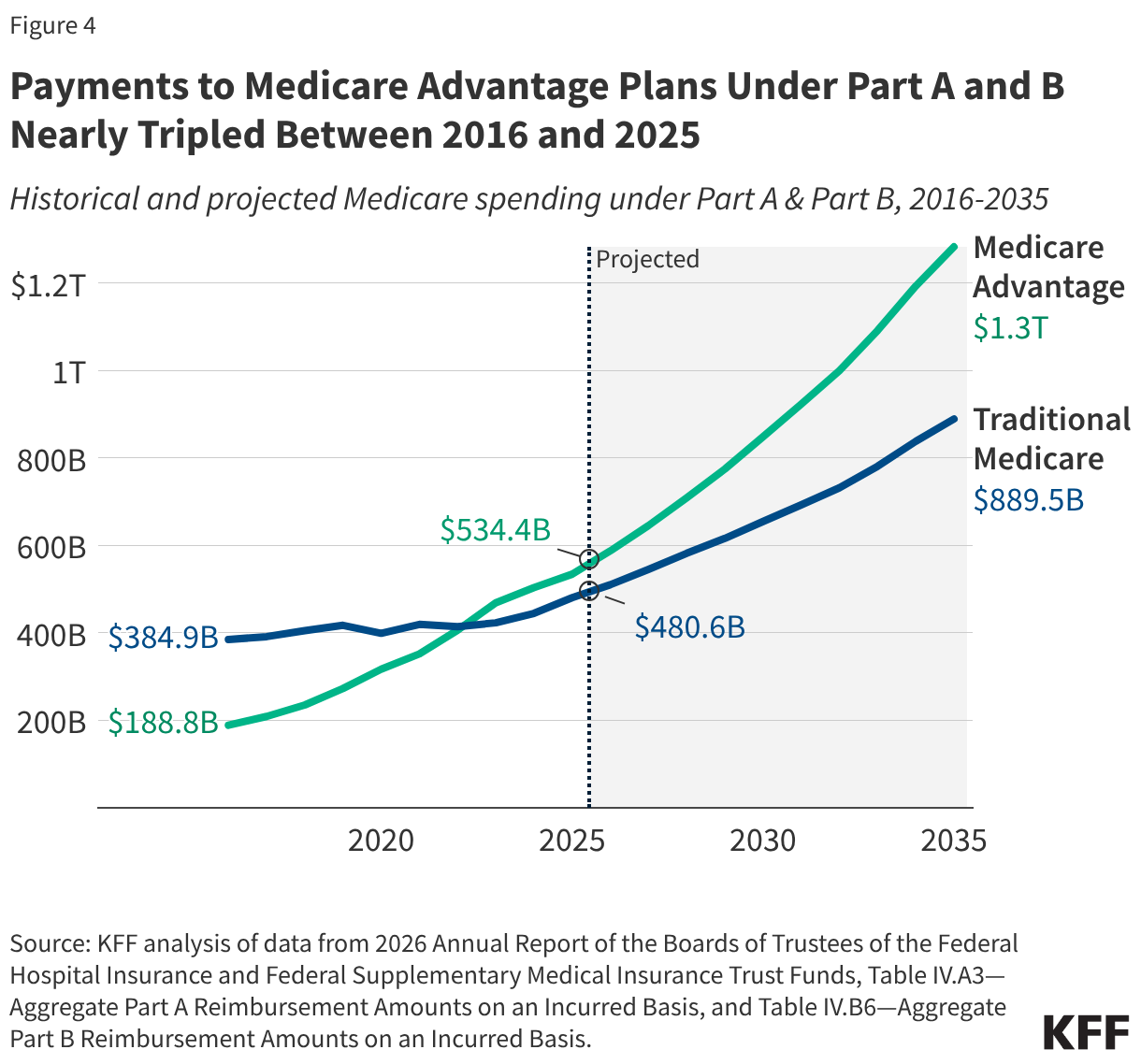
Spending on Medicare Advantage was $534 Billion in 2025, Over Half (53%) of Total Medicare Program Spending
Payments to Medicare Advantage plans under Medicare Part A and Part B nearly tripled as a share of total Part A and Part B spending between 2016 and 2025 (from $189 billion to $534 billion), including payments for the cost of Part A and Part B services, as well as rebates, which must be used to reduce cost sharing, pay for extra benefits, or buy down the Part B and/or Part D premium (Figure 4). This growth is partly due to increased enrollment in Medicare Advantage plans, which rose from 33% to 54% of all eligible beneficiaries over this same period. At the same time, Medicare pays an estimated 14% more per enrollee in Medicare Advantage than it would if the same beneficiary were covered by traditional Medicare, resulting in $76 billion in additional Medicare spending in 2026. Those higher payments largely reflect the impact of higher coding intensity and favorable selection into Medicare Advantage. Growth in Medicare Advantage spending is projected to continue into the next decade, with payments to Medicare Advantage plans under for Part A and B benefits projected to increase to $1.3 trillion in 2035, or 59% of total Part A and Part B spending.
The Medicare Part A Trust Fund is Projected to be Depleted in 2033, Seven Years from Now
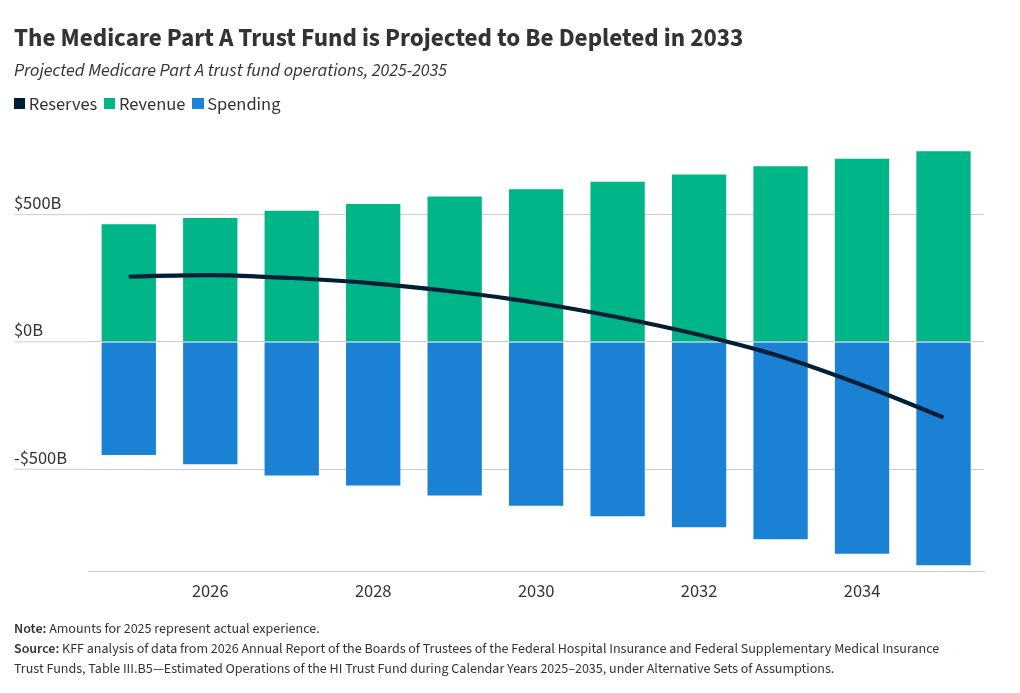
The depletion of the reserves in the Medicare Hospital Insurance (Part A) trust fund, which pays for inpatient hospital, skilled nursing facility, home health, and other Part A services, is projected to occur in the second quarter of 2033, based on the latest projections from the Medicare Trustees (Figure 5). This is one quarter earlier than the projection in last year’s report. According to the Medicare Trustees, the earlier depletion date is primarily the result of updated estimates of Social Security tax revenue (one source of Part A funding) that are lower than previously projected due to changes in the 2025 budget reconciliation bill (H.R. 1). If the reserves in the Part A trust fund are fully depleted, Medicare would not have sufficient funds to cover Part A benefit spending for the full year without additional revenues or reductions in spending on benefits or payments to providers.
Projected Increases in Medicare Spending Will Lead to Higher Medicare Premiums and Cost-Sharing Requirements
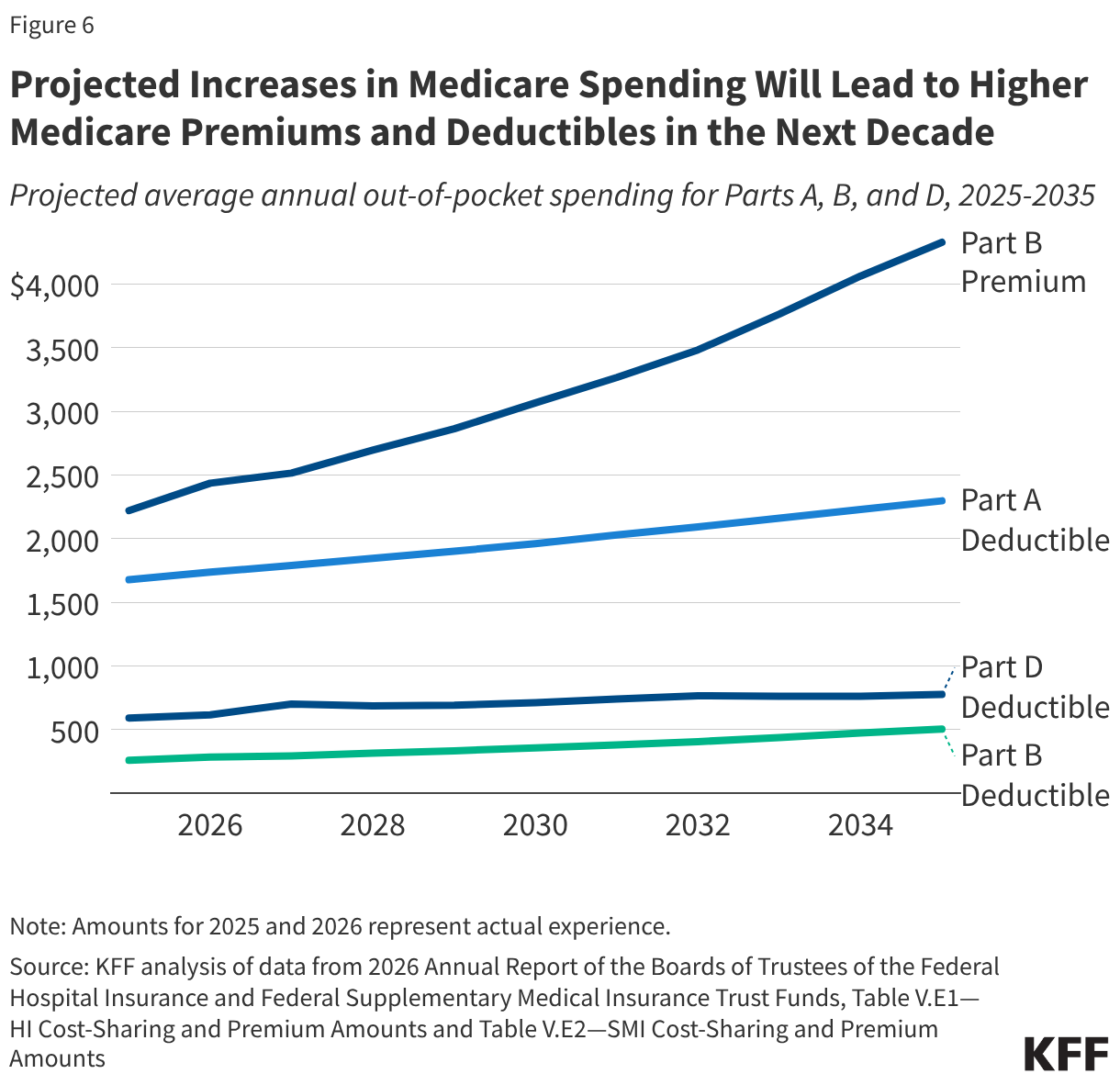
Medicare’s premium and cost-sharing requirements are determined annually based on expected growth in Medicare benefit costs for the coming year (though the exact approach to determining these amounts is different in each part). For 2027, the Trustees project that the monthly Part B premium will increase from $203 to $210 (3.3%), after increasing from $185 to $203 between 2025 and 2026 (9.7%). Likewise, the Part A hospital deductible is projected to increase from $1,736 to $1,788, and the Part D deductible from $283 to $292 in 2027. Further increases are estimated for the duration of the 10-year projection period in the 2026 Trustees report (Figure 6). These amounts may not reflect the costs that all beneficiaries face, particularly enrollees in Medicare Advantage plans, where cost sharing is generally different from the standard cost-sharing requirements for traditional Medicare beneficiaries. In 2024, seven million Medicare beneficiaries spent more than 10% of their income on the Part B premium alone. Increases in Medicare premiums and other out-of-pocket costs may represent a growing burden for many beneficiaries if income growth does not keep pace.