

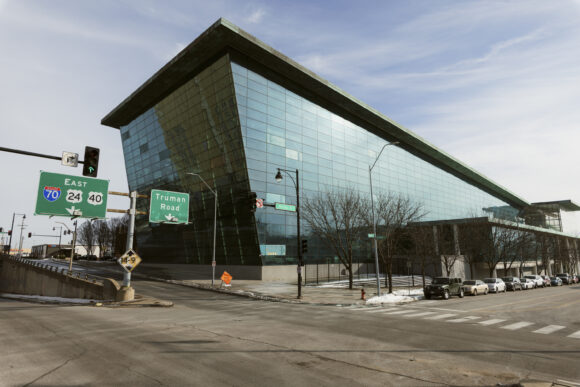
The Kansas City Star built a $200 million complex to house a state-of-the-art printing press in 2006. Less than 15 years later, the iconic structure of blue and green glass came to symbolize the collapse of print news when parent company McClatchy sold it at a steep discount.
Now the building is getting a second act as a data center, enabled by two big attractions. One is the robust electrical hook-ups it once needed for the printing press. The other is its downtown address as proximity becomes more valuable for emerging applications in artificial intelligence.
“It’s not your typical data center in a field sucking a bunch of power,” said John Johnson, chief executive officer of Patmos, the developer that overhauled the building.
Similar downtown data centers are popping up from Minneapolis to Chicago as landlords seek to fill buildings that emptied out during the pandemic. Driving the trend is the old real estate adage about the importance of location. With the rise of AI systems needed for technologies that make real-time decisions in urban cores — self-driving vehicles would be a major example — a nearby data center can shave precious milliseconds off data processing times compared with more distant facilities.
“You do want to be as close as you can to that compute, servicing your customers who are likely to be concentrated in that major metropolitan area,” said Raul Saavedra, who leads the data center advisory practice at Colliers Americas, which is marketing a data center in downtown Minneapolis.
Not long ago, data centers would have been considered a faux pas in urban redevelopment. Often housed in nondescript warehouse buildings in the suburbs and in the country, the facilities are known for their limited employment needs and voracious appetites for electricity and water.
The typical downtown data center is smaller, usually needing around 30 to 50 megawatts of electricity, enough to power as many as 40,000 US homes or so.
For cities, such hubs offer a way to reuse empty or discarded buildings. For intensive data users, they’re an attractive option for so-called AI inference, which Oracle Corp. defines as a system so highly trained that it has the ability “to reason and draw conclusions from data it hasn’t seen before.” Some popular uses: the robotic learning used in driverless cars and ChatGPT.
That puts a premium on speed, or so-called low latency requirements.
“What AI inference is going to do is create low latency applications of AI in markets like Chicago and Denver and Miami and Orlando,” said Pat Lynch, executive managing director for CBRE’s Data Center Solutions. “There will be low latency, inference-based data centers in Manhattan, for sure. They will be in London and Singapore. They’ll be everywhere.”
Examples have already proliferated outside the US.In Germany, data centers are being built in a Frankfurt complex anchored by a building that once served as the center of the country’s mail-order industry.
In Berlin, five miles from the Brandenburg Gate, one of Germany’s largest listed landlords, Aroundtown SA, is planning to convert a vacant office building into a data center in a bid to generate higher rents. The goal is to “participate in one of the fastest-growing asset classes of the real estate market,” Co-Chief Executive Officer Barak Bar-Hen said on a recent earnings call.
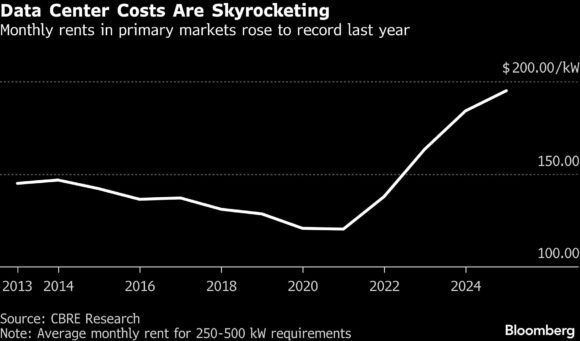
Back in the US, demand for data centers is so high that prices in primary markets including Chicago, Atlanta and Northern Virginia climbed to a record last year, according to CBRE. Leasing across top markets climbed to an all-time high in the last three months of the year, with Chicago inking deals for more than 300 megawatts, a record, according to a Green Street report.
Colliers is marketing a 1970s-vintage building in Minneapolis that once served as a 549,500-square-foot (51,000-square-meter) office for Wells Fargo & Co. Local developer Sherman Associates sought rezoning for the project to include two-floors of data center space, according to public filings.
Sherman plans to house the data center portion of the project in Wells Fargo’s original data rooms. While many proposed data centers have faced opposition from local residents, the Downtown Minneapolis Neighborhood Association endorsed the project, saying it would “bring new vitality and employment activity to the downtown core.”
Not every office building can be turned into a data center, of course. Those ripe for conversion typically need open floor plates, high ceilings and load-bearing floors, as well as the ability to be rezoned – a requirement that introduces a local variable in each city. Crucially, they also need higher-than-average power transmission or an agreement with the utility company to acquire additional electricity. Trading floors and life sciences buildings have many of those attributes, making them good candidates for data center conversions.
Sometimes the business case depends on obtaining access to more power. That can make such developments uncommonly profitable at a time when most office buildings are trading hands at steeply discounted prices because of high vacancy rates.
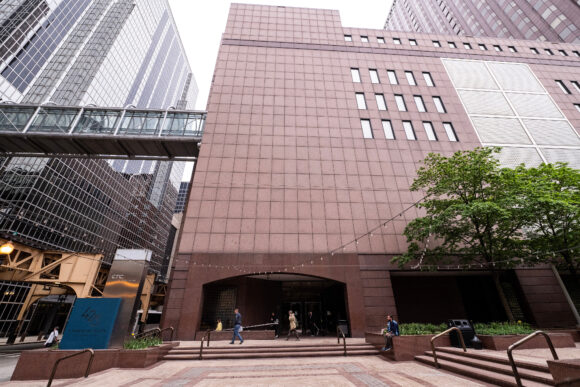
In Chicago, two local developers purchased the former headquarters of the Cboe Global Markets Inc. for $12 million after holding the property under contract for about three years. During the time it was under contract, they pursued and obtained an increase in power from the local utility company, Commonwealth Edison Co. They then sold the building to a data center developer for $40 million.
ComEd said it’s currently reviewing a handful of applications for other small data center projects downtown Chicago, which would probably be used for AI inference or enterprise cloud solutions.
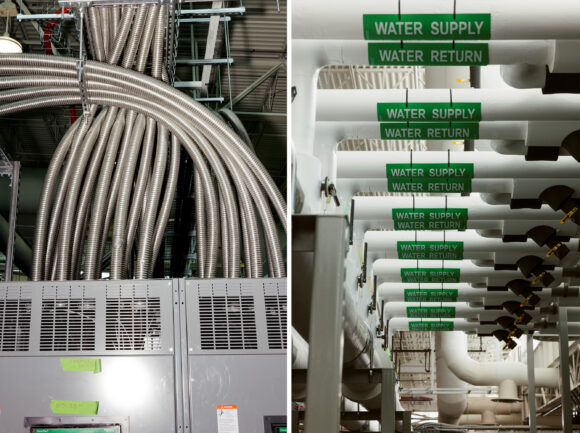
In Kansas City, the Star building made it easy for conversion, with the first portion completed over about 90 days, said Johnson, the CEO of developer Patmos. It had floor plates that could support heavy loads, freight elevators and internal cranes for servicing the printing press, and transmission lines for heavy-duty power use, meaning Patmos didn’t have to seek an increase from the local utility company for its 35 megawatts of power.
Residents initially had concerns ranging from noise to security that Patmos worked to assuage, Johnson said. The company said it worked with the city to get the property zoned for data center use. It also plans to turn a little less than half of the 360,000-square-foot complex into coworking offices for tech companies with a focus on artificial intelligence.
Johnson said the company didn’t seek subsidies for the development, adding that cities have been “burned by big companies coming in, begging for the world in subsidies and abatements of all sorts” and providing little return on investment to the communities.
“Data centers have earned a reputation for being a very low jobs, dense, power sucking, eyesore, burden on communities,” he said.
By contrast, he said, the project in the old printing press building will bring new life to an old downtown: “This building was sitting there as a giant paperweight for years and years, and not doing anything for Kansas City.”
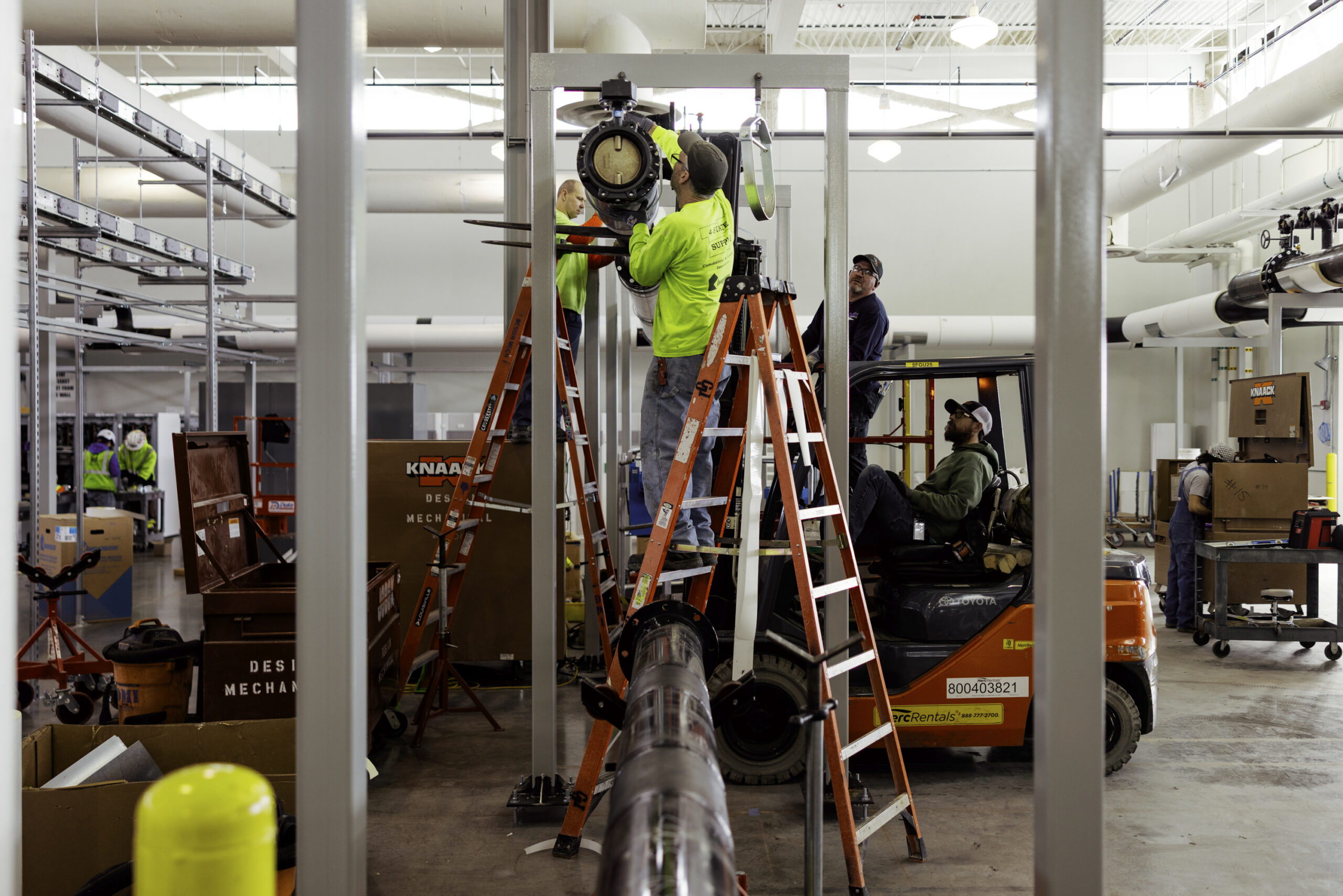
Photo: Workers install metal pipe at the Patmos data center in Kansas City, Missouri.
Copyright 2026 Bloomberg.
Topics
InsurTech
Data Driven
Artificial Intelligence
