

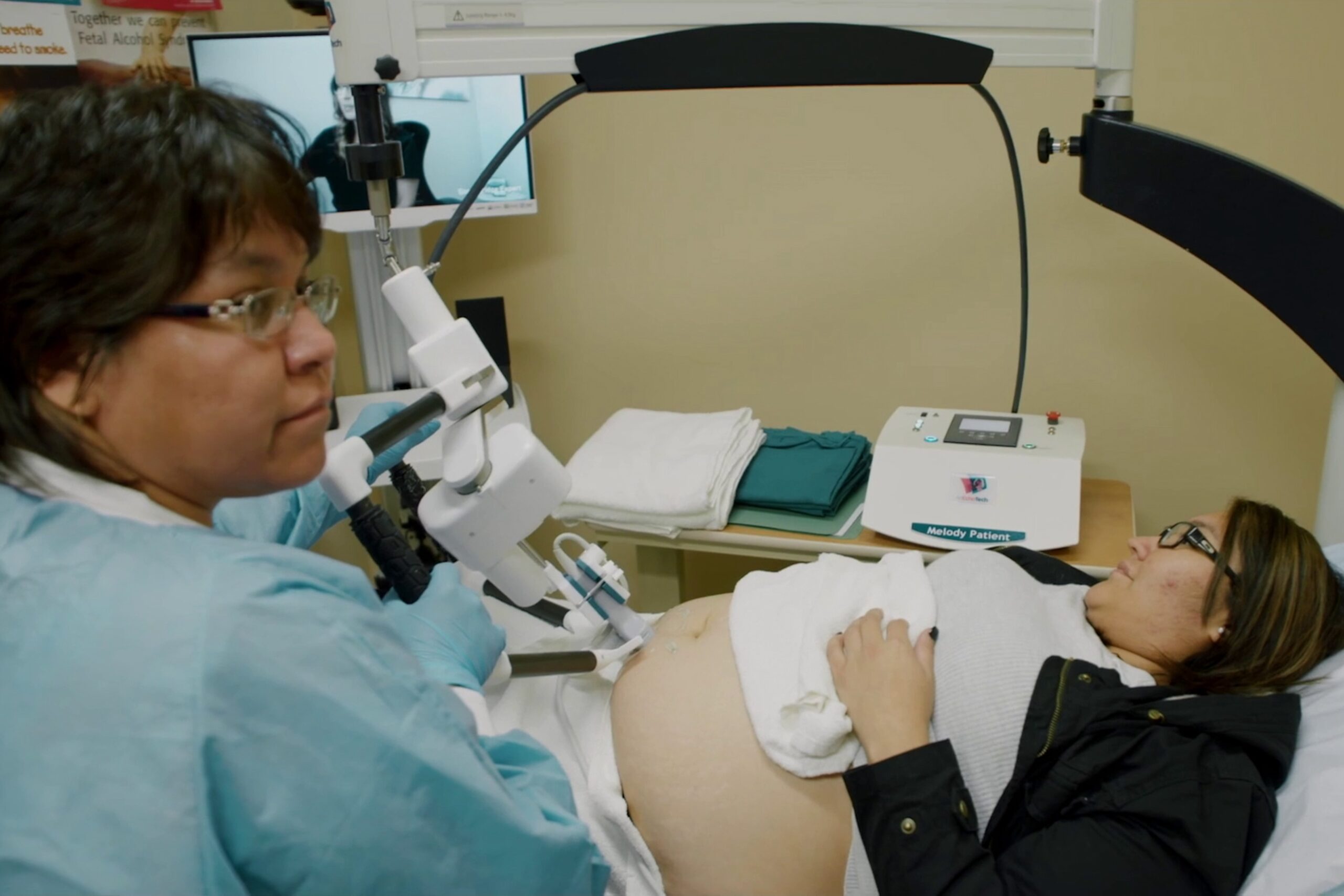
It sounds like something from a science fiction novel, but Alabama officials’ plan to use robots to improve care for rural pregnant women and their babies is real.
During a January White House roundtable touting the first grants to states under a new $50 billion rural health fund, Centers for Medicare & Medicaid Services Administrator Mehmet Oz called the idea “pretty cool.” Later that day, Sen. Bernie Sanders, the independent from Vermont, said it is decidedly not cool. And obstetricians and others chimed in on social media to express alarm, with one political activist calling it a “dystopian horror story.”
The disparate responses highlight how excitement over the tech-heavy ideas states pitched in their applications for the federal Rural Health Transformation Program conflicts with the reality that there simply aren’t enough health workers to serve patients in many rural communities. Now, as states prepare to spend their first-year awards, tension is mounting, and nowhere is that strain more visible than in Alabama.
Oz has lauded the state’s proposal to invest in the relatively new technology of robotic ultrasounds.
“Alabama has no OB-GYNs in many of their counties,” Oz said, sitting with President Donald Trump and Cabinet members. The dearth of care, he said, prompted the proposal to use robots for ultrasounds on pregnant women.
Britta Cedergren directs the Alabama Perinatal Quality Collaborative and has a firm grip on reality: “No one is using autonomous robots.”
While robotic ultrasounds are a “really neat technology,” she said, they are not yet being used in the state. Instead, clinicians providing obstetric care lean on phone consultations and — when equipment and internet are available — telehealth.
The goal, she said, is to “support places where there is no care.”
Cedergren is part of multiple state maternal and fetal health groups and works daily with doctors, hospitals, and first responders. While enhanced technology is vital for patient care, it’s not a replacement for a well-trained workforce and a coordinated care and data system, she said.
In 2024, the most recent year for which data is available, Alabama’s infant mortality rate was 7.1 deaths per 1,000 live births. The nationwide rate was 5.5 per 1,000 live births, according to provisional data released by the Centers for Disease Control and Prevention.
Hospital-based obstetric unit closures, which often lead to a loss of health care providers who can care for expectant mothers and their babies, are a long-standing, ongoing trend in rural America. But Alabama’s loss of services has been particularly profound.
In 1980, 45 of the state’s 55 rural counties had hospital-based obstetric services. By 2025, only 15 offered such care, according to state data. And the losses aren’t slowing. Five hospital obstetric units closed in 2023 and 2024, including in three rural counties: Monroe, Marengo, and Clarke.

Katy Backes Kozhimannil, a professor at the University of Minnesota School of Public Health, found that closures in remote areas lead to an increase in preterm births, a leading cause of infant mortality.
“People will be pregnant and give birth in communities all over the place,” she said. “You have to be able to get to a place where you can be cared for.”
Nearly all 50 states’ applications for the Rural Health Transformation Program declared workforce shortages and maternal health needs as priorities, but only Alabama proposed using robots to fill the gap. The rural fund, which Congress created as a last-minute sweetener in Trump’s One Big Beautiful Bill Act last summer, encouraged states to be creative, be innovative, and pitch tech solutions.
Alabama was awarded $203 million for the first of the program’s five years. Among nearly a dozen rural health initiatives, the state’s application included bolstering its rural workforce as well as improving maternal and fetal health.
Mike Presley, a spokesperson for the Alabama Department of Economic and Community Affairs, which is overseeing the plan, said no one was available for an interview about telerobotic ultrasounds.
LoRissia Autery, an obstetrics and gynecology specialist in rural Alabama northwest of Birmingham, said the robots won’t decrease maternal and infant mortality. There are nuances, she said, to doing ultrasounds.
Many of her patients have high-risk pregnancies with diabetes, high blood pressure, and hepatitis C, she said. She said she worries about the kind of care that will be given to her patients, many of whom drive an hour or more to get to her, if robots are used instead of a trained specialist.
“It takes away just the care that we need to have for women,” said Autery, who co-founded Walker Women’s Specialists. The clinic includes three doctors, draws patients from five counties, and could use an additional physician to meet the demand, Autery said.
“Probably for the past six or seven years, we’ve been putting out feelers trying to find a fourth partner,” Autery said. “It’s difficult for a variety of reasons.”
In his social media remarks to Oz, Vermont’s Sanders called the lack of rural health care providers in the U.S. an “international embarrassment.”
“In the richest country on earth, we need more doctors, nurses, dentists and mental health counselors, not more robots,” Sanders wrote on the social platform X.
At least one country is using robots paired with trained workers to decrease deaths.
In the remote Canadian village of La Loche, Julie Fontaine operates an ultrasound robot at a clinic with two on-site nurse practitioners and rotating doctors. She said patients like the robot because it saves them the time and expense of traveling to a bigger regional health care facility six to seven hours away.
“When people come in, they’re like, ‘Wow, like, technology these days,’” said Fontaine, a member of the Métis people in northern Saskatchewan. “It’s something they’ve never seen before or even used.”

When working with patients, Fontaine connects the robotic ultrasound machine to a tele-sonographer at a control station in Saskatoon. The sonographer then remotely operates a robotic arm on the machine. A radiologist, who can be anywhere, reads the scan’s report and sends it back to the family doctor in La Loche, said Ivar Mendez, a neurosurgeon and the director of Canada’s Virtual Health Hub. Most babies in Canada, he said, are delivered by family doctors or midwives, not specialists.
“The most important thing is the identification of a high-risk pregnancy early enough so you can intervene,” said Mendez, who added that the robotic ultrasound is “as good as the in-person ultrasound” but can’t be used when a patient needs a more invasive vaginal ultrasound. The mortality rate for mothers and newborns in the north, site of the La Loche clinic, is 20 to 25 times greater than in the rest of the nation, he said.
“One of the reasons is that there’s no availability of prenatal ultrasonography in those communities, so pregnant women have to travel to cities and they’re put up at hotels,” he said.
In a 2022 paper, Mendez and his team at the University of Saskatchewan examined 87 telerobotic ultrasounds and found that 70% of the time, the robotic ultrasound made travel for care unnecessary. Nearly all the patients said they would use the robot again.
The same robotic ultrasound technology was approved in 2017 for use in the U.S.
Nicolas Lefebvre, chairman and chief executive of the robot’s creator and manufacturer, AdEchoTech, said the company has “U.S. maternity-specific projects that are currently under preparation.” The average price of a robot will be $250,000 to $350,000, according to AdEchoTech’s U.S.-based business development consultant.
Using robotic ultrasounds is one part of Alabama’s proposed maternal and fetal health initiative, according to the state’s application. Acknowledging loss of hospital obstetric units, officials said they planned to connect smaller rural providers and health care facilities that lack “high-quality maternal and fetal health services” to regional care hubs that can provide the services digitally, including through telerobotic ultrasound.
For their workforce initiative, state officials proposed training programs for doctors, emergency services, and nurse-midwives.
The estimated required funding for the maternal and fetal health initiative is $24 million over five years. Alabama officials proposed $309.75 million for their workforce initiative over five years.
