

As Harmon Maher walked along the Keystone Trail in central Omaha one morning in February, he spotted something odd: The creek next to the path, normally a gray-green color, ran bright orange.
It was full of sediment, probably from some construction upstream, the retired geology professor reasoned. Maher didn’t think much of it until hours later when his son alerted him to a mishap that was quickly becoming the talk of the town.
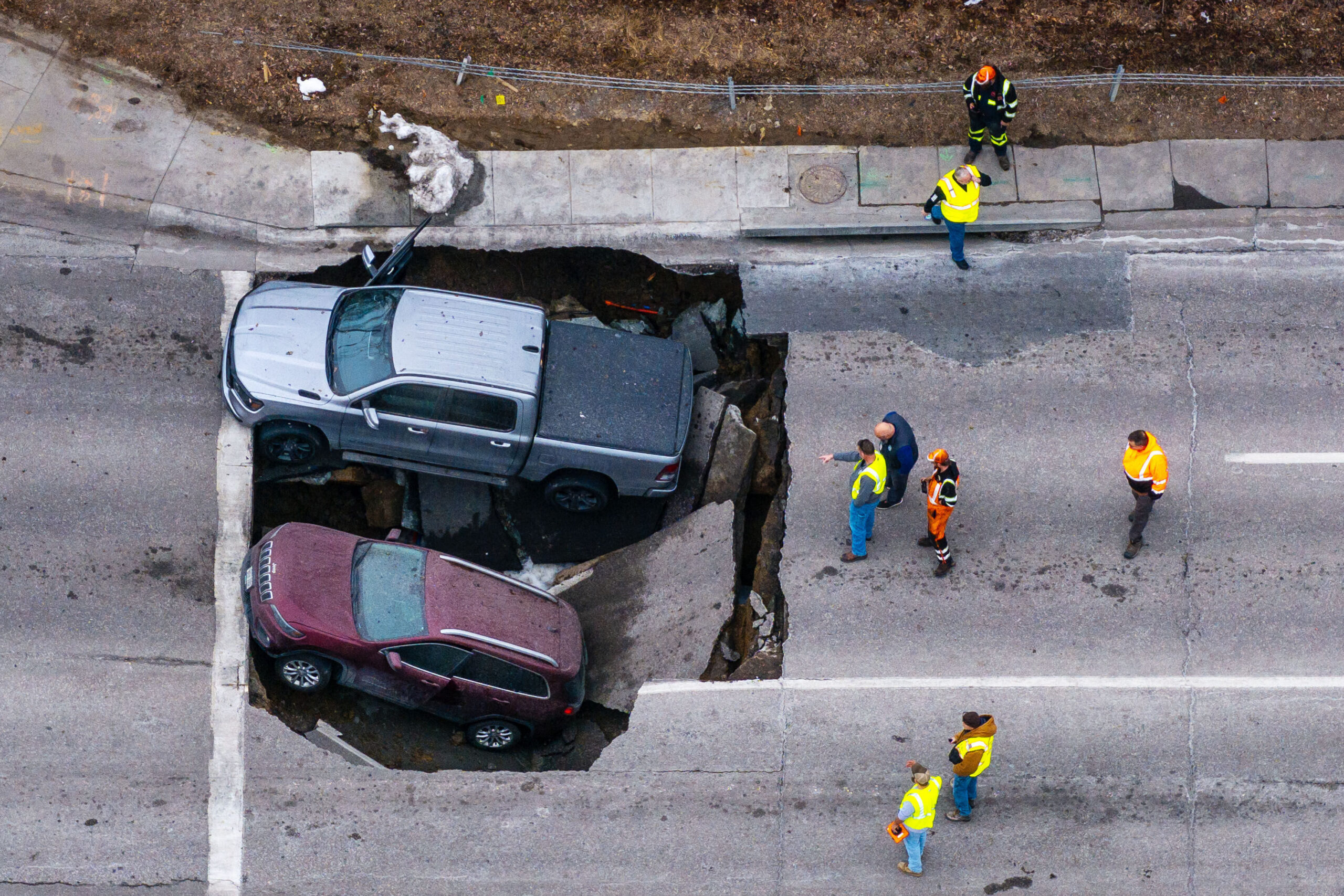
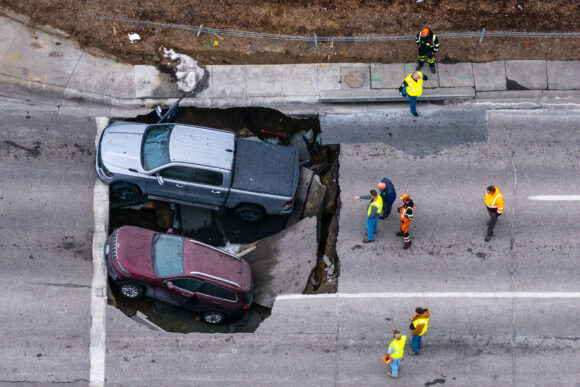
A patch of Pacific Street the size of a sand volleyball court had collapsed into the earth, swallowing a silver Ram pickup truck and a maroon Jeep Cherokee. The sediment Maher noticed in the creek had washed out from under the road, creating a massive void that the cars fell into.
“I was sorry I wasn’t still teaching,” Maher said. “I would’ve probably spent (time) in class saying, ‘Look, here’s the relevance. Here’s geology in action. Here’s a sinkhole.’”
Videos of the moment the road gave way quickly racked up millions of views from all over the world. But most Omaha sinkholes don’t go viral.
Over the last five years, city work crews reported more than 2,100 “cave-ins,” ranging from small dips in the pavement to gaping chasms like the Pacific Street sinkhole. Though most are minor, Omaha sees more cave-ins than several other Midwestern cities, according to a Flatwater Free Press analysis.
The city’s susceptibility to sinkholes comes from its soil, geologists say. Much of Omaha sits atop a fine-grained sediment called loess (pronounced “luss”) that can be easily carried away by water, leaving behind gaps underground.
“It’s great for growing corn, but terrible for building roads,” said City Engineer Austin Rowser.
More or loess
The sinkholes that typically attract online virality and dominate the pages of geology textbooks don’t happen in Nebraska.
That’s because the state is one of only a few that doesn’t appear to have much karst topography. Dissolvable bedrock makes places such as the Missouri Ozarks and Florida’s “Sinkhole Alley” more susceptible to massive sinkholes, said Matt Joeckel, Nebraska’s state geologist and a professor at the University of Nebraska-Lincoln.
By contrast, Omaha’s sinkholes are generally shallower and often result from human-made infrastructure interacting with the fine-grained sediment that blankets eastern Nebraska, geologists said.
“We’re not going to have a situation in which a giant sinkhole suddenly appears … and continues to grow and eat up a neighborhood,” Joeckel said.
When a pipe breaks or a sewer leaks, water can carry away loess or fill dirt underground. Omaha’s hilly topography aids that movement, said Maher, who taught at University of Nebraska at Omaha for four decades.
Rowser, the city engineer, theorized that the Pacific Street sinkhole started months before as a small leak in a Metropolitan Utilities District water main that found its way into the storm sewer, creating a small void that went undetected. Eventually, the water pushed enough dirt into the sewer to create the huge cavity that collapsed under the weight of two vehicles on Feb. 24, Rowser said.
MUD has challenged the city’s explanation, contending that the city’s damaged storm sewer was responsible for the sinkhole and that the water main broke after the road collapse.
Locked in a chicken-and-egg dispute, the city and MUD have filed claims against each other for the cost of repairs.
Omaha has averaged more than 400 cave-ins annually since 2021, according to a Flatwater analysis of Public Works data.
Many appeared only as slight dips in a road or sidewalk. The city ordered barricades for about 40% of cave-ins indicating some kind of hazard at the surface, Rowser said.
Omaha sees far more sinkholes in warmer months than colder ones — frozen soil doesn’t erode as easily, Rowser noted. That differentiates them from potholes, which typically form as moisture seeps into cracks in pavement during freeze-thaw cycles in late winter and early spring.
UNO geology professor Ashlee Dere isn’t surprised that Omaha sees so many cave-ins given its soil type, human-altered topography and aging infrastructure.
“It’s surprising in that it doesn’t cause more problems,” Dere said.
The city has seen memorable sinkholes over the years, including a collapse on St. Mary’s Avenue that swallowed a car and injured its driver in 2014. Another downtown sinkhole that sucked half of a garbage truck into 16th Street last year is still being repaired following a yearlong dispute between the city and a property owner.
But Omaha drivers shouldn’t worry about their car falling into a sinkhole since the chance of it happening is so low, Rowser said.
The two unlucky drivers who were suddenly plunged into Pacific Street emerged unharmed.
Even though the risk of injury is minimal, local engineers need to keep in mind that they’re building on soil that can erode rapidly, Joeckel said.
Beneath the surface
Every cave-in must be checked out to prevent sinkholes from forming, and in Omaha, that duty falls to Public Works crews.
When the city gets a cave-in report, an employee investigates the scene to find the root cause, Rowser said.
Injecting colored dye into a hole or crack in the pavement is usually the first step, he said.
If workers can see the dye in the sewer water downstream, it means water and sediment are likely leaking into the sewer. Sending a camera down next allows them to trace the water’s path and find where it’s entering. Then, they can repair the sewer and stop the leak.
When the dye doesn’t show up in the sewer, an animal burrow or dead tree root might be the cause of the cave-in. Workers then use a special concrete to fill in the gap.
Reported cave-ins have decreased in recent years from more than 500 in 2021 to about 340 last year, but as Omaha’s underground infrastructure ages, it could put the city at greater risk of sinkholes, geologists said.
In recent weeks, the city has explored new ways to diagnose problems underground, Rowser said. Fiber optic cables may be able to detect leaks in water lines and alert the city, he said.
Joeckel, the state geologist, said conducting certain geological surveys could illuminate where water is concentrated and identify potential trouble spots.
“It would be great if you could see what was going on below the surface before something happened,” Joeckel said.
Rowser said he’s not sure what would have raised red flags on Pacific Street before the sinkhole appeared. City workers did a dye test late last year while investigating some settlement at the surface, but it didn’t show the sewer had been breached.
After the collapse, construction crews worked rapidly to repair pipes and fill in the square of missing road.
The street reopened to drivers just nine days after it closed, but by then, the sinkhole had become world famous. The New York Times, USA Today and Fox News wrote articles on it, and international outlets from Belgium to Vietnam published video footage of the incident.
The sinkhole owes its internet popularity to the UNO security camera that recorded the dramatic moment, Rowser said.
“If a picture’s worth a thousand words, I don’t know what a video is worth,” Rowser said. “It’s got to be a lot more.”
But the clip’s virality speaks to something about how humans are wired, too, Maher said.”I suspect it has to do with the psychology of how we are intrigued by the unexpected,” Maher said. “It’s unexpected that the ground that is so solid and firm beneath your feet just gives way.”
___
This story was originally published by Flatwater Free Press and distributed through a partnership with The Associated Press.
Photo: FILE – Authorities assess two vehicles that fell into a sinkhole in Omaha on Feb. 24, 2026. (Chris Machian/Omaha World-Herald via AP, File)
Copyright 2026 Associated Press. All rights reserved. This material may not be published, broadcast, rewritten or redistributed.
