

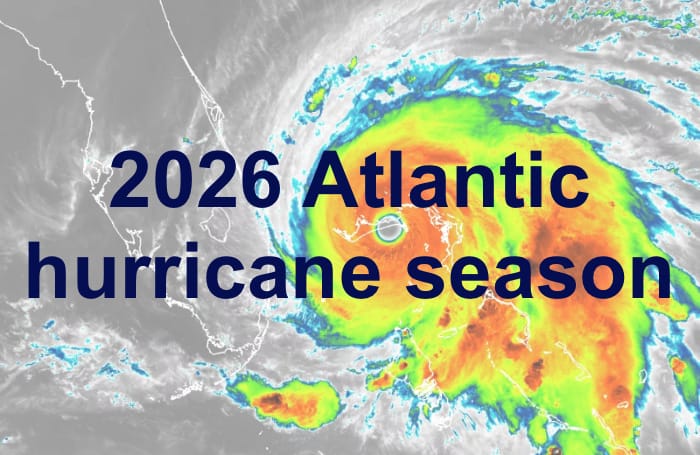
The Colorado State University (CSU) tropical meteorology team has issued its first forecast for the 2026 Atlantic hurricane season, calling for “somewhat below-normal” levels of activity, citing the potential for a robust El Niño and associated increases in vertical wind shear as key factors.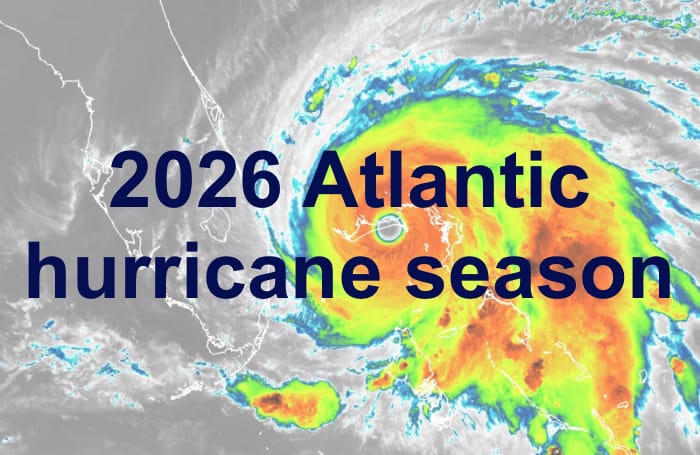
Phil Klotzbach, Senior Research Scientist in the Department of Atmospheric Science at Colorado State University and a leader on the team delivering these forecasts, said indications are for a “somewhat below-normal season”, with a “high likelihood of robust El Nino and associated increases in vertical wind shear the primary factor.”
The CSU April forecast calls for 13 named tropical storms in the 2026 Atlantic season, with 6 becoming hurricanes and 2 achieving Category 3 strength or greater to become major hurricanes.
That’s below the 1991 to 2020 average of 14 named storms, 7 hurricanes and 3 major hurricanes.
In addition the forecast calls for accumulated cyclone energy (ACE) at an index level of 90, again below the 1991 to 2020 average of 123.
Klotzbach further stated, “The primary reason for CSU’s somewhat below-normal Atlantic hurricane season forecast is a high likelihood for a robust El Nino. El Nino typically decreases Atlantic hurricane activity via increases in Caribbean/tropical Atlantic vertical wind shear.”
He added, “The Caribbean is slightly warmer than normal, while the eastern and central tropical Atlantic are slightly cooler than normal. This pattern of Atlantic sea surface temperatures provides mixed signals regarding the potential for an above- or below-normal Atlantic hurricane season.”
Perhaps encouraging for another less impactful hurricane season for the United States and with potential implications for insurance, reinsurance, catastrophe bond and insurance-linked securities (ILS) market participants, the CSU forecast also suggests lower landfalling probabilities for major hurricanes in 2026.
The forecast gives the following landfall probabilities for a Category 3 or stronger hurricane hitting the United States coastline:
- 32% for the entire US coastline (below the 1880 to 2020 average of 43%).
- 15% for the U.S. East Coast including Peninsula Florida (south and east of Cedar Key, Florida) (the average is 21%).
- 20% for the Gulf Coast from the Florida Panhandle (west and north of Cedar Key, Florida) westward to Brownsville (the average is 27%).
The probability for a major hurricane tracking through the Caribbean is given as 35%, below the average of 47%.
The forecast further explains the meteorology behind the early seasonal forecast, “The tropical Pacific is currently characterized by weak La Niña conditions. These La Niña conditions are likely to transition to neutral ENSO conditions shortly, with an expected transition to El Niño over the next few months. However, there remains considerable uncertainty as to how strong this likely El Niño will be by the peak of the 2026 Atlantic hurricane season. Sea surface temperatures in the western tropical Atlantic are warmer than normal, while they are slightly cooler than normal in the eastern and central tropical Atlantic. We currently anticipate that a robust El Niño will dominate the tropical circulation during the peak of the 2026 Atlantic hurricane season, likely driving above-normal levels of vertical wind shear across the tropical Atlantic and Caribbean.
“The early April forecast is the earliest seasonal forecast issued by Colorado State University and has modest long-term skill when evaluated in hindcast mode. The skill of CSU’s forecast updates increases as the peak of the Atlantic hurricane season approaches.”
With the developing El Nino conditions we are likely to see the majority of forecasters calling for normal to below-normal storm numbers in the 2026 Atlantic hurricane season.
As we always caution, it only takes one major storm to make landfall in a region of high coastal exposure concentrations and values, for there to be meaningful impacts to the insurance, reinsurance, catastrophe bond and insurance-linked securities (ILS) markets.
These longer-range seasonal forecasts are helpful to provide some direction, but the forecasts announced closer to the season and during the season itself are considered more likely to prove accurate.
We will be tracking the tropics as the season begins and have now set up our typical 2026 Atlantic hurricane season page, which will be updated as more forecasts are released and when any tropical storm activity occurs.
Read some articles on the value of seasonal hurricane forecasts:
– Cat bond portfolio construction more important than seasonal hurricane forecasts: Man Group.
– ILS investment outcomes about more than just hurricane season forecasts: Gibson, Schroders Capital.
– Adjusting ILS exposure for July hurricane forecast can deliver excess returns: Euler, TSR study.

