

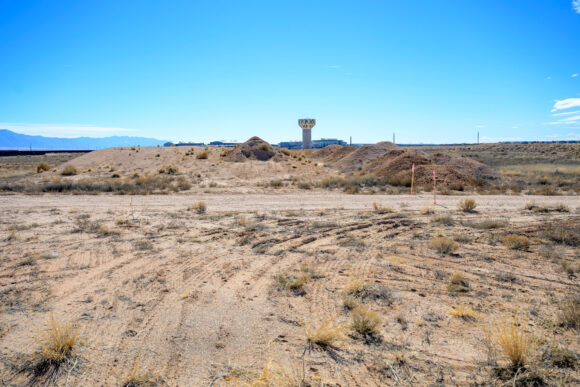
If all goes according to plan for the nation’s second-largest sovereign wealth fund, a barren stretch of desert in Albuquerque’s plains will soon become a research center where scientists replicate nuclear fusion — the process that powers the sun and stars.
The $1 billion project from startup Pacific Fusion seeks to unlock a new energy source, a bold goal for experimental technology that’s years away from practical breakthroughs. That didn’t stop the New Mexico State Investment Council, the sovereign wealth fund investing the state’s oil and gas revenues, from telling the firm to build big.
When Pacific Fusion worried whether private capital in the state would support its ambitions to create commercially viable power by fusing light atoms, the oil fund said cash would come. Punctuating its point, the wealth fund dispensed hundreds of millions across venture funds committed to developing fusion in the state.
It’s part of a bid to revive returns at a private equity initiative that one state official called one of the most expensive economic development programs in New Mexico history. The state’s wealth fund overhauled the program it drove for years and rolled out a new venture capital push focused on its backyard.
It’s now ramping up investments in a wave of venture firms angling to find the next big innovator in defense, advanced tech and energy, and encouraging them to invest in New Mexico.
While the state-focused program represents just a piece of a roughly $70 billion pool of money, the stakes are high. The sovereign wealth fund’s assets underpin more than 20% of New Mexico’s spending needs — including public education services and the state’s rollout of universal childcare.
Investment programs that target in-state businesses have historically delivered mixed returns, underscoring the risks when political and investment considerations collide. The largest U.S. sovereign wealth fund, Alaska’s oil fund, in 2023 began phasing out its version after officials decided it wasn’t the best use of capital.

Still, others such as Maryland’s pension have recently earmarked funds to invest in local businesses and state infrastructure. For its part, New Mexico’s wealth fund says it now expects all managers to prioritize returns and doesn’t require venture capital funds it invests with to back state businesses if they can’t turn a profit.
“Programs tend to not work when they’re not set up to make money,” Chris Cassidy, the wealth fund’s director of private equity and venture, said in an interview. “We want the financial returns as well as economic impact.”
Beyond Software
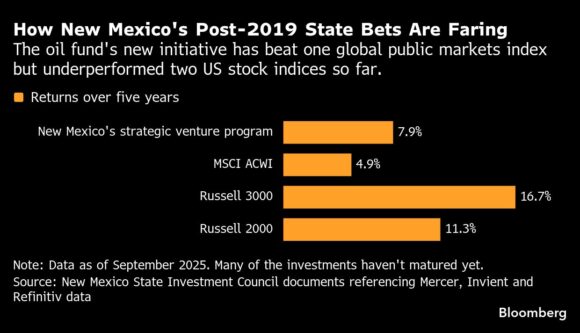
In the past three years, the New Mexico State Investment Council has doled out $1.8 billion to dozens of venture capital funds interested in investing in the state. One out of every $5 it puts into private equity has gone towards the effort since late 2022. The wealth fund’s latest state-focused investments delivered a 7.3% net internal rate of return by late last year. It will take years before the bets mature.
How New Mexico’s Post-2019 State Bets Are Faring | The oil fund’s new initiative has beat one global public markets index but underperformed two US stock indices so far.
The state’s deepening investment in defense comes as the US-Israeli attacks against Iran portend a bigger role for the sector. President Donald Trump is also advocating for advanced tech and energy as tools to win the technological race against China. Plus, his push to move critical supply chains to US shores is accelerating a yearslong shift in Silicon Valley’s focus beyond software, and into capital-intensive businesses, heavy industry and data centers — another potential boon for states like New Mexico with land and resources.
In New Mexico, the test lies in whether the campaign can mint returns even if markets and political tides turn. The program is concentrated in younger companies and tilted to industry sectors it handpicked. Case in point: fusion energy, which the Trump administration has championed but remains commercially untested.
In 2022, scientists in California achieved fusion ignition — the first demonstration that lab-made fusion reactions could produce more energy than it took to start the process.
But the road to turning that fraction-of-a-second breakthrough — hailed by the government as “one of the most impressive scientific feats of the 21st century” — into a reliable energy source remains uncertain. No fusion power plants exist. Three-year-old Pacific Fusion is among dozens of companies seeking to commercialize fusion energy.
“Nobody really knows what it’s going to cost,” said Steve Koonin, a theoretical physicist and senior fellow at Stanford University’s Hoover Institution. “You have to be patient and you have to be risk tolerant to invest in this stuff.”
New Mexico is willing to make the bet.
“We think the state has a right to win,” said Cassidy, who was elevated to his current position in 2022.
The National Interest
Back in 1991, New Mexico’s oil fund began setting aside money to stimulate its local economy on top of the regular business of investing across a mix of stocks, bonds and other global wagers. New Mexico has long attracted less private equity money than dozens of other US states, and its gross domestic product has also trailed neighbors.
For years, the fund tried to boost New Mexico by leaning into the “buy local” mantra and channeling sizeable investments through Sun Mountain Capital, a state-based asset manager that invests private assets, including venture capital. The Santa Fe firm says it was proud to deliver returns while it was an adviser to the program. But for the oil fund, state-focused investments made prior to 2019 have struggled, with the fund losing money on more than $500 million in past bets.
“It was an economic failure, and it was a fiscal failure,” New Mexico State Investment Officer Jon Clark said of the program in August. “It lost us a lot of money, and we got very, very little economic productivity out of that.”
By then, the investment council had hired an outside adviser to restructure the program. In place of rigid headquarters requirements, it searched out venture bets with the potential to thrive in New Mexico, according to Cassidy.
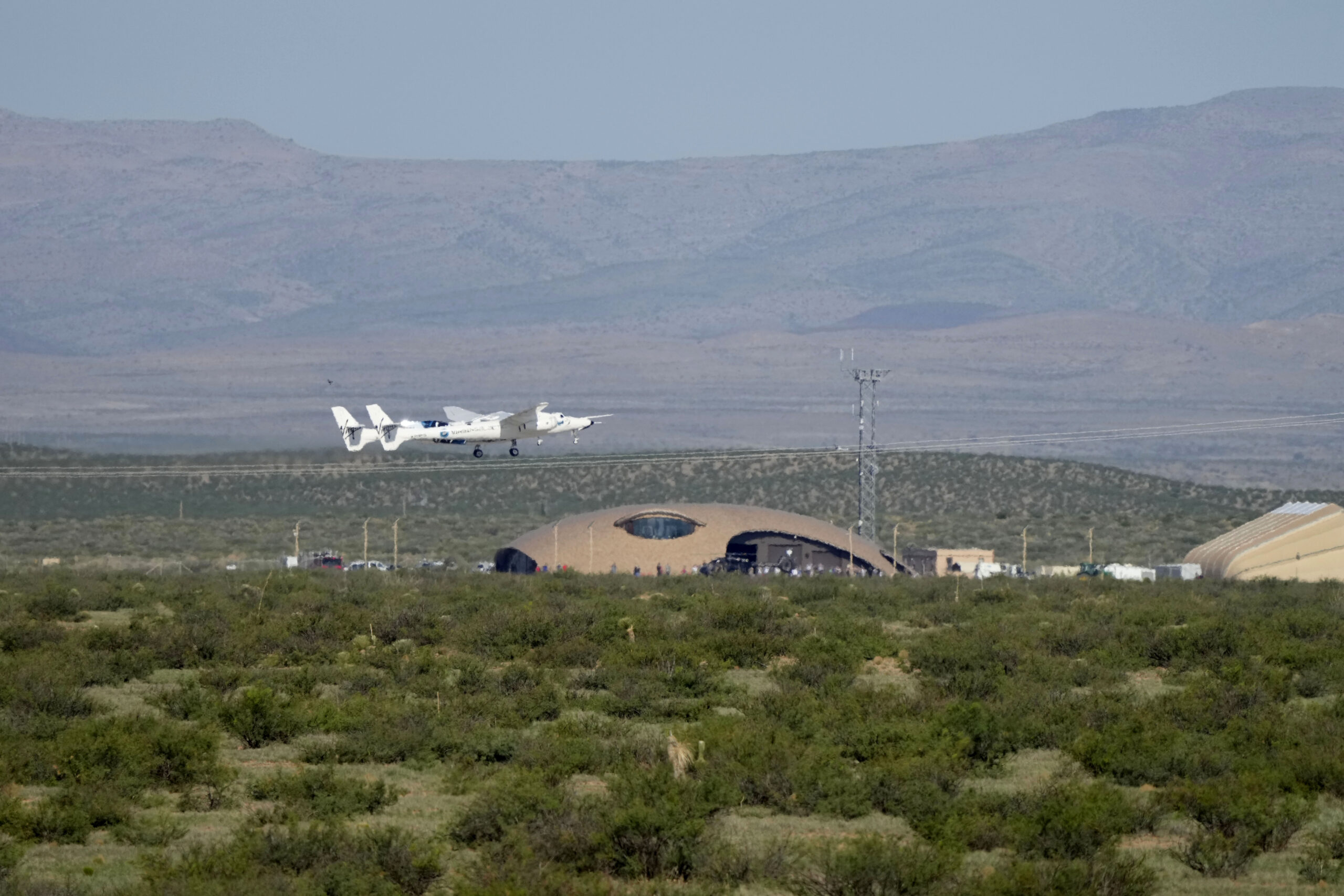
While casting a broader net for managers, officials zeroed in on sectors like aerospace and advanced manufacturing where they thought the state had an edge. It houses two major Department of Energy laboratories — Los Alamos National Laboratory and Sandia National Laboratories — as well as the spaceport where Richard Branson-founded Virgin Galactic conducts space tourism flights.
Those facilities and New Mexico’s wide-open desert land make the state fertile ground for defense startups seeking to rival established firms for Pentagon contracts.
At the same time, defense startups are becoming a central plank of a venture capital trade focused on shoring up the defense-industrial base, which Andreessen Horowitz has dubbed “American dynamism.” Once shunned by Silicon Valley, weapons developers are hot tickets as the Trump administration doles out contracts for kamikaze drones in Ukraine, the planned multibillion-dollar Golden Dome missile interception system, and potentially new defenses for escalating Middle East conflict.
The state investment council jumped on the national security movement early. In 2022, it backed America’s Frontier Fund, co-founded by Gilman Louie, who formerly led In-Q-Tel, the venture firm founded by the CIA. The oil fund later plunked down a founding investment in Roadrunner Venture Studios — which Louie championed — and the state picked the Albuquerque-based firm to help launch a quantum venture studio.
Hypersonic Missiles
New Mexico’s ambition was on full display as defense startup Castelion broke ground on its 1,000-acre manufacturing site in Sandoval County on a bright January morning. Decked out in hard hats, Castelion executives, the governor and other local and military officials drove shovels into the desert. A representative for the state wealth fund attended. Behind them, excavators and bulldozers flew by on dirt roads.
The California-based company, founded by former SpaceX engineers, aims to scale production of hypersonic strike weapons at its new facility, now expected to be the nation’s largest such site. Hypersonic systems, which are highly nimble and can fly faster than the speed of sound, have emerged as a critical asset for the US military as adversaries like Russia and China ramp up their own similar capabilities.
The oil fund is invested in it through Lightspeed Venture Partners.
When Castelion began a nationwide search for the location of its manufacturing campus just over a year ago, New Mexico’s wealth fund launched a charm offensive. The investment council assured the young company of the capital it could facilitate, and the local spaceport provided behind-the-scenes encouragement. Meanwhile, New Mexico state and local governments hit the gas on regulatory approvals.
The project faced some local opposition: Michael Farrell, a resident in Sandoval County, told local officials in November that “they’re asking us to build the road, send the water and shoulder the long-term risks to our aquifer, our safety, our health and possibly declining home values near Project Ranger.”
But just days later, Castelion announced that the same county would be home to its newest hypersonic missiles factory. It promised at least 300 jobs in the state and over $650 million in economic output over the next decade. In December, the startup announced that it had closed a $350 million funding round, co-led by Lightspeed.
“What we are building here in New Mexico is absolutely core,” Castelion co-founder and chief financial officer Andrew Kreitz said. “It is, I would say, very congruent with what the administration is working to do to revitalize the defense industrial base.”
‘Unimaginably Good’
The wealth fund used a similar playbook with Pacific Fusion. The California-based startup had been deciding between building in two cities in its home state — but then New Mexico entered the picture.
While the California cities were courting Pacific Fusion, venture capital executives introduced the startup to the New Mexico governor’s economic development adviser, who brokered an introduction to the investment council. Officials impressed upon the California startup the merits of building in New Mexico, and the wealth fund accelerated investments in fund managers that pledged to help build its fusion industry. In August, a slew of new commitments included checks to Lowercarbon Capital, DCVC and Lightspeed — all of which have invested in Pacific Fusion.
Meanwhile, New Mexico came through with an incentive package of about $10 million and tax abatements on up to $776 million of equipment and facilities for Pacific Fusion over time. In September, the startup announced it would build its research facility in New Mexico, where it has worked with Sandia National Laboratories. That same month, the Trump administration announced a slew of funding programs to accelerate fusion energy.
Pacific Fusion expects the project to bring hundreds of advanced energy jobs to the state, co-founder Carrie von Muench said, adding that the firm looks forward to expanding its economic impact and is following through with its plan.
At a public meeting, New Mexico State Investment Council officials said if Pacific Fusion didn’t pan out, it would just be one deal in a diversified portfolio — and the potential upside would be huge.
“It’s unimaginably good in terms of an opportunity for New Mexico,” said Bruce Brown, head of the oil fund’s strategic climate initiatives. “This is like nothing I have ever seen.”
Top photo: Virgin Galactic’s VMS Eve carries the VSS Unity on takeoff from Spaceport America. Photographer: David Lienemann/Getty Images.
Topics
InsurTech
Tech
Mexico
