


Georgia wants to lower income taxes. Some of the world’s biggest companies are standing in the way.
A state Senate bill that would all but exempt many lower- and middle-income earners from state income tax is stalling in the Georgia House, stymied by opposition from corporations that stand to lose billions in tax breaks. Both chambers of Georgia’s legislature are controlled by Republicans.
The legislation, which passed Georgia’s upper chamber 32-18 last month, would cut the state’s flat income-tax rate for individuals and corporations from 5.19% to 4.99% starting this year. It would also exempt the first $50,000 of earnings for individual filers and the first $100,000 for married couples from income tax beginning in 2027.
If the measure were to become law, Georgia could see a $5.1 billion decline in revenue in fiscal 2028, equivalent to about 13% of its budget, according to the Georgia Budget & Policy Institute. That would be an even bigger hit than a nearly 10% drop in revenue in 2009, during the Great Recession.
To help pay for the tax reductions, the bill proposes ending dozens of incentives and exemptions for businesses including data centers, cigarette exporters, medical-equipment manufacturers and banks.
Manufacturing giants including Hyundai Motor Group, Rivian Automotive Inc. and Kia Corp. have accepted incentive packages with property-tax breaks, sales-tax exemptions and job tax credits to open large warehouses and plants in Georgia.
A Rivian spokesperson said the EV maker will “continue to work closely with state and local partners in Georgia” and remains “committed to building a state-of-the-art manufacturing facility in Stanton Springs.” Kia declined to comment and Hyundai didn’t respond to requests for comment.
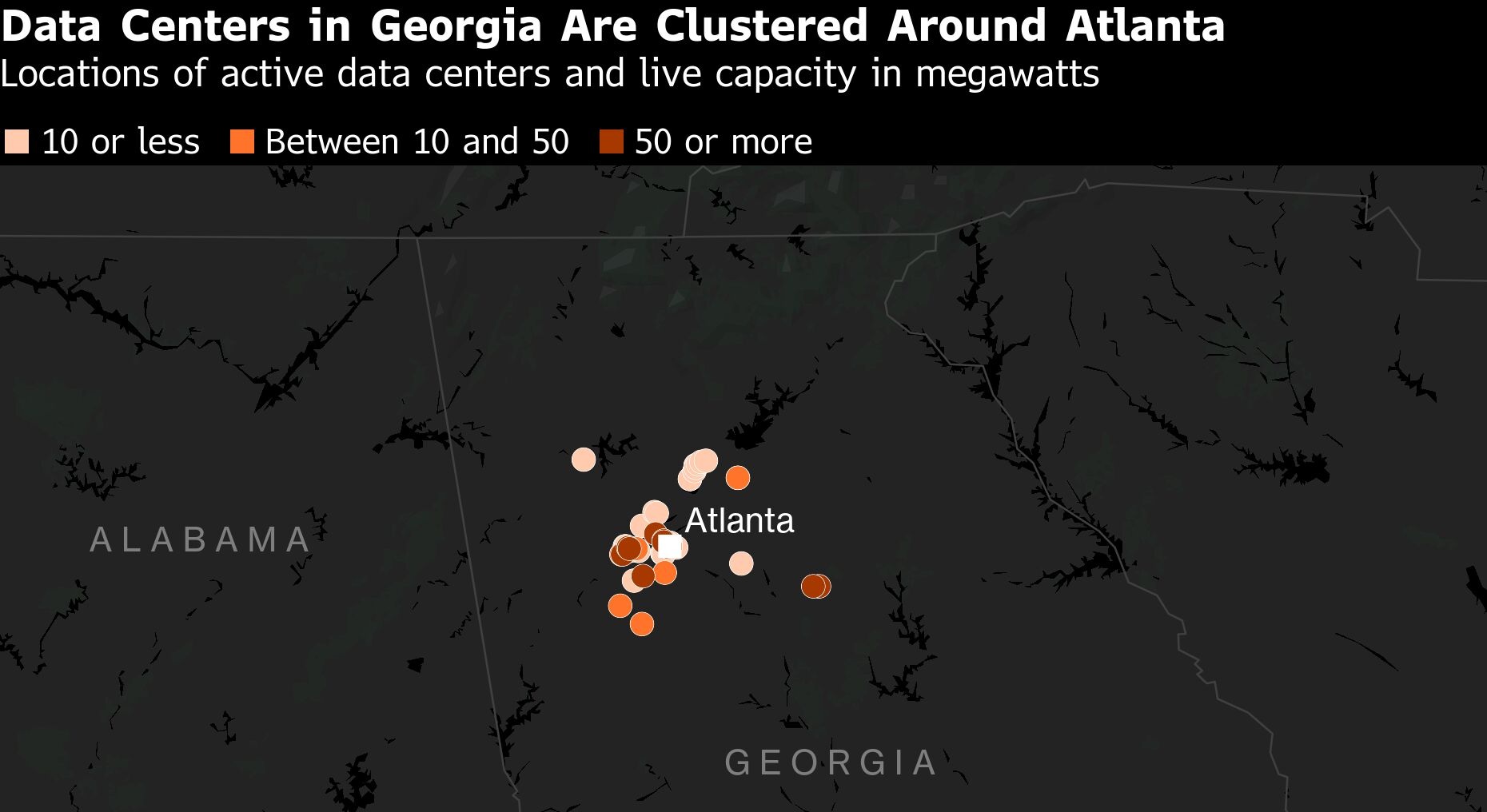
Amazon.com Inc., Meta Platforms Inc. and Microsoft Corp. operate data centers in Georgia, taking advantage of sales and use tax exemptions on some high-tech equipment. The exemptions would be phased out under the Senate bill.
Microsoft declined to comment. Meta and Amazon didn’t respond to requests for comment.
Republican Senator Blake Tillery, the measure’s sponsor, said the legislation would make the state more affordable for the middle class. It targets corporations to avoid burdening residents with sales taxes typically used to offset income-tax cuts, he said.
“All we’re trying to do is value people over corporate credits,” said Tillery. “You shouldn’t be getting the credit just because you were wealthy enough to afford a lobbyist.”
Data-Center Debate
Using tax breaks to lure businesses has long enjoyed bipartisan support in Georgia. Organizations lobbying against the bill warn that companies could choose to relocate if the exemptions are cut.
Since the Inflation Reduction Act passed in 2022, state and federal incentives have pushed Georgia to the center of a surge in clean-energy manufacturing and AI infrastructure, including a major expansion by Amazon Web Services and Microsoft. The mix of subsidies, lower costs and available power has drawn promises of jobs and investment.
“Some senators have made an assumption these industries would continue to exist and flourish and grow and exist here in the state with or without these credits,” said Don Bolia, a lobbyist who represents businesses opposed to the bill. “These industries are making the argument that they would simply leave or certainly reduce the amount of business they do in the state.”
Data center lobbying groups have made similar arguments. Khara Boender, director of state policy at The Data Center Coalition, said the bill “would discourage further investment and send a signal that Georgia is closed for business.”
Data centers could see their current tax burden more than double if the proposal were to become law, according to state projections.
Data centers have been a fast-growing source of employment in recent years in Georgia, supporting more than 5,000 jobs in 2025, according to a December report by the state’s Department of Audits and Accounts. However, lobbyists have warned lawmakers that those jobs could be moved to other states.
“Georgia is surrounded by a number of states that are very competitive. They’re willing to offer extremely attractive incentives to these companies and they’ll just follow the incentives,” Bolia said.
Senate Majority Leader Jason Anavitarte, who backed the legislation, said there was “significant debate” over its effect on data centers. In drafting the bill, he said lawmakers leaned on a 2025 report from the University of Georgia’s Carl Vinson Institute of Government that said 70% of data centers in the state would exist without tax exemptions.
“It’s our pro-business environment, historically low taxes, having a balanced budget, truly policies that allow the free market to thrive,” said Anavitarte. “So that’s why I say I think they’re going to come even if the tax credit went away.”
Economic-development agencies have been uneasy about the bill. Dave Williams, chief policy officer at Metro Atlanta Chamber, a pro-business advocacy group, urged lawmakers in a statement to reduce income and property taxes while maintaining the business incentives.
Affordability Angle
Critics charge that Tillery, who is running for lieutenant governor, and Republican legislators crafted the measure knowing it would face opposition, betting they could claim credit for affordability measures heading into November’s midterm elections even if the bill doesn’t pass.
“Republicans have been telling people of Georgia all these years that it’s because of these credits that we’re the number one state to do business,” said Democratic Senate Minority Leader Harold Jones II. “Now all of a sudden they’re no good?”
Georgia’s House has until April 2 to vote and can propose edits that could send the bill back to the Senate. If passed in both chambers, it would go to Republican Governor Brian Kemp for his signature.
A spokesperson for Kemp said he declined to comment while the legislation was being debated.
Georgia isn’t the only Republican-led state pushing for tax cuts. Florida, Missouri, South Carolina, Mississippi, Oklahoma, and Kentucky have advanced or proposed income and property-tax cuts over the past year, positioning themselves as a counter to proposed tax increases — particularly on the wealthy — in Democratic-led states.
The Washington state legislature this month passed a new tax on millionaires, while a proposed measure in California, if it makes the November ballot, would impose a one-time 5% tax on billionaires in the state.
“The optics of voting against a bill like this in public would be very detrimental to anybody in a conservative Republican primary,” said Republican commentator Ben Burnett. “How are you going to look your opponent in the face when they say the number one issue is affordability?”
Map: Bloomberg
Copyright 2026 Bloomberg.
Topics
Georgia
