

Josh Courville has harvested crawfish his whole life, but these days, he’s finding a less welcome catch in some of the fields he manages in southern Louisiana.
Snails. Big ones.
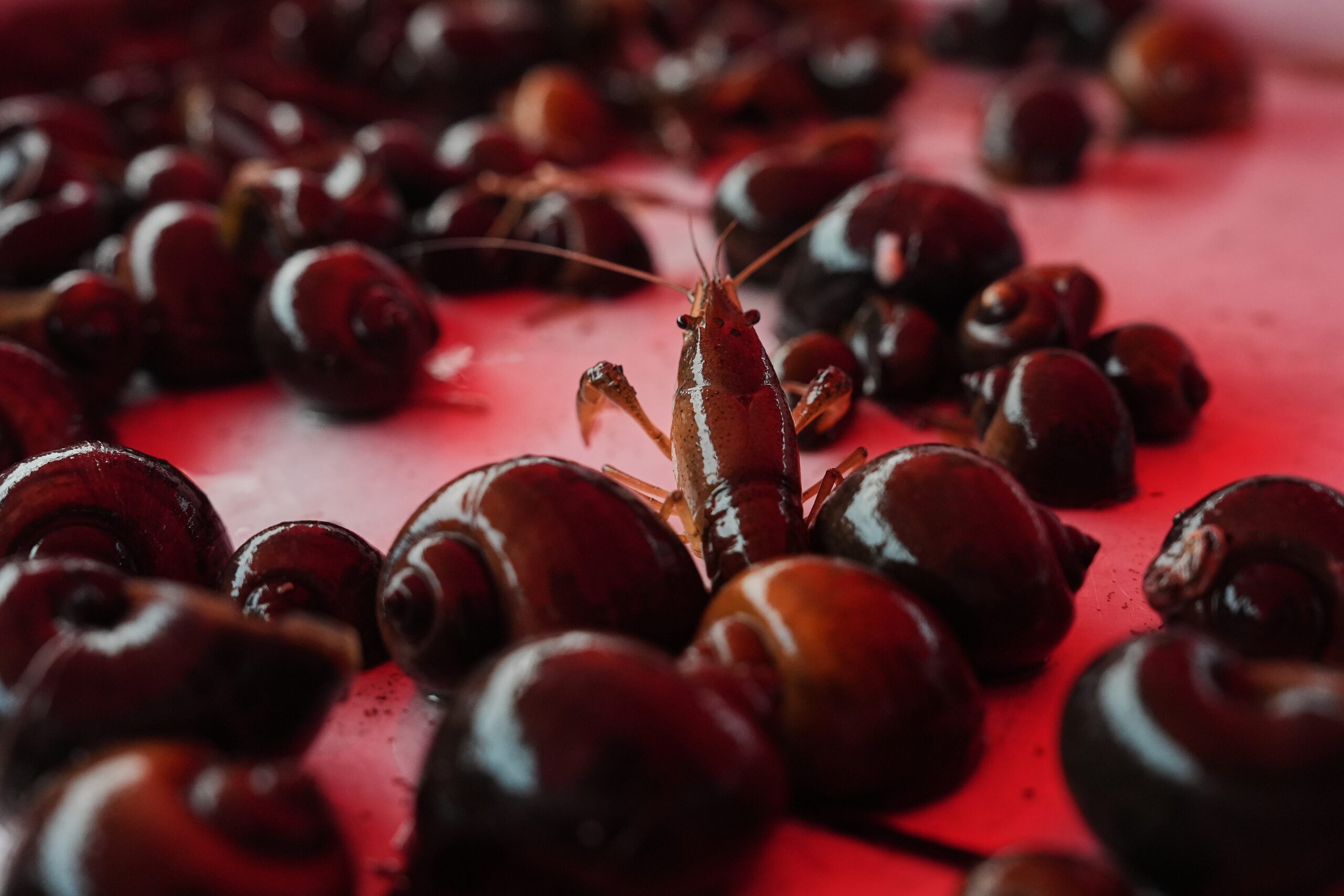
For every crawfish Courville dumps out of a trap, three or four snails clang onto the boat’s metal sorting table. About the size of a baseball when fully grown, apple snails stubbornly survive all kinds of weather in fields, pipes and drainage ditches and can lay thousands of bubblegum-colored eggs every month.
“It’s very disheartening,” Courville said. “The most discouraging part, actually, is not having much control over it.”
Apple snails are just one example of how invasive species can quickly become a nightmare for farmers.
In Louisiana, where rice and crawfish are often grown together in the same fields, there’s now a second threat: tiny insects called delphacids that can deal catastrophic damage to rice plants. Much about these snails and insects is still a mystery, and researchers are trying to learn more about what’s fueling their spread, from farming methods and pesticides to global shipping and extreme weather.
Experts aren’t sure what role climate change may play, but they say a warming world generally makes it easier for pests to spread to other parts of the country if they gain a foothold in the temperate South.
“We are going to have more bugs that are happier to live here if it stays warmer here longer,” said Hannah Burrack, professor and chair of the entomology department at Michigan State University.
It’s an urgent problem because in a tough market for rice, farmers who rotate the rice and crawfish crops together need successful harvests of both to make ends meet. And losses to pests could mean higher rice prices for U.S. consumers, said Steve Linscombe, director of The Rice Foundation, which does research and education outreach for the U.S. rice industry.
Inconvenience, stress and higher costs for farmers
Courville manages fields for Christian Richard, a sixth-generation rice farmer in Louisiana. Both started noticing apple snails after a bad flood in 2016. Then the population ballooned.
In spring, at rice planting time, the hungry snails found a feast.
“It was like this science fiction movie,” Richard said, describing how each snail made its own little whirlpool as it popped out of the wet ground. “They would start on those tender rice plants, and they destroyed a 100-acre field.”
Louisiana State University scientists estimate that about 78 square miles (202 square kilometers) in the state are now regularly seeing snails.
To keep the rice from becoming a snail buffet, Richard’s team and many other rice and crawfish farmers dealing with the pests start with a dry field to give the rice plants the chance to grow a few inches and get stronger, then flood the field after.
It’s a planting method they’d already used on some fields, even before the snails arrived. But now, with the snails, that’s essentially their only option, and it’s the most expensive one.
They also can’t get rid of the snails entirely. Many of the pesticides that might work on snails can also hurt crustaceans. People directly eat both rice and crawfish, unlike crops grown for animal feed, so there are fewer chemicals farmers can use on them. One option some farmers are testing, copper sulfate, can easily add thousands of dollars to an operation’s costs, Courville said.
It all means “lower production, decreased revenue from that, and increased cost with the extra labor,” Richard said.
Cecilia Gallegos, who has worked as a crawfish harvester for the past three years, said the snails have made her job more difficult in the past year.
“You give up more time,” she said of having to separate the crawfish from the snails, or occasionally plucking them out of sacks if they roll in by mistake. Work that already stretched as late as 3 a.m. in the busy springtime season can now take even longer.
The snails separated from the crawfish get destroyed later.
One of the most significant pest appearances since the 1950s
To look for pests much smaller than the apple snails, entomologists whip around heavy-duty butterfly nets and deploy Ghostbusters-style specimen-collecting vacuums. Since last year, they’ve been sampling for rice delphacids, tiny insects that pierce the rice plants, suck out their sap and transmit a rice virus that worsens the damage.
It’s worrying for Louisiana because they’ve seen how bad it can get next door in Texas, where delphacids surged last year. Yields dropped by up to 50% in what’s called the ratoon crop, the second rice crop of the year, said The Rice Foundation’s Linscombe. Texas farmers are projected to grow rice on only half the acres they did last year, and some are worried they won’t be able to get bank loans, said Tyler Musgrove, a rice extension specialist at the Louisiana State University AgCenter.
Musgrove said entomologists believe almost all rice fields in Louisiana had delphacids by September and October of last year. By then, most of the rice had already been harvested, so they’re waiting to see what happens this year.
“The rice delphacid this past year was probably one of the most significant entomological events to occur in U.S. rice since the ’50s when it first appeared,” Musgrove said. Delphacids had eventually disappeared after that outbreak until now. It’s been identified in four of the six rice-producing states — Texas, Louisiana, Arkansas and Mississippi — but it’s not clear yet whether it’s made a permanent winter home in the U.S.
Scientists are still in the early stages of advising farmers on what to do about the resurgence of the destructive bugs without adding costly or crawfish-harming pesticides. And they’re also starting to study whether rice and crawfish grown together will see different impacts than rice grown by itself.
“I think everyone agrees, it’s not going to be a silver bullet approach. Like, oh, we can just breed for it or we could just spray our way out of it,” said Adam Famoso, director of Louisiana State University’s Rice Research Station.
Climate change makes it harder to plan around pests
Burrack, of Michigan State, said that climate change is making it harder for modeling that has helped predict how big populations of invasive pests will get and when they may affect certain crops. And that makes it harder for farmers to plan around them.
“From an agricultural standpoint, that’s generally what happens when you get one of these intractable pests,” Burrack said. “People are no longer able to produce the thing that they want to produce in the place that they’re producing it.”
Photo: A crawfish crawls through apple snails after harvest Wednesday, Jan. 21, 2026, at a farm in Kaplan, La. (AP Photo/Joshua A. Bickel)
Copyright 2026 Associated Press. All rights reserved. This material may not be published, broadcast, rewritten or redistributed.
Topics
Agribusiness
