

It took just days for the Iran war to hobble oil fields, refineries and gas plants across the Persian Gulf, but it could take years to restore their full potential as the conflict drags on.
More than three weeks of war have created a massive supply disruption by effectively closing the critical Strait of Hormuz, while also damaging dozens of energy assets. But as President Donald Trump claims talks are under way with Iran to end the conflict, calculating the wider economic fallout must factor in the time it will take to reboot the Gulf’s oil and gas infrastructure.
The strikes last week on the Qatar’s Ras Laffan liquefied natural gas complex, which houses the world’s biggest export plant, reinforce concerns that turning the taps back on won’t be quick or easy, with an official estimate of as long as five years to repair the damage.
Oil and gas production systems require steady flows operating under a pressure gradient from deep underground reservoirs to the valves that control loading onto tankers, engineers say. Even if unscathed by missiles and drones, the speed at which output can be returned to pre-war levels will depend on whether fields and their individual wells have been fully halted — and for how long — or if they were kept at minimum flow rates.
“You can’t just push the pause button when oil flows are inconvenient,” said Jim Krane, a fellow at Rice University’s Baker Institute, who’s followed Middle East energy for more than two decades. “Interrupting such huge petroleum supply chains causes cascading effects across the globe.”
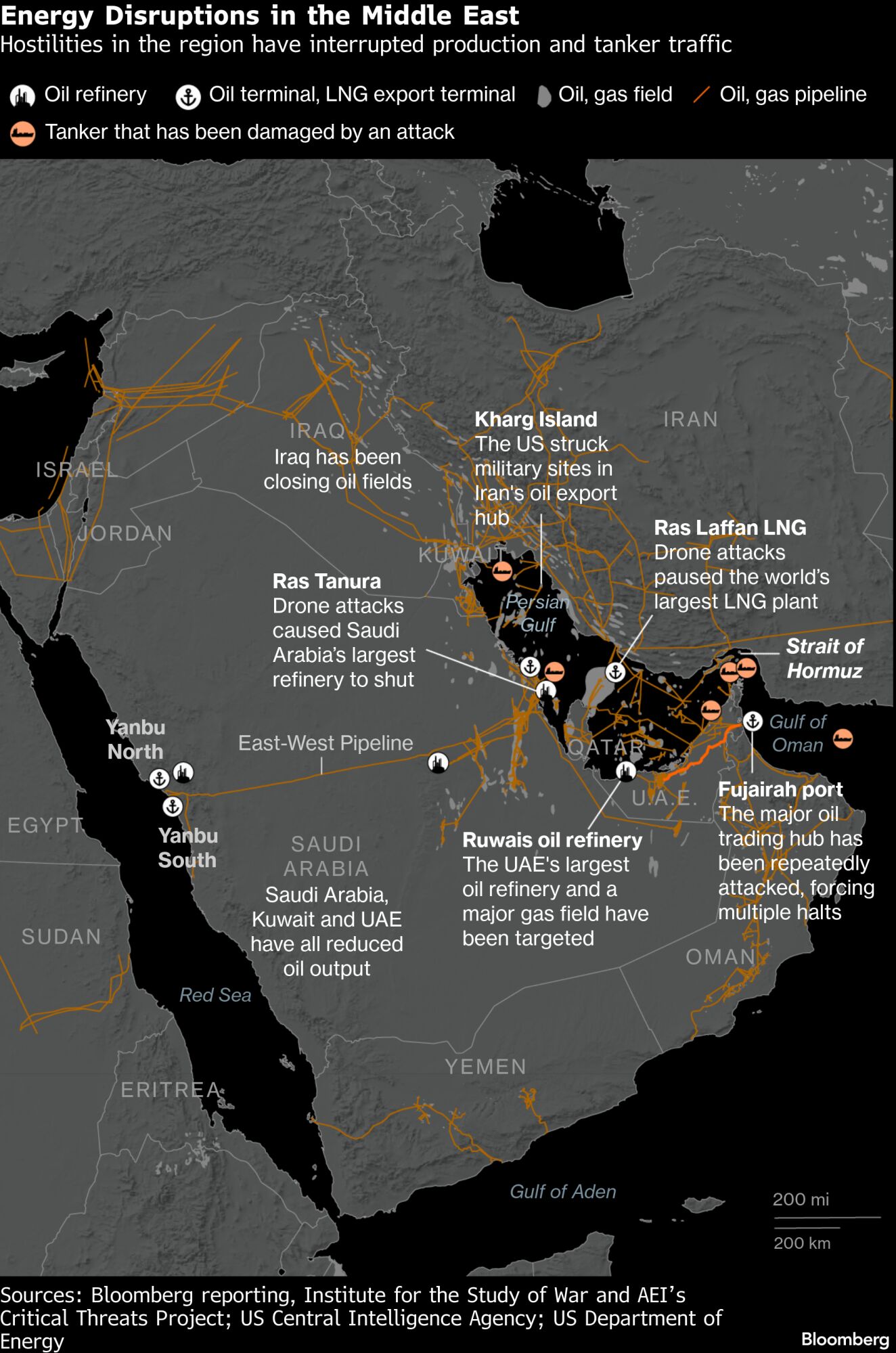
More than 40 energy assets across nine countries in the Middle East have been “severely or very severely” damaged by the war, International Energy Agency Executive Director Fatih Birol said, potentially prolonging disruptions to global supply chains after the conflict ends.
Oil Fields
Earlier this month, Saudi Aramco Chief Executive Officer Amin Nasser said the company expects a relatively quick return — “within days” — to full production for curtailed oil fields.
While that may be true for fields that have been kept running at reduced rates, the picture is markedly different for those that have been shut completely.
It could take two to three weeks to restore full production at a small field that’s been halted, and four or five weeks for a larger one, according to Aditya Saraswat, Rystad Energy’s director of research for the Middle East and North Africa, who has a background in reservoir engineering. Rushing fields back into operation can cause damage, as pressure needs to be built gradually in the entire system, he said.
“The priority is to keep the fields running,” Saraswat said by phone from Dubai. “Once you shut down, your entire trunk line is depressurized.”
Where force majeure has been declared, fields are often shut-in completely, he said. Where production has been scaled back due to lack of storage — such as in Iraq and Kuwait — it’s likely that shut-downs have been partial, he added.
Stagnant wells can encounter issues of corrosion and wax buildup, according to Matt Randolph, an Oklahoma-based veteran of oil fields around the world for more than three decades.
“And this is why they initially just reduced production and kept wells flowing at much lower rates, because it keeps the system clean, so to speak,” he said, adding that the longer the shut-in, the longer the restart.
In addition, several international oil companies and service providers have evacuated staff from the region, according to the International Energy Agency. To restart some fields, the situation will need to have stabilized enough for those workers to return.
Refinery Challenges
Similar challenges face refineries in the region, after a number of major facilities either shut or curbed their output due to attacks and a lack of viable export outlets.
Restarting plants could take more than two weeks, while facilities that have been slowed, rather than stopped, could come back more quickly.
The UAE shut its huge Ruwais plant, one of the biggest refineries in the world, as a precautionary measure after a drone strike caused a fire in the industrial area where it’s located. Kuwait’s Mina Al-Ahmadi oil refinery suffered another attack Friday that shut down some units, a day after the facility was targeted in a wave of strikes on energy infrastructure across the Middle East.
Saudi Aramco halted operations at Ras Tanura — the kingdom’s largest crude processing plant with 550,000 barrels a day of capacity — after a drone attack in the first few days of the war, though the facility has since been restarted. Bahrain’s Bapco Energies had its 400,000 barrel-a-day plant damaged in an attack and declared force majeure on operations that had been impacted.
For large, complex refineries “that have fully halted operations, the restart process typically will require longer duration to stabilize,” said Priti Mehta, a senior analyst for consultancy Wood Mackenzie. She estimates that it may take 10 to 15 days to return to normal utilization levels, assuming no major structural damage.
Tanker Returns
While the restart can be carried out in parallel at fields and refineries, none of that can begin until brimming storage tanks at Gulf ports are emptied. That means getting tankers back through Hormuz as a key first step to restoring flows.
That presents logistical challenges, with dozens of supertankers diverted elsewhere, including to Saudi Arabia’s Red Sea port of Yanbu.
Still, there are currently plenty of empty tankers south of Fujairah — the UAE port outside the Strait of Hormuz — or further out in the Arabian Sea, suggesting shipping may not be the most important constraint, according to Robin Meech, managing director at Marine and Energy Consulting Ltd. in Oxford.
Tanker tracking data compiled by Bloomberg support that view, at least for oil. There are about 60 empty, non-Iran-linked supertankers, each capable of hauling about 2 million barrels a day, anchored outside Hormuz in the Gulf of Oman, or further out in the Arabian Sea. Those ships could be at berths in the Middle East within three or four days, as long as they don’t have to queue to transit Hormuz.
LNG Reboot
Perhaps the greatest energy challenge to emerge so far in the Gulf is at Qatar’s Ras Laffan, the world’s largest LNG plant.
The strikes last week damaged two production trains, representing about 17% of Qatar’s exports of the fuel. Repairs will take up to five years, according to QatarEnergy, impacting supplies to Europe and Asia.
Even before the attack, any startup of Ras Laffan would have to be “intentionally slow” to avoid overloading the equipment, said Mehdy Touil, an LNG lead specialist at Calypso Commodities who previously worked at the plant that covers almost a fifth of global supply.
Once Hormuz is reopened, finding LNG carriers should be less of a problem, with a further 90 vessels will hit the market this year, according to Kaushal Ramesh, vice president, gas and LNG at Rystad.
Managing the restart of traffic through critical waterway may be a bigger challenge, as a backlog of energy, food and other materials rushes to enter and exit the Gulf.
“Pre‑announced convoy slots, staging at safe anchorages and mandatory pilotage at chokepoints may be needed,” the IEA said.
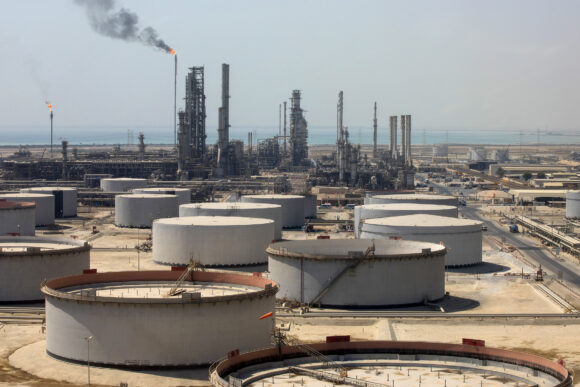
Photograph: An oil refinery in Ras Tanura, Saudi Arabia; photo credit: Simon Dawson/Bloomberg
Copyright 2026 Bloomberg.
