

Editorial Note
This brief was updated on March 4, 2026 to include changes related to the 2025 reconciliation law and new federal Medicaid reverification requirements.
Medicaid is the primary program providing comprehensive coverage of health and long-term care to over 81 million low-income people in the U.S. Medicaid is jointly financed by states and the federal government but administered by states within broad federal rules. In addition to meeting federal and state income and residency requirements, eligibility for coverage under Medicaid and the Children’s Health Insurance Program (CHIP) is limited to U.S. citizens and certain lawfully present immigrants. Starting October 1, 2026, the 2025 reconciliation law will further restrict lawfully present immigrant eligibility for Medicaid and CHIP. Federal Medicaid funds cannot be used to cover undocumented immigrants. Undocumented immigrants also are excluded from other federally funded health programs, including Medicare and the Affordable Care Act (ACA) Marketplaces.
On February 19, 2025, the Trump administration issued an executive order to “end taxpayer subsidization of open borders”, which includes language calling for enhanced verification systems to ensure taxpayer-funded benefits exclude unauthorized immigrants and requires federal agencies to identify sources of federal funding for undocumented immigrants. Current federal rules require states to verify an applicant’s eligible immigration status through the Department of Homeland Security (DHS) as part of the process for determining Medicaid eligibility. On August 19, 2025, the Centers for Medicaid and Medicare Services (CMS) announced a new initiative to require states to reverify whether certain individuals enrolled in Medicaid are citizens or have a satisfactory immigration status. This reverification process may increase administrative burdens for states and lead to coverage losses among eligible individuals due to administrative barriers. This brief describes federal citizenship and immigration status eligibility and eligibility verification requirements for Medicaid and the new reverification requirements.
What are Medicaid eligibility requirements for immigrants?
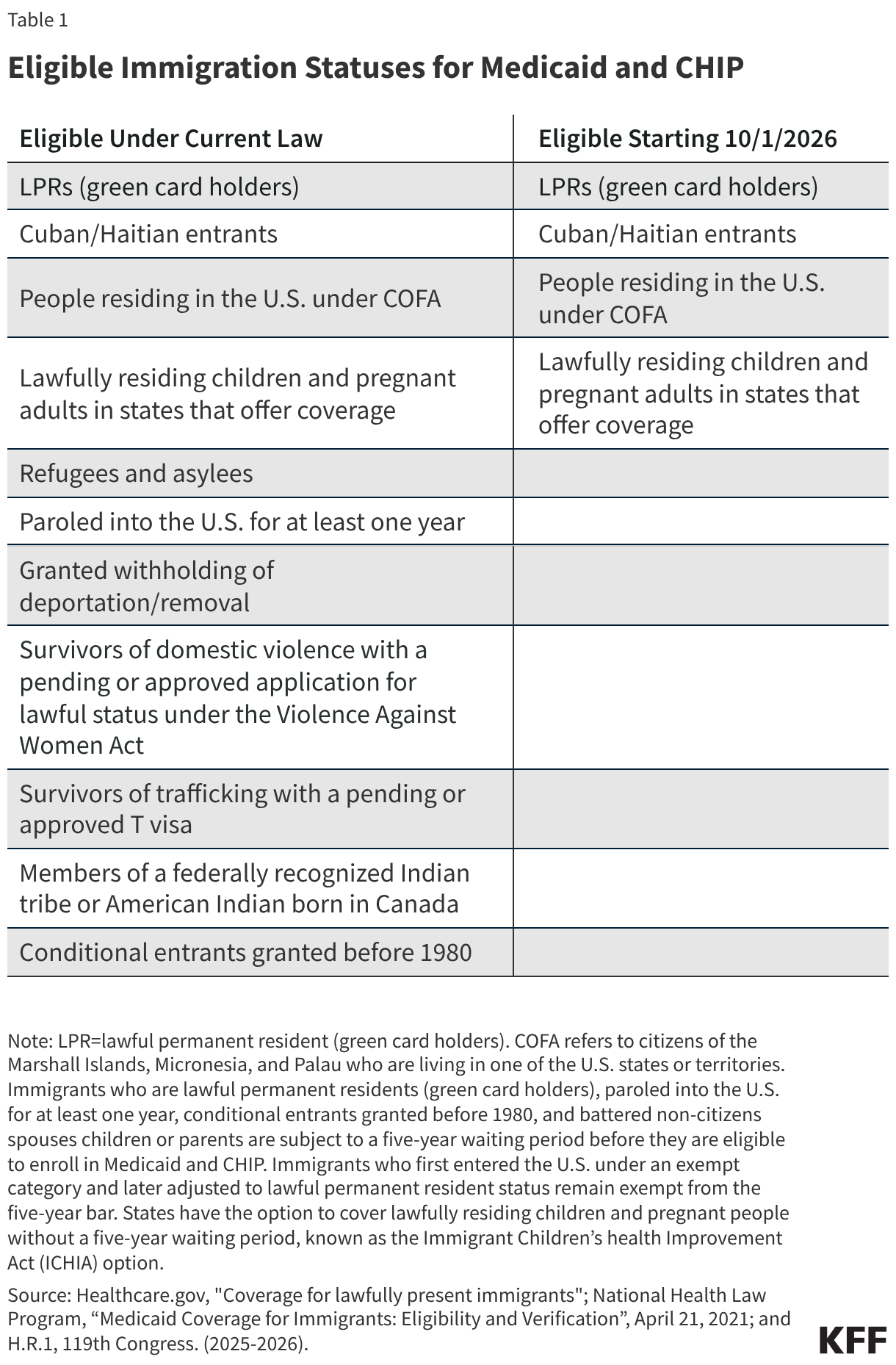
Federal rules limit Medicaid and Children’s Health Insurance Program (CHIP) eligibility to U.S. citizens and certain lawfully present immigrants; undocumented immigrants are not eligible for federally funded coverage. In general, in addition to meeting other eligibility requirements, lawfully present immigrants must have a “qualified non-citizen” status to be eligible for Medicaid or CHIP (Table 1), and many, including most lawful permanent residents or “green card” holders, must wait five years after obtaining qualified status before they may enroll. These immigrants may enroll in Marketplace coverage and receive subsidies during this five-year waiting period. Some immigrants with qualified status, such as asylees and refugees, do not have to wait five years to enroll in Medicaid and CHIP coverage. Some immigrants, such as those with temporary protected status, are lawfully present but do not have a qualified status and are not eligible for Medicaid and CHIP coverage even after a five-year wait. The Trump administration reversed Biden administration actions that had expanded ACA Marketplace coverage to Deferred Action for Childhood Arrivals (DACA) recipients, once again making them ineligible to purchase ACA Marketplace coverage effective August 25, 2025. States have the option to cover lawfully residing children and pregnant people in Medicaid or CHIP without the five-year waiting period otherwise known as the Immigrant Children’s Health Improvement Act (ICHIA) option. States can also provide prenatal care and pregnancy-related benefits to targeted low-income children beginning at conception through the CHIP From-Conception-to-End-of-Pregnancy (FCEP) option regardless of their parent’s citizenship or immigration status. Some states provide fully state-funded coverage to fill gaps in coverage for immigrants, including lawfully present immigrants and undocumented immigrants.
The 2025 reconciliation law will further restrict lawfully present immigrant eligibility for Medicaid and CHIP. Starting October 1, 2026, the 2025 reconciliation law will restrict immigrant Medicaid and CHIP eligibility to lawful permanent residents (LPRs) (i.e., “green card” holders), Cuban and Haitian entrants, people residing in the U.S. as citizens of the Freely Associated (COFA) nations of the Marshall Islands, Micronesia, and Palau residing in U.S. states and territories, and lawfully residing children and pregnant immigrants in states that cover them under the Medicaid or CHIP option (Table 1). States also will still have the option to extend prenatal and pregnancy-related benefits to targeted low-income children from conception through the end of pregnancy through the FCEP option. These restrictions will eliminate eligibility for many other groups of lawfully present immigrants, including refugees and asylees without a green card, among others.
Emergency Medicaid reimburses hospitals for emergency care provided to individuals ineligible for Medicaid due to their immigration status. Emergency Medicaid spending reimburses hospitals for emergency care they are obligated to provide to individuals who meet other Medicaid eligibility requirements (such as income) but do not have an eligible immigration status, including undocumented immigrants and lawfully present immigrants who remain ineligible for Medicaid or CHIP. Emergency services include those requiring immediate attention to prevent death, serious harm or disability, although states have some discretion to determine reimbursable services. Spending on Emergency Medicaid accounts for less than 1% of total Medicaid expenditures. Without Emergency Medicaid, the costs of emergency care would be shifted to hospitals that are required to treat individuals in emergency situations or fully to states. Starting October 1, 2026, in states that have expanded Medicaid under the ACA, the 2025 reconciliation law will limit federal matching payments for Emergency Medicaid for individuals who would otherwise be eligible for expansion coverage except for their immigration status to the state’s regular federal Medicaid match rate (which ranges from 50% to 77%) as opposed to the expansion match rate (which is 90% in all states).
How do states verify citizenship and immigration status to determine Medicaid eligibility?
States must verify citizenship and immigration status with the Social Security Administration (SSA) and DHS to determine eligibility for Medicaid coverage at the initial application. Applicants who are U.S. citizens must provide documentation of citizenship, or states must verify the applicant’s Social Security number with the SSA. Applicants who are not U.S. citizens must provide documentation showing that they have a qualified immigration status eligible for Medicaid coverage (Figure 1). States verify immigration status through the DHS Systematic Alien Verification for Entitlements (SAVE) system, which can provide automatic real-time verification. If the system cannot provide real-time verification, the state must request an additional review and may request additional documentation of eligible immigration status from the applicant. Applicants cannot self-attest to having an eligible immigration status without documentation for the state, with the exception of qualified immigrants exempt from the five-year wait due to a military connection. Current federal rules prohibit states from requiring applicants to disclose the immigration status of non-applicants, such as household members, which is not relevant to eligibility determination, and under statute, the SAVE system cannot be used for non-criminal immigration enforcement.
States are required to provide Medicaid benefits to applicants during a “reasonable opportunity period” of 90 days while their immigration status is being verified, if they otherwise meet all eligibility criteria. The reasonable opportunity period is allowed when the SAVE system cannot verify immigration status in real time and the state needs to conduct additional review and collect additional documentation to verify the qualified immigration status. This period gives applicants the opportunity to correct information in SAVE or submit additional documentation in support of their application. States may extend the period if they need more time to complete verification or if applicants are attempting to correct issues with documentation. States are entitled to receive federal matching funds for expenditures for Medicaid services provided to individuals during the reasonable opportunity period, regardless of whether eligibility is ultimately verified. If states determine an applicant ineligible for Medicaid coverage due to their immigration status at any point during the reasonable opportunity period, they must terminate eligibility within 30 days. This may also occur if applicants do not provide additional requested documentation or correct any discrepancies in the application. Applicants have the right to dispute the state’s decision in a fair hearing process, but states are not required to provide Medicaid benefits during this time.

In some cases, states need to reverify immigration status as part of Medicaid annual redetermination of eligibility processes. States do not need to reverify immigration status for most enrollees during the annual renewal if that status is unlikely to change (e.g., the enrollee is a lawful permanent resident). However, immigrant children and pregnant people who have been lawfully residing in the U.S. for less than five years receiving coverage through the ICHIA option must have their immigration status re-verified at renewal. If, at any point during the coverage period, the state receives information about a change in an enrollee’s immigration status that might affect ongoing eligibility, the state is required to act on that change in circumstance to review eligibility and request additional documentation from the enrollee if needed. The 2025 reconciliation law will require states to conduct eligibility redeterminations at least every 6 months for Medicaid expansion adults for renewals scheduled on or after December 31, 2026.
On August 19, 2025, CMS announced a new initiative to require states to reverify whether certain individuals enrolled in Medicaid are citizens or have a satisfactory immigration status. CMS will use Transformed Medicaid Statistical Information System (T-MSIS) enrollment data to attempt to verify enrollee citizenship and immigration status in the SAVE system and send states a sample of Medicaid enrollees whose immigration status it could not verify. States are required to reverify the status of those individuals in accordance with current federal rules, including the requirement to provide a reasonable opportunity period, and disenroll individuals who do not verify a satisfactory immigration status.
These new reverification requirements may increase administrative burdens for states and may lead to coverage lapses among eligible individuals if they are unable to complete reverification-related requests from states. Under the new requirements, states will need to reverify eligible immigration status for individuals CMS identifies in the sample shared with states, which can include immigrants as well as citizens. For several reasons, the CMS process for identifying individuals in the sample may include individuals who do not need reverification, which will increase the administrative burden on states. For example, the sample may include people in the reasonable opportunity period who do not require immediate verification or those receiving Emergency Medicaid services only who do not need a qualified immigration status. In addition, the T-MSIS data used by CMS is at least 2-3 months behind that of state enrollment data, so CMS may flag enrollees that states have since verified or already removed from Medicaid. The CMS sample may also include citizens because the SAVE system may not be able to verify citizenship in certain cases if that information is not available in the databases that SAVE has access to, such as for naturalized citizens whose citizenship information may not be up-to-date with the SSA. This could result in states reverifying citizenship status for citizens even though citizenship is not typically reverified. Some individuals may lose coverage during the reverification process even if they are still eligible if they have trouble completing the process, for example, if they miss notices or face challenges submitting required documentation.
CMS will require states to share reports on eligibility redeterminations for individuals whose citizenship or satisfactory immigration status CMS was unable to verify through its data match. CMS will require each state to report back on reverifications using a standardized template on the procedures used, the outcomes of the states’ independent verification efforts, and resulting redeterminations. CMS may publish monthly, de-identified counts of individuals for whom federal verification was unsuccessful and may issue disallowances or deferrals of federal matching funds when states claim federal matching funds for services or administrative Medicaid expenditures associated with individuals for whom they could not verify a satisfactory immigration status. The new reporting requirements will increase administrative burdens for states that are already working to meet implementation requirements tied to the 2025 reconciliation law.
