


OAKLAND, Calif. — Rosa María Carranza leaned forward to hold a 3-year-old’s back as the girl climbed a rock in the forested hills of northeast Oakland.
Dressed in hiking gear and beaded necklaces, Carranza, 67, maneuvered between trees and children on a sunny morning in December. “Hold on to that branch,” she said in Spanish. “You can do it, my love!”
Carranza, a child development professional who grew up swinging through trees and swimming in rivers in El Salvador, said she feels at home in the forest at the outdoor preschool she co-founded. She has worked with children and teens as a caregiver and educator for more than three decades, long enough to know when to lean in and when to step back to let her students find their own footing.
When she transitioned to working part-time last year, Carranza counted on getting Medicare and Social Security checks — benefits given to American workers and lawfully present immigrants when they retire, if they meet work history and age or disability requirements. She’s contributed tens of thousands of dollars into Medicare and Social Security over 24 years, according to her Social Security Administration earnings record, reviewed by El Tímpano and KFF Health News. But Carranza and an estimated 100,000 other lawfully present immigrants will soon be cut out of Medicare.
The GOP’s One Big Beautiful Bill Act, signed last July by President Donald Trump, barred certain categories of lawfully present immigrants — including temporary protected status holders, refugees, asylum-seekers, survivors of domestic violence, trafficking victims, and people with work visas — from Medicare.
Those already in the program, like Carranza, will be disenrolled by Jan. 4 — a move by Republican lawmakers to rein in Medicare spending, as they and Trump have argued that taxpayer dollars should not be used to pay for the health care of immigrants in the U.S. without authorization.
“The Democrats want Illegal Aliens, many of them VIOLENT CRIMINALS, to receive FREE Healthcare,” Trump posted on Truth Social two months after he signed the bill into law. “We cannot let this happen!”
However, the categories of immigrants now losing coverage do have legal status. Neither the White House nor the Department of Health and Human Services responded to a question about whether it was fair to disenroll legal residents from Medicare.

Immigrants without legal status were already ineligible for Medicare or most other federally funded public benefits.
Carranza is worried that she could also lose legal permission to live in the United States if the Trump administration ends temporary protected status for Salvadorans, as it sought to do during his first term.
If that happened, Carranza would lose legal residency, risking time in an immigration detention center or deportation.
“This is like a horror movie, a complete nightmare,” Carranza said. “This is not how I imagined getting old.”
‘Under Constant Attack’
Carranza left El Salvador in 1991 during a brutal civil war, leaving behind three young children, to earn money to send home to her family. She overstayed her visa until 2001, when she qualified for temporary protected status, after two earthquakes struck El Salvador, killing more than 1,100 people and displacing 1.3 million.
Temporary protected status, or TPS, was passed by Congress and signed into law by Republican President George H.W. Bush in 1990.
It allows people such as Carranza, from select nations undergoing armed conflict, civil war, and climate disasters, to live and work in the United States if being in their home country poses a risk.
Carranza missed her youngest daughter’s graduation from kindergarten and first medal-winning performance in track. She worked overnight shifts babysitting newborns and later substitute-taught in public schools in the San Francisco Bay Area to pay for her children’s schooling in El Salvador, and for her own classes at City College of San Francisco, where she earned a degree in child development.
And she cared for dozens of 3-, 4-, and 5-year-olds who gazed in awe as they uncovered little treasures buried in the redwood forest of the Oakland park where she co-founded Escuelita del Bosque, a Spanish immersion preschool that teaches children outdoors.
The trade-off was supposed to be a peaceful retirement. But Congress narrowed Medicare eligibility to citizens, lawful permanent residents, Cuban and Haitian nationals, and people covered under the Compacts of Free Association, agreements between the United States and Pacific island nations.
The move followed Trump’s efforts to bar some lawfully present immigrants from Medicaid, marketplace insurance subsidies, and social support services, such as food assistance, housing subsidies, and medical visits in federally funded health centers. Altogether, 1.4 million lawfully present immigrants were projected to lose health insurance, according to KFF, a health information nonprofit that includes KFF Health News.
A spokesperson for House Speaker Mike Johnson, Taylor Haulsee, did not respond to requests for comment.
Michael Cannon, director of health policy studies at the Cato Institute, a libertarian think tank, said Republicans wanted to enact tax cuts and eliminate health insurance for immigrants because it wouldn’t upset their base.
“They don’t want to turn the United States into a welfare magnet,” he said. “And they resent the government for making them pay for a welfare state.”
While data on lawfully present immigrants is not available, immigrants without legal status paid $6.4 billion into Medicare and $25.7 billion into Social Security in 2022, according to the Institute on Taxation and Economic Policy. The Congressional Budget Office estimated that the Medicare restrictions alone would reduce federal spending by $5.1 billion by 2034.
Health experts say eliminating coverage for immigrants with legal status is unprecedented.
“This is actually the first time that Congress has taken away Medicare from any group,” said Drishti Pillai, director of immigrant health policy at KFF. “This change is impacting immigrants who have lawful presence in the U.S., and many of whom have already worked and paid into the system for decades.”
As older adults like Carranza lose their Medicare coverage, clinicians anticipate that they will delay their care, leading to an increase in severely ill patients, especially in hospital emergency rooms.
Seniors can become sick suddenly and quickly, and they are more vulnerable to cardiovascular diseases such as heart disease and high blood pressure, especially if they put off routine care, said Theresa Cheng, an emergency physician at Zuckerberg San Francisco General Hospital and assistant clinical professor of emergency medicine at the University of California-San Francisco.
“It’s quite easy for them to fall off the cliff,” Cheng said.
Carranza hikes and considers herself healthy, but she acknowledges that she is aging and starting to struggle to keep up with the kids in the forest.
Late last year she was diagnosed with high blood pressure, and in January she woke up with a tight chest and went to urgent care because it had spiked to dangerous levels. A few weeks later, she tripped on a curb while walking and fell to the ground. She woke up the next day with a swollen foot. A doctor at the local hospital told her she had arthritis.
These were scary moments, she said, but she was grateful to have to pay only $10 for the urgent care visit and $5 to see her primary care doctor. However, that will change when she loses Medicare by early next year.
The stress of knowing she will lose health insurance coverage, and potentially her legal status, all while masked federal agents are detaining immigrants like her across the country, has taken a toll on her mental health, she said. She is searching for a therapist and acupuncture services to treat her insomnia and anxiety — and the feeling that she is “under constant attack.”

Nowhere To Turn
In California, home to the largest number of immigrant seniors, Carranza could have enrolled in state-sponsored insurance, but this year the state froze enrollment for adults 19 and older who are a TPS holder, in the U.S. without authorization, or an asylum-seeker. Other states with Democratic governors such as Illinois and Minnesota have also scaled back their health programs for immigrants amid budget pressures.
In January, California Gov. Gavin Newsom proposed a state budget that would not backfill federal health care cuts to about 200,000 lawfully present immigrants, noting the $1.1 billion annual price tag and state budget shortfalls.
“Given these fiscal pressures, the administration cannot backfill for this change in federal policy,” California Department of Finance spokesperson H.D. Palmer said.
But some Democratic lawmakers and consumer advocates say the state should step in. State Assembly member Mia Bonta, who chairs the Assembly’s health committee, said she is working on a legislative budget solution to bring immigrants who will lose health coverage, including older adults, into Medi-Cal, the state’s version of Medicaid.
The East Bay Democrat is especially concerned for people like Carranza, “who have lived here for decades and contributed into this economy, who have given into our cultural fabric and into our communities and who built families and lives and who are now wanting to be able to retire with dignity and live with dignity and have the health care that they need.”
A Sign of the Future
Last April, Carranza got a glimpse of what losing her health coverage and retirement benefits could look like, after the Social Security Administration sent her a letter informing her that she no longer qualified for retirement benefits because she was not lawfully present in the U.S. — even though she was. Then Medicare stopped payments to her health plan, which disenrolled her as a result.
As a TPS holder with a work permit, she knew a mistake had been made. Yet, without her check, Carranza didn’t have money to pay her rent for a month. She worked off her rent by babysitting her landlords’ children. Last May, the office of U.S. Rep. Lateefah Simon, an Oakland Democrat, helped Carranza recover her retirement benefits, but it took months for her to get her health insurance back.
The experience left her reeling.
“It’s like getting slapped on the face after more than 30 years working for the system here,” Carranza said. “And in return, this is what we have now.”
She lies awake at night imagining the future: here, where she’s spent half her life, without health insurance and possibly Social Security benefits; or in El Salvador, where two of her three children remain. Her daughter, a green-card holder who lives in Texas, hopes to become a citizen so she can petition for permanent residency for Carranza, but the process can take years. Then there’s the possibility she fears most: indefinite detention or deportation.
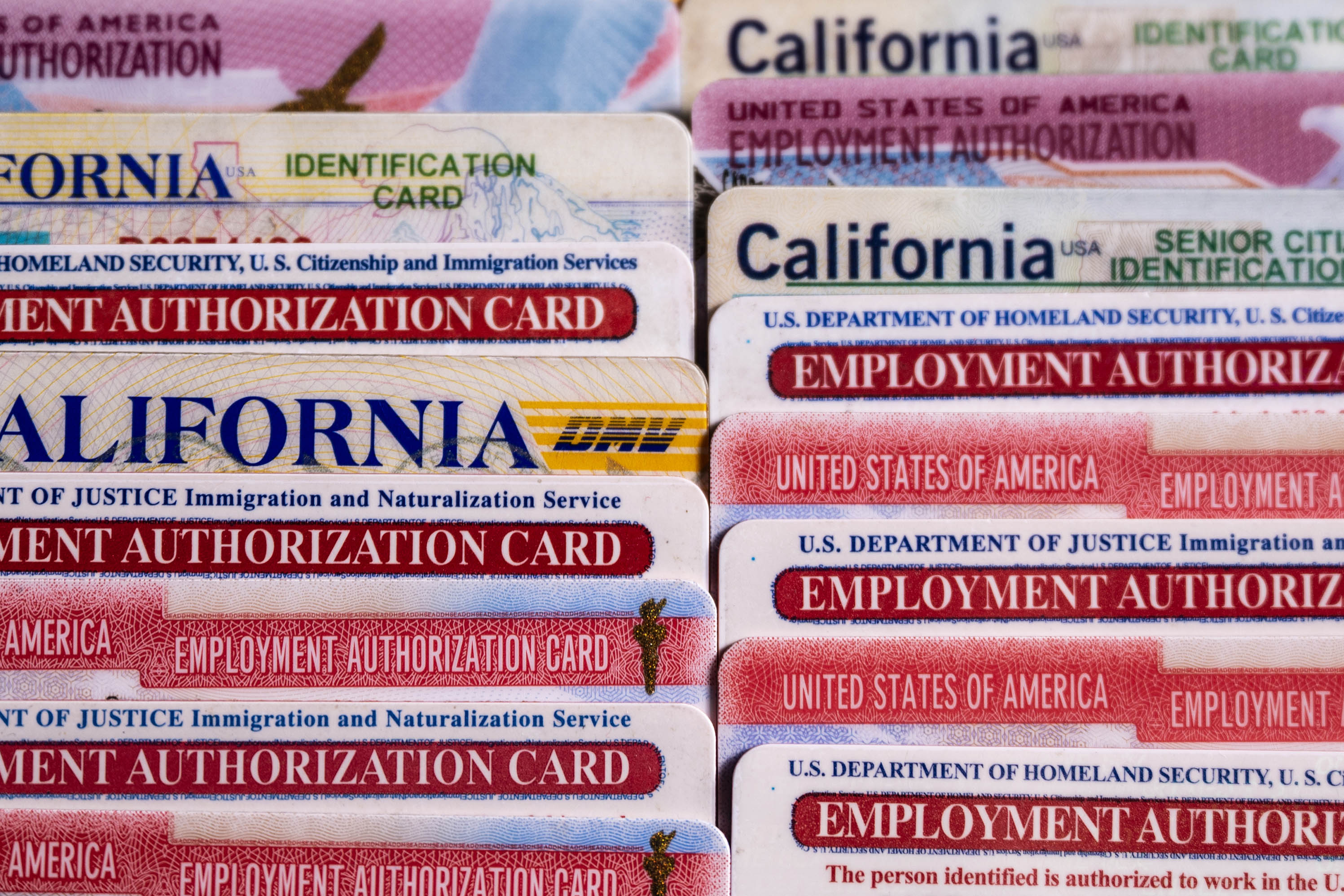
On a recent morning in her basement studio in Oakland, Carranza pulled a box from the back of her closet. In it was a thick stack of identification cards that included old driver’s licenses, her Social Security card, and dozens of work IDs issued by the federal government.
“My life is in that box,” she said.
This article was produced in collaboration with El Tímpano, a civic media organization serving and covering the Bay Area’s Latino and Mayan immigrant communities.
