

How many people are uninsured?
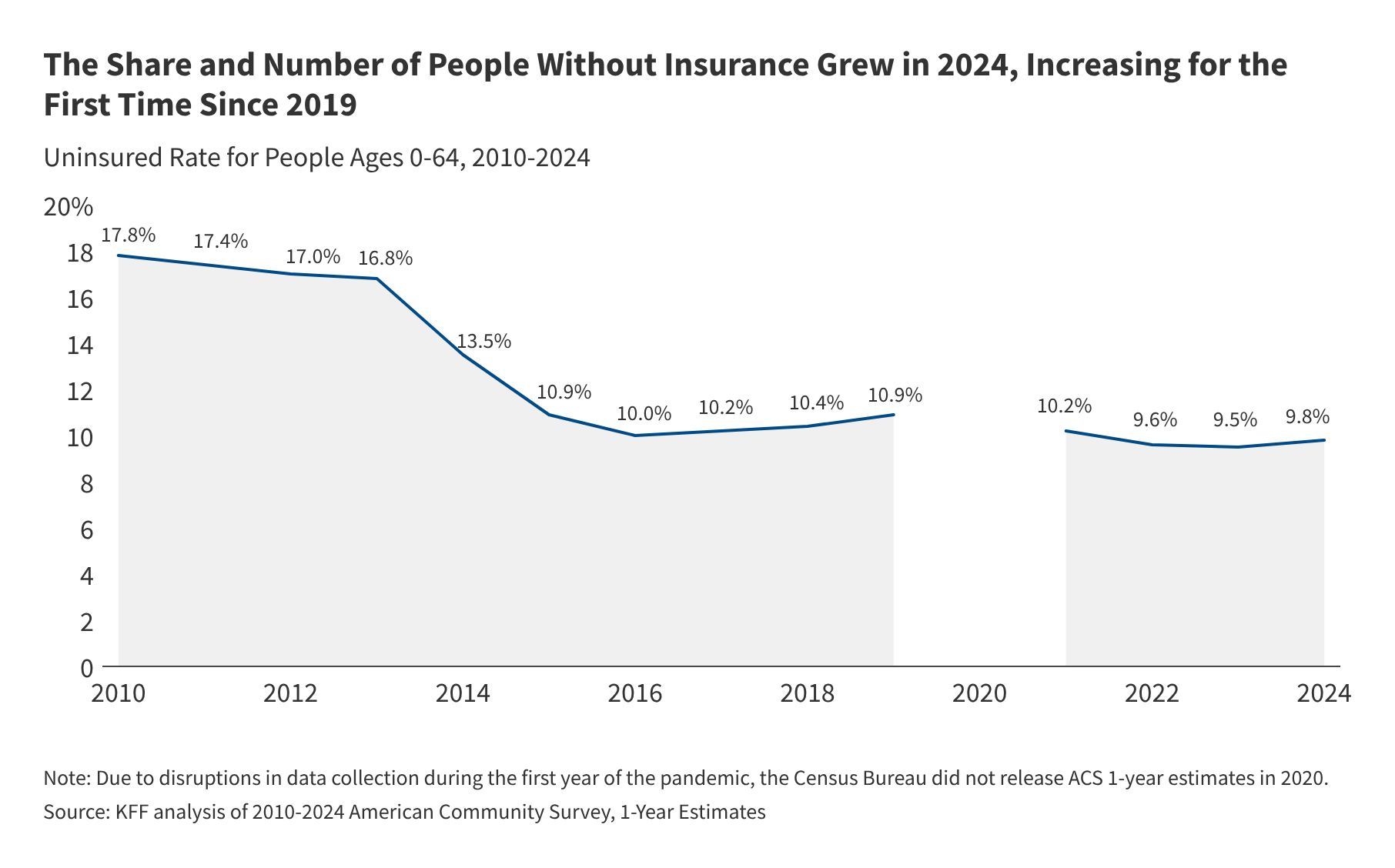
For the first time since 2019, the number of people without health coverage and the uninsured rate increased in 2024. The total number of people ages 0-64 without health coverage increased by more than 1.3 million to 26.7 million in 2024, and the uninsured rate for the population under age 65 increased from 9.5% to 9.8%.
A decline in Medicaid coverage drove the increase in the uninsured rate in 2024. While non-group coverage, including ACA Marketplace coverage, increased from 2023 to 2024, the increase did not fully offset the drop in Medicaid coverage from 2023 to 2024 among both adults and children.
Who is uninsured?
In 2024, over eight in ten people who are uninsured were in low-income families (80.1%) and had at least one worker in the family (85.1%), and over six in ten were people of color (63.7%). Reflecting the more limited availability of public coverage in some states, adults ages 19-64 are more likely to be uninsured than children (11.3% vs. 5.9%). Despite coverage gains across groups over time, American Indian or Alaska Native, Hispanic, Black, and Native Hawaiian or Pacific Islander people were more likely to be uninsured than White and Asian people.
A disproportionate share of uninsured individuals under age 65 (42%) live in the ten states that have not expanded Medicaid. Individuals living in non-expansion states are nearly twice as likely as those in expansion states to be uninsured; the uninsured rate in non-expansion states was 14.5% compared to 8.0% in expansion states.
Why are people uninsured?
The high cost of insurance is the main reason many people are uninsured. In 2024, 61.7% of uninsured adults ages 18-64 said they were uninsured because coverage is not affordable. Many uninsured people do not have access to coverage through a job, and some people, particularly poor adults in states that have not expanded Medicaid, remain ineligible for public coverage. Among uninsured adults who were working, 71% were not offered or were not eligible for coverage from their employer in 2024.
About half (52.2%) of people who are uninsured may be eligible for Medicaid or subsidized coverage in the Marketplace. However, they may not be aware of these coverage options or may face barriers to enrolling. In addition, with the expiration of the enhanced premium tax credits, Marketplace coverage has gotten more expensive and may be unaffordable for some.
How does not having coverage affect health care access?
People without insurance coverage are less likely to access care and more likely to delay or forgo care because of costs. In 2024, nearly four in ten uninsured adults (38.6%) reported delaying, skipping, or not getting needed care or medication due to cost, more than twice the share of adults with private coverage (17.0%) and those with public coverage (18.8%). Among adults with chronic health conditions who need ongoing medical management, those without insurance coverage were three to four times more likely to delay or forgo needed medical care due to cost than adults with the same condition who were insured. Research demonstrates that gaining health insurance, particularly through Medicaid, improves access to care, utilization of services, and reduces mortality.
What are the financial implications of being uninsured?
Uninsured adults are nearly twice as likely as insured adults to have difficulty paying health care costs. Nearly six in ten (59%) uninsured adults said they or someone living with them had problems paying for health care compared to 30% of insured adults. People who are uninsured are also more likely to experience measures of financial distress, including overdrawing their checking account, having been contacted by a debt collection agency, and having used pay day loans.
Unaffordable medical bills can lead to medical debt, particularly for uninsured adults. More than six in ten (62%) uninsured adults reported having health care debt compared to over four in ten (44%) insured adults. Uninsured adults are more likely to face negative consequences due to health care debt, such as using up savings, having difficulty paying other living expenses, or borrowing money.
