

The U.S. car business is grappling with a stubborn affordability problem, one that threatens to relegate more Americans to the used-car lot and leave automakers vulnerable to lower-priced rivals.
Lawmakers have framed the issue around partisan lines. U.S. President Donald Trump and other Republicans blame environmental and safety regulations. Democrats blame Trump’s tariffs.
But a Reuters review of industry sales data found a more market-based reason: Automakers are offering relatively few budget models, while they’ve filled showrooms with bigger, more upscale models, raising the selling price of the average U.S. vehicle to around $47,000. The trend toward fancier vehicles on the new-car lot is a stark example of the so-called K-shaped U.S. economy: More affluent consumers are driving a larger share of spending, while middle- and lower-income people struggle.
The result: the American car-buying public has shifted decidedly more affluent, while a swath of lower- and middle-class consumers have been relegated to the used-car lot.
The narrow selection of reasonably priced choices has been frustrating for Delaware resident Sarah Merriman. She is nearing the end of her lease on a Ford Mustang Mach-E electric SUV, and struggling to find affordable options to replace it.
“I’m stressing out, because I’m already in a $700 car payment right now,” Merriman said.
The affordability issue presents a “tremendous vulnerability” for traditional carmakers if Chinese brands were to someday enter the U.S. market, said John Casesa, senior managing director at Guggenheim Partners and a former Ford Motor executive.
“It’s a risk that they underserve less affluent consumers, and new entrants come in and steal that business,” he said.
‘We’re Buying More Loaded Vehicles’
Affordability has become a fixation for Trump and some lawmakers ahead of the country’s midterm congressional elections. In December, Trump administration officials cited the need to lower vehicle prices as a rationale for weakening fuel-economy standards.
Inside the car business, the affordability debate centers on the so-called average transaction price, or an average that individual buyers spend to purchase vehicles across all new models. That figure rose 40% from December 2018 through December of last year, to about $47,000, research from J.D. Power shows.
“We’re buying more expensive vehicles. We’re buying more trucks and SUVs. We’re buying more loaded vehicles,” said Tyson Jominy, a senior vice president at J.D. Power.
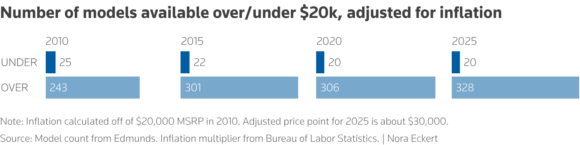
In 2010, 96 models sold at a sticker price at or above the relatively lofty $40,000 mark, according to data from shopping site Edmunds. The availability of models at that price point, even adjusted for inflation, has proliferated since then. Last year, there were 156 models offered at that level, or roughly $60,000.
Meanwhile, budget models remain scarce. In 2010, there were 25 models priced at around $20,000 or less. By last year, there were only 20 models available at that equivalent price today, or roughly $30,000.
The result is a dramatic shift in the income demographics of the car-buying public.
The share of U.S. new-vehicle purchases from households earning $100,000 or less held steady at between 50% to 60% for several years until early this decade, according to vehicle-registration data from S&P Global Mobility. Last year, those $100,000-or-less earners accounted for 36% of new vehicle sales.
“It’s truly a K economy for us,” said Brad Sowers, a car dealer in the St. Louis area who has General Motors GM.N, Jeep-maker Stellantis and Kia dealerships.
Nicer Cars, Bigger Profits
The trend has helped automakers generate larger profits despite lower vehicle sales in recent years. Over the years, the traditional Detroit carmakers – GM, Ford and Stellantis – phased out many smaller, entry-level U.S. models in favor of more trucks and SUVs.
Many of those discontinued car lines had lower profit margins. Meanwhile, core profit margins on large SUVs and pickup trucks can exceed 20%, former auto executives say. In 2024, for example, GM made an operating profit of about $4,200 per vehicle sold in North America, up from the $3,000 in 2018.
GM executives have touted their commitment to affordability, and point to several small SUVs that it sells as popular entry-level offerings, including the Chevrolet Trax and Buick Envista small SUVs.
“We’ve been able to create a portfolio where we can make money top to bottom,” GM CFO Paul Jacobson said at an event last month.
In February, Ford said it will have five models under $40,000 available by the end of the decade, including at least one electric model priced around $30,000.
Stellantis’ Jeep brand, the iconic off-road and SUV name, highlights the broader trend to more upscale vehicles. A decade ago, Jeep’s U.S. lineup of about a half-dozen nameplates ranged in starting price from around $17,000 to $30,000.
Today, starting prices on Jeep’s U.S. vehicles range from about $30,000 to $65,000 for the upscale Grand Wagoneer, which can run to more than $100,000. The surge in Jeep pricing coincided with healthier profits but a steep drop in U.S. market share.
Stellantis CEO Antonio Filosa, who took over last year, has said he is making affordability a priority to win back customers. Jeep made add-ons like LED lighting and heated steering wheels complimentary or less expensive, a move that in combination with broader price cuts is adding up to $4,000 in value on certain models, the company said.
“I need to unlock some of the things that you love about Jeep, make them more affordable,” Jeep brand CEO Bob Broderdorf told Reuters in December.
