

Gun violence affects many children and adolescents across the U.S. In response to growing gun violence – including school shootings – federal firearm policies and awareness of the physical and mental harm associated with gun violence have increased. However, during the second Trump Administration, some of these policies are being rolled back, including broadening access to mental health and trauma services in schools.
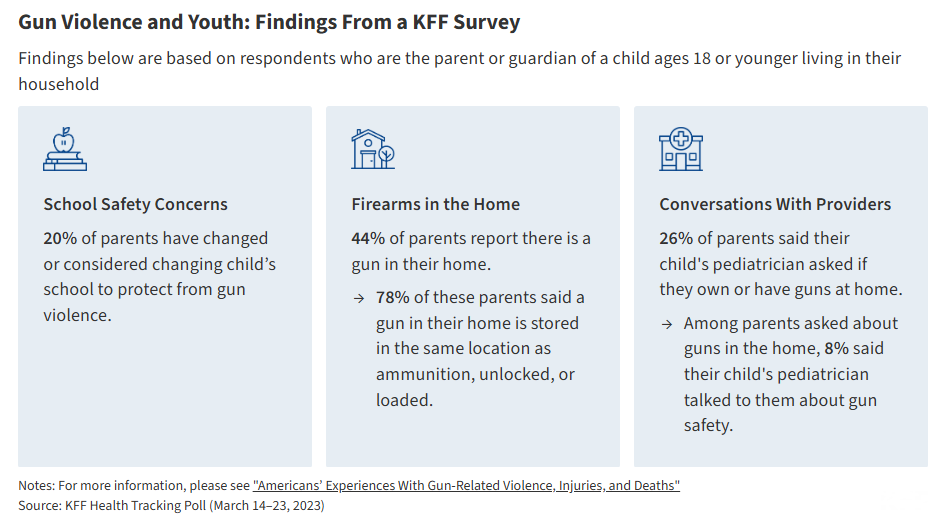
Over the past decade, nearly 22,000 youth ages 17 and younger died by firearm.1 For every firearm fatality, there are at least two survivors of firearm injuries. Additionally, a growing body of research links gun violence exposure – both direct and indirect – to adverse impacts on the mental health and well-being of youth. This suggests that many youths across the U.S. have experienced some form of gun violence and subsequent mental health impacts. Although the number impacted cannot be quantified due to data limitations, findings from a KFF survey provide insight on the extent of youth exposure to guns and gun violence in the U.S. For example, 20% of parents reported that they have changed or considered changing their child’s school to protect them from gun violence; and 44% of parents have a gun in the home and many of these parents have at least one gun that is not safely stored (Figure 1).
Figure 1
This brief explores the different ways in which youth gun violence occurs, disparities among youth, and how exposure is linked to negative impacts on mental health and well-being.
What is known about nonfatal firearm injury exposure among children and adolescents?
The number of nonfatal firearm injuries far exceeds the number of firearm fatalities among children and adolescents. However, estimates vary, with research suggesting nonfatal firearm injuries occur anywhere from two to four times more often than firearm fatalities. After the COVID-19 pandemic began, nonfatal firearm injuries among children and adolescents increased. The majority of youth nonfatal firearm injuries are a result of assaults.
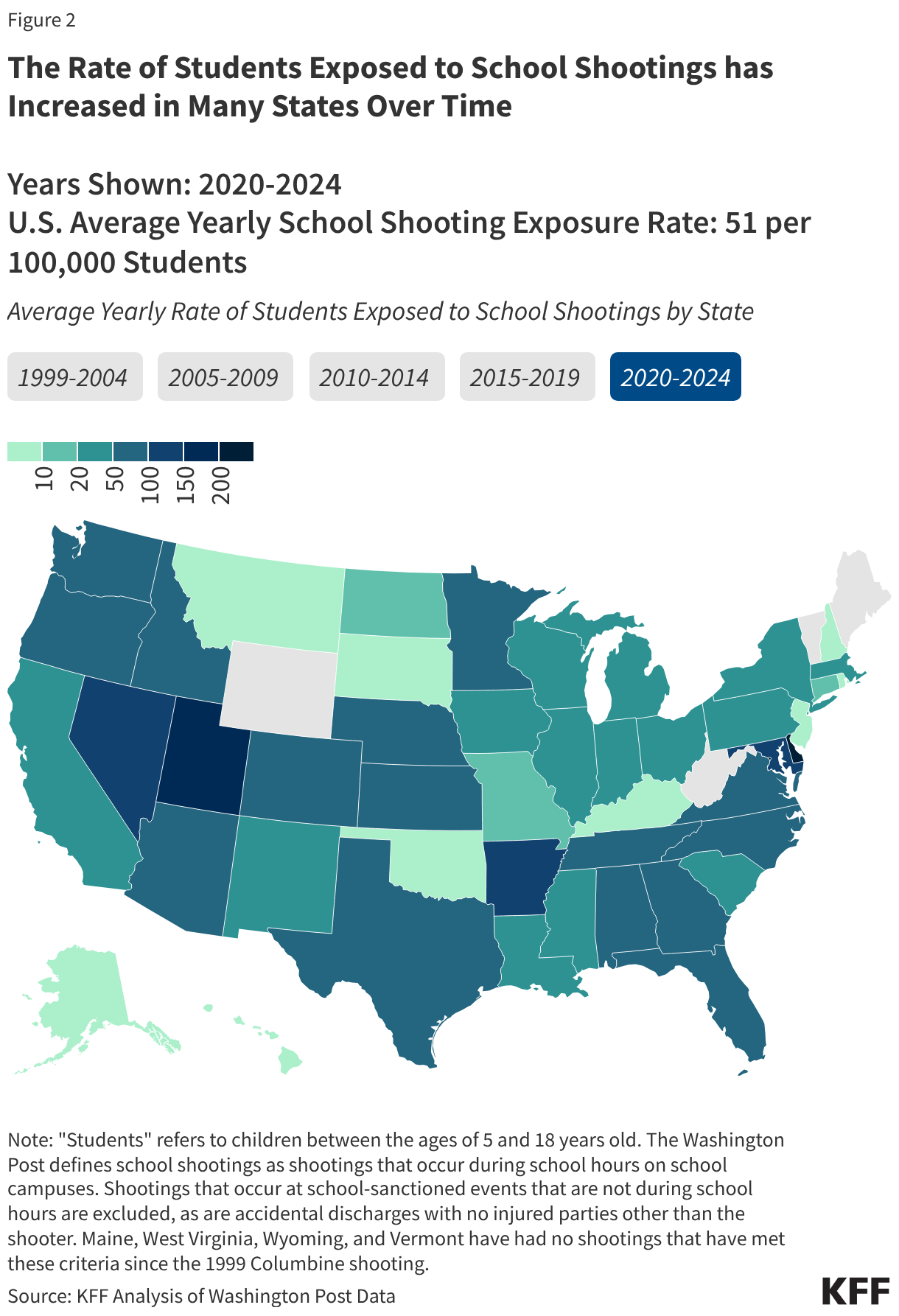
Many children and adolescents are exposed to gun violence, even if they are not directly injured. Data on exposure to gun violence among youth is generally limited. However, a KFF analysis found that 51 per 100,000 U.S. school-age children were exposed to a school shooting from 2020-2024. Additionally, a CDC analysis found that in 34% of unintentional child and adolescent firearm deaths, at least one other child was present during the incident. Prior data from the National Survey of Children’s Exposure to Violence found that 8% of children and adolescents were exposed to a shooting in their lifetime, with a higher share (13%) reported among adolescents (ages 14-17). Further, 17% of adults in the U.S. reported witnessing someone being injured by a gun, based on a KFF poll.
Black children and adolescents are more likely to experience firearm injuries and exposures than their White peers. Black and male children and adolescents are more likely to experience nonfatal firearm injuries than their peers – a disparity that grew alongside the pandemic. In general, children of color are more often exposed to gun violence than their White peers. Children living in areas with a high concentration of poverty are more likely to experience firearm-related deaths, and poverty disproportionately affects children of color.
How does gun violence affect the mental health and well-being of children and adolescents?
Gun violence can adversely affect the mental health and well-being of children and adolescents. Exposure to gun violence is linked to post-traumatic stress disorder and anxiety, in addition to other mental health concerns among youth. Gun violence may also lead to challenges with school performance, including increased absenteeism and difficulty concentrating. In response to indirect gun violence, such as witnessing a shooting or hearing gunshots, many children and adolescents report feeling sad, anxious, or fearful. Children and adolescents are exposed to gun violence in multiple ways, outlined below.
- Neighborhood and community violence. Many children and adolescents experience violence within their communities. Firearm homicides occurring within an adolescent’s community have been linked to anxiety and depression among adolescents, particularly for females. Other analyses have similarly found an association between incidents of neighborhood firearm homicides and poor mental health outcomes among youth.
- Suicide. Suicides are the second leading cause of death among adolescents and many suicides involve a firearm. Research has found that access to firearms, particularly in the home, is a risk factor for suicide deaths among children and adolescents. Nearly half of suicide attempts occur within 10 minutes of the current suicide thought, further underscoring access to firearms as a risk factor for suicide.
- Domestic or intimate partner violence. Women and children are often the victims of intimate partner violence, which may involve firearms. The presence of a firearm in the home is linked to the escalation of intimate partner violence to homicides. Even when firearms are not used, they may serve as a means of threatening and intimidating victims of domestic violence.
- Mass shootings. Although mass shootings, including school shootings, account for a small portion of firearm-related deaths, they can negatively impact the mental health of children and communities at large. Youth antidepressant use and suicide risk may increase in communities with exposures to school shootings. Survey data showed that the majority of teenagers and their parents felt at least somewhat worried that a school shooting may occur at their school. School shootings are on the rise, with the U.S. average yearly rate of student exposure to a school shooting increasing threefold over time (from 19 per 100,000 students in 1999-2004 to 51 in 2020-2024, Figure 2). In response to school shootings, nearly all schools practice active shooter drills, which may have a negative psychological impact on participants. Although research is limited on how mass shootings affect individuals not directly exposed to them, current literature suggests that information and knowledge of mass shootings may be linked to increased levels of fear and anxiety.
Youth survivors of firearm injuries are at increased risk of mental health and substance use issues, in addition to chronic physical health conditions. An analysis of commercially insured children and adolescents found that, in the year following a firearm injury, survivors were significantly more likely to experience psychiatric and substance use disorders compared to their peers. Increases in psychiatric disorders were more pronounced among youth with more severe firearm injuries compared to youth with less severe firearm injuries. Youth gunshot survivors are more likely to utilize mental health services following their injury compared to their uninjured peers. However, a study of youth survivors enrolled in Medicaid found that more than three out of five survivors had not received mental health services within the first six months following their injury.
Negative mental health impacts can extend to the family members of youth gun violence victims and to the children of parents with firearm injury. Parents, particularly mothers, of youth firearm-injury survivors had an increase in psychiatric disorders and mental health visits in the year following a firearm incident, based on an analysis of commercially insured individuals. These increases in psychiatric disorders and mental health visits were more pronounced among families of youth firearm fatalities.
