

Introduction
The Temporary Protected Status (TPS) program was established in 1990 and allows the Secretary of Homeland Security to designate a country for TPS if there is an ongoing armed conflict, environmental disaster, epidemic, or other conditions that may “temporarily prevent the country’s nationals from returning safely.” Eligible individuals from TPS designated countries can receive TPS, which protects them from deportation and allows them to work in the U.S. for temporary, extendable periods.
The Trump administration has carried out numerous immigration policy changes focused on increasing immigration enforcement and reducing immigration into the country, including seeking to end TPS designations for many countries. Further, under the 2025 reconciliation law, TPS holders will lose access to subsidized ACA Marketplace coverage starting January 1, 2027, and Medicare starting no later than January 4, 2027, while they already are ineligible for Medicaid and the Children’s Health Insurance Program (CHIP). This brief provides an overview of the TPS program, recent changes to TPS designations announced by the Trump administration, and potential implications of loss of TPS for individuals on health and health care. It includes KFF analysis of Congressional Research Service reports to assess changes in the number of individuals and countries with TPS designations over time and of 2024 American Community Survey (ACS) data to estimate the number of noncitizen immigrant workers likely to have TPS, who could be impacted by the elimination of TPS designations.
According to federal data, as of March 2025 (the latest data available), nearly 1.3 million individuals from 17 countries had TPS. As of March 2026, the Trump administration has ended or attempted to end TPS designations for 13 of 17 countries with active TPS designations at the time he took office, which could impact over one million TPS holders. However, implementation of some of these changes is subject to ongoing litigation. Individuals who lose TPS lose their work authorization and become at risk for deportation, which may negatively impact their health and access to health coverage and care. Moreover, termination of TPS designations could negatively impact the U.S. economy and workforce by putting hundreds of thousands of immigrant workers at risk of deportation. Immigrants likely to have TPS from 16 of the 17 countries for which data are available made up about 740,000 workers ages 18 and older in the U.S. as of 2024, including about 53,000 workers in the health care industry.
Overview of the TPS Program
The TPS program was established under the Immigration Act of 1990 to allow eligible immigrants from designated countries to live and work in the U.S. The program is administered by U.S. Citizenship and Immigration Services (USCIS) within the Department of Homeland Security (DHS). DHS has the authority to designate a country for TPS for periods of 6 to 18 months and can extend these periods if conditions in the country continue to prevent its nationals from returning safely, such as due to armed conflict or environmental disasters. TPS provides immigrants with employment authorization and protection from deportation but it does not provide a pathway to citizenship. A TPS holder can only obtain permanent status by separately qualifying for another immigration status, such as lawful permanent residence through a family-based or employment-based visa petition.
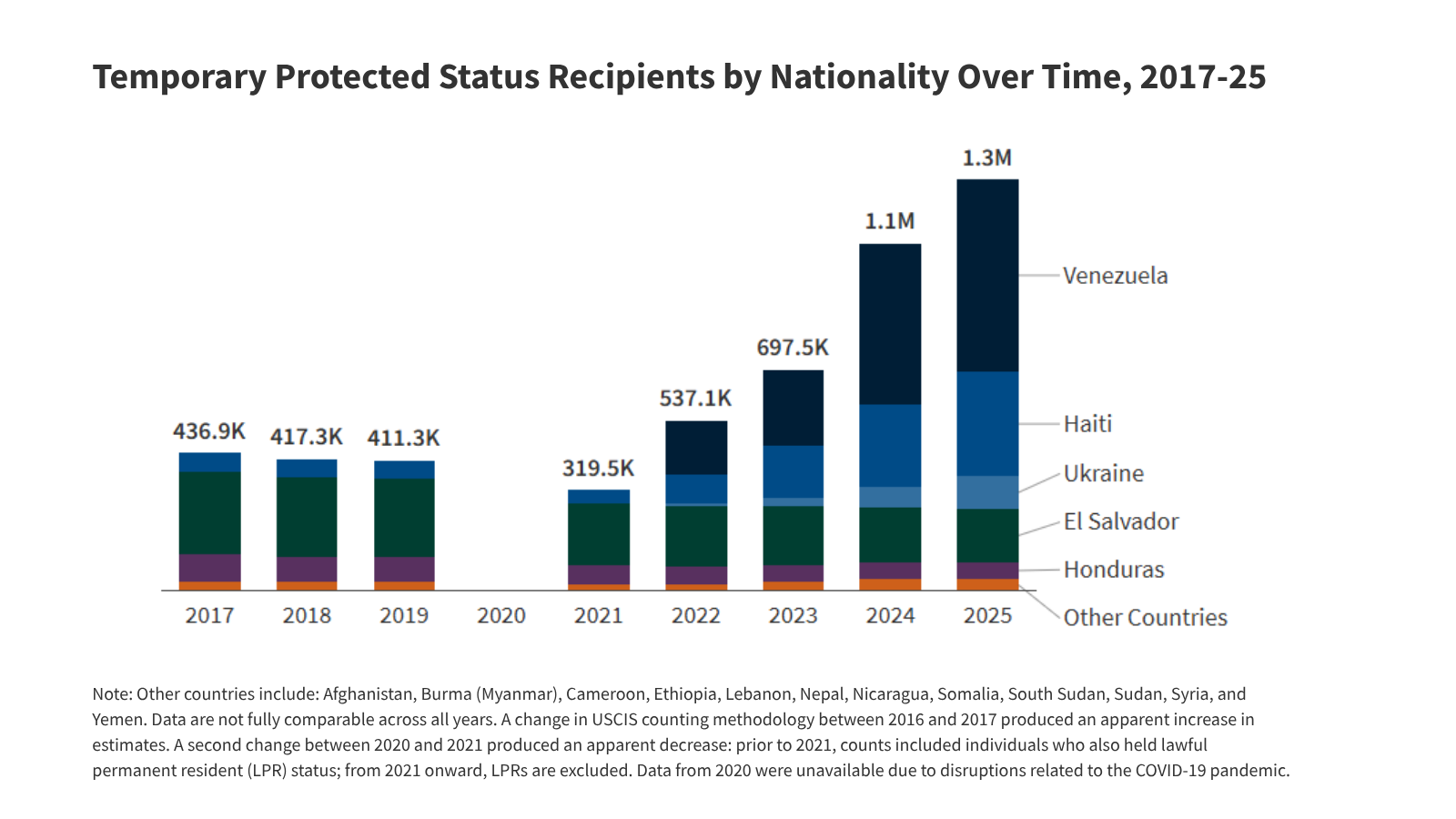
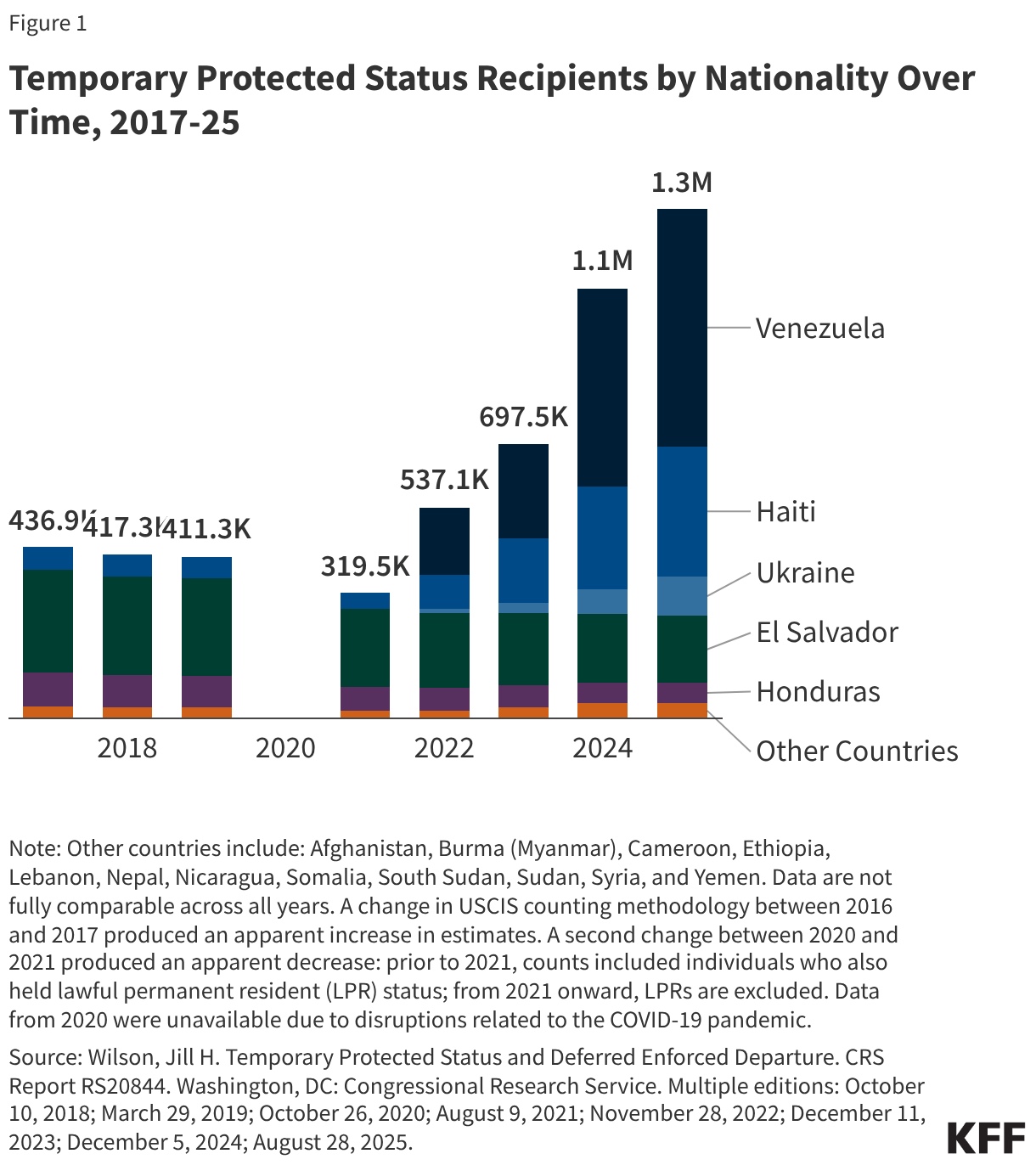
As of March 2025, close to 1.3 million noncitizen immigrants from 17 countries had TPS with five countries, Venezuela, Haiti, El Salvador, Ukraine, and Honduras, accounting for approximately 97% of all recipients. The remaining 12 countries include over 39,000 individuals with TPS. The number of people with TPS has grown in recent years, from under 500,000 in 2017 to about 1.3 million in 2025, driven by new country designations, particularly for Venezuela and Ukraine, as well as redesignations for countries like Haiti that continue to face ongoing humanitarian crises (Figure 1).
Recent Changes to TPS Designations
The Trump administration has ended or attempted to end TPS designations for 13 of 17 countries that had designations when he took office, which could impact about one million TPS holders, but implementation is subject to ongoing litigation (Appendix Table 1). As of March 31, 2026, termination of TPS designations for Afghanistan, Cameroon, Honduras, Nepal, Nicaragua, and certain Venezuelan TPS holders had already taken effect, impacting close to 320,000 TPS holders from these countries. Termination of TPS designation for Yemen is expected to take effect in May 2026, and termination of TPS designation as well as work authorization for remaining Venezuelan TPS holders is expected to take effect in October 2026, which could impact over 350,000 immigrants from these countries. Further, the Trump administration has taken steps to end TPS designations for Burma (Myanmar), Ethiopia, Haiti, Somalia, South Sudan, and Syria, but these terminations were on hold as of March 31, 2026, due to court challenges. If allowed to proceed, these terminations could lead to an additional 330,000 immigrants losing TPS status.
Potential Implications of Loss of TPS
Individuals who lose TPS lose their work authorization and become at risk of deportation, which may negatively impact their access to health coverage and care. The Trump administration’s attempts to end TPS designations for 13 of 17 countries put a vast majority of TPS holders at risk of losing their status and becoming subject to deportation as well as losing access to health coverage. As of 2026, TPS holders are eligible for subsidized ACA and Medicare coverage if they meet other program eligibility requirements. They are not eligible for Medicaid and CHIP. TPS holders who lose their status would become undocumented and lose access to any federally funded coverage. Under longstanding policy, undocumented immigrants are ineligible for all forms of federally funded health coverage including Medicaid, CHIP, Medicare, and coverage through the ACA Marketplace. Further, loss of TPS would result in immigrants losing their work authorization, leading to employment loss and, consequently, potential loss of access to employer-sponsored health coverage. At the same time, lost income due to job loss may make it difficult for impacted immigrants to afford health care. Based on KFF analysis of ACS data, as of 2024, over four in ten (44%) of likely TPS workers 18 and older from 16 of 17 countries with active TPS designations at the time had employer-sponsored health coverage compared to 45% of other noncitizen workers and 70% of U.S. citizen workers 18 and older.
Loss of TPS may also negatively affect people’s health by increasing their immigration-related worries and making them more reluctant to access health care. People losing TPS status become undocumented, putting them at risk for deportation and likely increasing their immigration-related worries. Data from the 2025 KFF Survey of Immigrants show that over three in four (77%) of likely undocumented immigrants say they have experienced negative health impacts due to immigration-related worries since January 2025, and about half (48%) say that they have avoided seeking medical care since January 2025 due to immigration-related concerns.
Termination of TPS designations may also have negative impacts on the U.S. workforce, which included about 740,000 likely TPS workers overall as of 2024. KFF analysis of ACS data show that, as of 2024, noncitizen immigrants likely to have TPS from 16 of the 17 countries with active designations at the time made up about 740,000 workers in the U.S., including about 53,000 health care workers. These include noncitizen immigrants ages 18 and older who were born in a country with an active TPS designation as of December 2024 and whose year of entry in the U.S. is on or before the most recent continuous residence requirement for their country as specified by USCIS (see methods for more details). Data for immigrants from South Sudan were not available separately in ACS. Among noncitizen immigrants ages 18 and older likely to have TPS from the 16 countries with data available, about three in four (74%) report being employed compared to about two-thirds (67%) of other noncitizen immigrants and about six in ten (62%) U.S. citizens ages 18 and older.
Methods
This analysis is based on KFF analysis of the 2024 American Community Survey (ACS) 1-year Public Use Microdata Sample. Individuals likely to have TPS were identified in ACS as those who report being noncitizen immigrants, were born in a country with an active TPS designation as of December 2024 for which data are available namely, Afghanistan, Burma (Myanmar), Cameroon, El Salvador, Ethiopia, Haiti, Honduras, Lebanon, Nepal, Nicaragua, Somalia, Sudan, Syria, Ukraine, Venezuela, or Yemen (country of birth data for South Sudan is not available separately in ACS); arrived in the U.S. on or before the year of the most recent continuous residence requirement for their country as specified by USCIS; do not receive Medicaid, Supplemental Nutrition Assistance Program (SNAP), or Social Security; and do not work for the U.S. government or military since TPS holders are excluded from these benefits and are generally excluded from government and military service. Workers were further identified as those ages 18 and older who report being employed and currently at work in the U.S. civilian labor force and health care workers were identified as a subset of all workers who worked in the health care industry (industry codes 7970 through 8290).
Appendix
| Table 1 | ||||
| Country | Initial Designation | Latest Designation | Status as of March 2026 | Number of TPS Holders as of March 2025 |
| Afghanistan | 5/20/2022 | 11/21/2023 | Terminated effective 7/14/2025 | 8,105 |
| Burma (Myanmar) | 5/25/2021 | 5/26/2024 | Terminated effective 1/26/2026, but restored subject to court order | 3,670 |
| Cameroon | 6/7/2022 | 12/8/2023 | Terminated effective 8/4/2025 | 4,920 |
| El Salvador | 3/9/2001 | Active | 170,125 | |
| Ethiopia | 12/12/2022 | 7/13/2024 | Terminated effective 2/13/2026, but restored subject to court order | 4,540 |
| Haiti | 1/21/2010 | 8/4/2024 | Terminated effective 2/3/2026, but restored subject to court order | 330,735 |
| Honduras | 1/5/1999 | Terminated effective 9/8/2025 | 51,225 | |
| Lebanon | 11/27/2024 | Active | 140 | |
| Nepal | 6/24/2015 | Terminated effective 8/20/2025 | 7,160 | |
| Nicaragua | 1/5/1999 | Terminated effective 9/8/2025 | 2,910 | |
| Somalia | 9/16/1991 | 9/18/2024 | Terminated effective 3/17/2026, but restored subject to court order | 705 |
| South Sudan | 11/3/2011 | 11/4/2023 | Terminated effective 1/5/2026, but restored subject to court order | 210 |
| Sudan | 11/4/1997 | 10/20/2023 | Active | 1,790 |
| Syria | 3/29/2012 | 4/1/2024 | Terminated effective 11/21/2025, but restored subject to court order | 3,860 |
| Ukraine | 4/19/2022 | 10/20/2023 | Active | 101,150 |
| Venezuela (2021 desig.) | 3/9/2021 |
Terminated effective 11/7/2025, small number of individual cases on hold pending court activity | 252,825 | |
| Venezuela (2023 desig.) | 9/20/2023 | Terminated effective 10/3/2025, with work authorization for some beneficiaries valid until 10/2/2026 subject to court order | 352,190 | |
| Yemen | 9/3/2015 | 9/4/2024 | Terminated effective 5/4/2026 | 1,380 |
| Note: Updates are current as of March 2026. | ||||
| Sources: U.S. Citizenship and Immigration Services, “Temporary Protected Status Designated Country” (last reviewed March 31, 2026). Number of TPS holders obtained from Congressional Research Service, “Temporary Protected Status and Deferred Enforced Departure” (August 28, 2025). | ||||
