

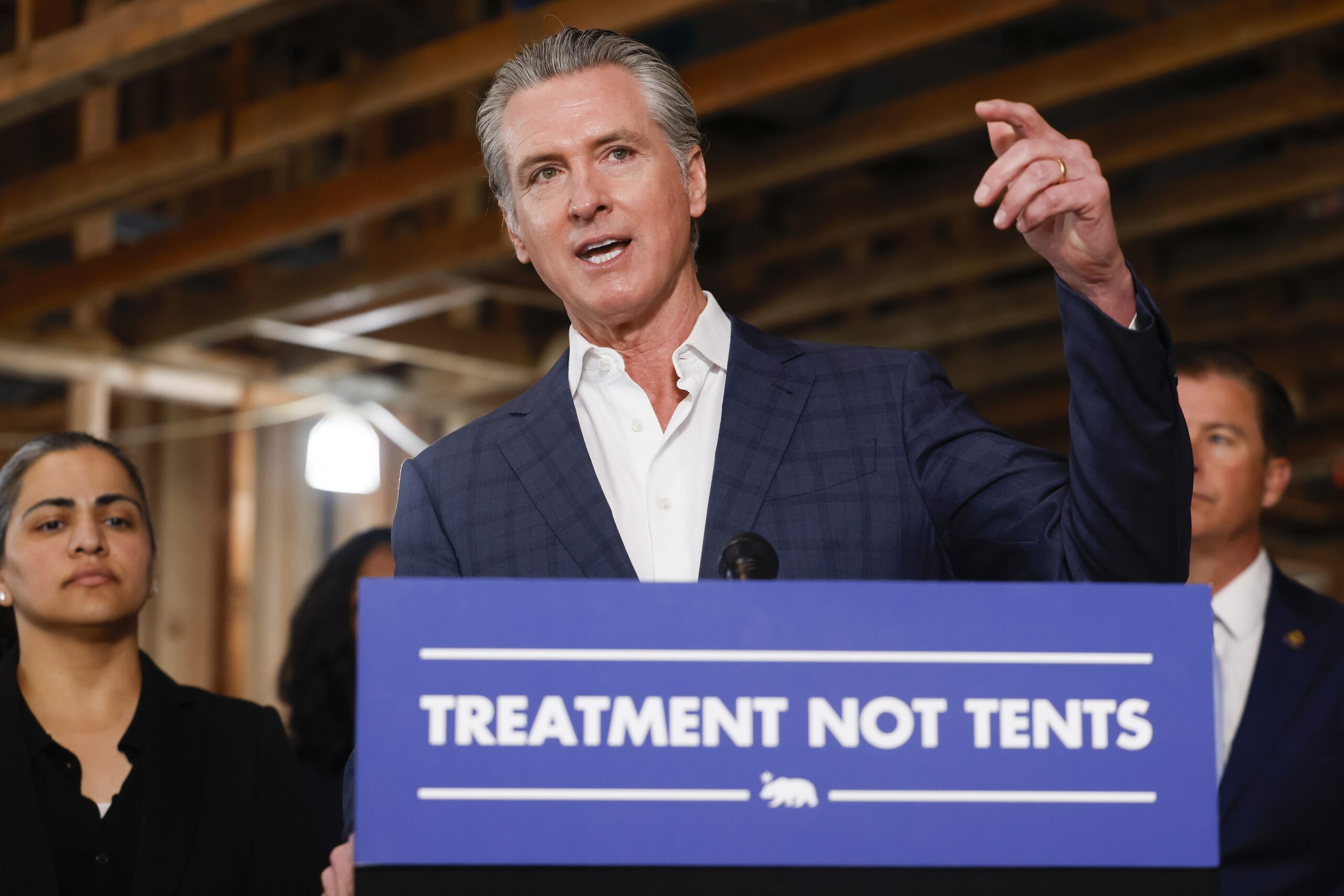
SACRAMENTO, Calif. — In his earliest days in the governor’s office, Democrat Gavin Newsom huddled with his advisers to consider how to realize a key campaign promise: transforming a healthcare system replete with insurance company intermediaries into the nation’s first state-run single-payer model providing comprehensive coverage to all residents, similar to those in Canada and Taiwan.
He’d need to secure tax increases to help cover the high cost of a single-payer system, once pegged at about $500 billion a year, and Republican President Donald Trump, then in his first term, would have to give California permission to use federal funding to convert the system of coverage from one determined by employment, age, or income.
Neither was politically feasible.
Instead, in the years that followed, Newsom muscled through a compassionate healthcare agenda that poured billions into new benefits, including Medi-Cal coverage for low-income immigrants without legal status and incarcerated people leaving jail or prison, as well as programs for people experiencing homelessness in America’s richest and most populous state. Medi-Cal, the state’s Medicaid program, now includes housing services, including six months of free rent for those in need, and home-delivered healthy meals for low-income Californians with chronic health conditions. He made it a priority to expand mental health and addiction treatment, especially for the tens of thousands living on the streets.
He also tackled the soaring cost of healthcare, including by offering bigger subsidies for low- and middle-income earners to purchase insurance and empowering a new state agency to slow the rise in healthcare spending. Years before TrumpRx, the president’s program to lower prices for some medicines for people without insurance, Newsom signed into law a policy setting up a state-branded generic prescription drug label known as CalRx to provide lower-price drugs. And amid a federal attack on reproductive rights, Newsom led efforts to safeguard abortion.
The liberal values that guided Newsom’s healthcare ambitions were forged early in his life and cultivated during his two terms as mayor of San Francisco. His approach in the governor’s office is described by allies as socially liberal and fiscally pragmatic. The policies he has supported offer a road map for the direction he would lead the nation, should he run for and be elected president in 2028. Now in his final term as governor, Newsom will be scrutinized for his healthcare record, criticized by liberals as too moderate and by Republicans as too radical.

Newsom, 58, is known for his all-out approach, a style that leads him to take on a barrage of flashy and complicated policy proposals at once, earning him a reputation in some political circles of overpromising and underdelivering. Newsom has notched some successes, but his record is also marked by failures. He hasn’t housed as many people as he envisioned — there are nearly 190,000 homeless people in California, according to the most recent federal estimates, more than when he became governor. Medicaid spending has more than doubled under his watch, drawing criticism from Republicans, and patients around the state are experiencing problems getting timely medical appointments and quality care.
Newsom’s closest allies argue that he has balanced efforts to make healthcare more equitable, accessible, and affordable. They argue his unmet policy goals are not failures but investments and long-term strategies to better serve poor and marginalized people while containing healthcare costs.
“We would talk about how you win by losing,” said Mark Ghaly, who served as Newsom’s health and human services secretary until 2024. “The governor isn’t afraid to fail. But by failing you learn about how to make it successful.”
Although voters in the Democratic stronghold of California have supported many of his ideas, residents have grown increasingly weary in their support. An early 2026 poll from the University of California-Berkeley Institute of Governmental Studies showed Newsom’s job approval slipping as he has focused on attacking Trump on the national stage.
Rising costs have become a top concern for voters across the political spectrum. Two-thirds of the public in January said they worried about being able to afford healthcare for themselves and their families, according to a KFF national survey. And a recent Gallup poll found roughly a third of adults in America have made at least one trade-off to afford healthcare, such as driving less, skipping meals, cutting utility use, rationing prescriptions, or borrowing money.
Despite the criticisms, Newsom’s extensive record on healthcare can give him an edge in a presidential primary contest, said Celinda Lake, a national Democratic strategist who specializes in healthcare polling. “Newsom has, by far, the most comprehensive and authentic agenda of any Democrat out there,” she said.
Universal Healthcare
Newsom has said that healthcare should be a basic human right, not a privilege. Though he backed away from single-payer, he remains steadfast in his support for a universal healthcare system that covers everybody, regardless of immigration status or ability to pay.
When he was mayor of San Francisco, in 2006, he signed into law Healthy San Francisco, a universal health program that extended care to all uninsured adults who had been unable to access coverage. The program, paid for through a combination of public funds, employer contributions, and a sliding fee scale for patients based on income, became immensely popular, extending care to 85% of adults who had been uninsured.
Newsom also waded into the national healthcare debate leading up to the enactment of the Affordable Care Act, pushing for a government-run insurance plan to compete with commercial health insurers. “Healthcare reform without a public option is not reform,” Newsom said in 2009.
In 2017, amid his two terms as lieutenant governor, Newsom had launched his run for governor and gained momentum by making healthcare a central pillar of his campaign. During the gubernatorial primary, he said healthcare “is the issue of our time.” He set himself apart by tacking left and earned a critical endorsement from the California Nurses Association, pledging to fight for single-payer.
“It’s time for a new approach,” Newsom said during his campaign. “I’m tired of politicians saying they support single-payer but that it’s too soon, too expensive, or someone else’s problem.”
On his first day in office, he signed a series of directives to explore the feasibility of single-payer, in part by seeking federal healthcare waivers that would be needed to fund a new system. He didn’t deliver, but advisers argued he mimicked some components of single-payer, including cost containment, comprehensive benefits, and universal coverage.
“He looks much more broadly at the healthcare system, and what it can do to help people,” said Newsom Deputy Cabinet Secretary Richard Figueroa. “There is also a role for the government to play in cost containment. The governor has been trying to set up some fundamental changes to move toward a more accountable healthcare system.”
The nurses union, however, blasted Newsom for backtracking, arguing he kept the profit-driven insurance system intact and failed to deliver a critical healthcare promise.
Jasmine Ruddy, a lead organizer for the California Nurses Association, said Newsom pulled a bait and switch on Californians, purposely mixing up universal healthcare with single-payer. She pointed to a report commissioned by the Newsom administration that found single-payer could increase taxes but, in one scenario, would save an estimated $16 billion the first year in state healthcare costs.
“Covering everyone is important, but Newsom is supporting a system that still has insurance premiums, deductibles, and copays,” Ruddy said. “And you can still wind up with an enormous hospital bill and medical debt. That is not the same as guaranteeing healthcare for all.”
The pressure is already building for Newsom to get behind single-payer — at home and nationally. Ruddy said, “If he runs for president as a progressive, he has no choice but to support Medicare for all.”
A Behavioral Health Crisis
Newsom has taken an ambitious approach to homelessness, framing it as a public health crisis fueled by a lack of affordable housing and inadequate mental health and addiction care. Arguing that the state had ignored the problem for too long, he took ownership of the challenge by increasing temporary funding for cities and counties to move people off the streets and into housing. At the same time, he called for a statewide push to dislodge homeless encampments.
Although his policies rankled homeless advocates by sweeping people from their encampments without providing enough services or housing, Newsom considers it his highest calling. “The junction of mental illness, drug addiction, and homelessness was why I had even pursued a life in politics in the first place,” he wrote in his memoir, Young Man in a Hurry, published in February.
Since Newsom took office in 2019, California has doled out an unprecedented $37 billion for homelessness and housing-related programs.
His interest in mental health and addiction, he said, stems from personal experience, and seeing that it touches so many Californians. “It’s not just about what’s happening on the streets and sidewalks; it’s what’s happening behind closed doors as well,” Newsom said in response to a question from KFF Health News in March. He referenced his grandfather, saying, “He ultimately took his life, committed suicide.”
In his memoir, Newsom alludes to those family issues. He also references his drinking as mayor of San Francisco, a time when his political celebrity was rising and he had an affair with the wife of his campaign manager. Although he never went to traditional rehab, he said he stopped drinking until a family friend who operated a rehabilitation center gave him permission to drink again. For all his investments in the healthcare safety net, Newsom’s critics say his policies have weakened access to basic care and failed to solve homelessness.
“Despite all that spending, there are still so many people who can’t even get in to see a doctor, and who might be covered on paper but aren’t able to actually get the care they need,” said Rep. Kevin Kiley, a Republican-turned-independent who is running in a newly drawn House seat and served in the Democratic-controlled state legislature earlier in Newsom’s tenure as governor. “Billions of dollars have gone to immigrants, when our own citizens haven’t had access to healthcare.”
Assembly member David Tangipa, a Fresno Republican, said Newsom is bankrupting the state, referring to ballooning costs in Medi-Cal, which have grown from $100.7 billion in 2019 to $222.4 billion for the fiscal year starting July 1. “It’s baffling to see this governor attacking the president, when we have our own problems: Doctors are leaving this state, and we have hospitals on the verge of collapse,” he said.
Newsom’s healthcare record could be a political liability. “Single-payer is a perfect example of Gavin Newsom — that when things get tough, he cuts and runs,” said Lanhee Chen, a health policy fellow at the conservative-leaning Hoover Institution.
Now in his final full year in office, Newsom is confronting massive fiscal challenges.
Recent state financial deficits, worsened by the healthcare cuts in congressional Republicans’ One Big Beautiful Bill Act, have forced Newsom to partially backtrack on his expansion, particularly of Medi-Cal. This year, he froze new enrollments for adult immigrants living in the country without authorization.
Yet he is still framing his healthcare record as one of success. In an interview with Axios, Newsom proclaimed that he had achieved universal healthcare. “We delivered it,” he said.
But California does not have universal healthcare. Before passage of the One Big Beautiful Bill Act, estimates showed nearly 2.6 million Californians were uninsured, including people who chose to forgo coverage and immigrants without legal status who earned too much money to be eligible for Medi-Cal.
Projections in 2025 showed that 6% of Californians remained uninsured, lower than the roughly 8% when Newsom took office. Yet the number of uninsured residents is expected to climb as a result of Trump administration healthcare policies. Estimates show the GOP bill will cost the state an estimated $30 billion over the next 10 years and result in up to 3.4 million Californians losing coverage.
Even so, Newsom has been reluctant to raise taxes. He opposes one to backfill federal healthcare funding losses through a one-time 5% levy on the state’s more than 200 billionaires.
“That’s not what we need right now, at a time of so much uncertainty,” Newsom said. “Quite the contrary.”
