


From a distance, the small solar farm in central Tennessee looks like others that now dot rural America, with row upon row of black panels absorbing the sun’s rays to generate electricity.
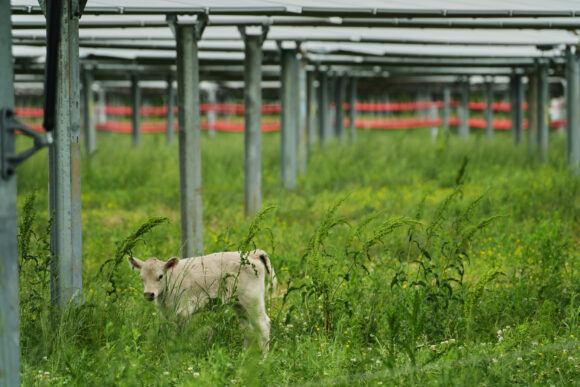
But beneath these panels is lush pasture instead of gravel, enjoyed by a small herd of cattle that spends its days munching grass and resting in the shade.
Silicon Ranch, which owns the 40-acre farm in Christiana, outside of Nashville, believes cattle-grazing is the next frontier in so-called agrivoltaics, which mostly has involved growing crops or grazing sheep beneath the panels.
The solar company debuted the project this week and will spend the next year working to demonstrate to farmers that much larger cattle also can thrive at solar sites. If successful, advocates say, that could jump-start new projects to meet the soaring electricity demand driven by rapidly expanding data centers — without contributing climate-warming carbon emissions — and help cattle producers hold onto their land and livelihoods.
“Solar is one of the most powerful tools we have for cutting emissions and … is cost-competitive with fossil fuels,” said Taylor Bacon, a doctoral student at Colorado State University who has studied ecological outcomes at solar grazing sites. “I think we’re starting to see enough research that, when you do it well, the land use can be more of an opportunity than a downside.”
Though there are far more cattle than sheep in the U.S., their size poses challenges at solar sites, where both expensive equipment and the animals, which can weigh more than half a ton, must be protected.
Solar panels often pivot to near-vertical angles to capture the sun’s rays, leaving little room underneath for cattle; simply raising the panels is cost-prohibitive because of the amount of steel required. So Silicon Ranch raised the panels a little but also developed software that workers activate to turn the panels close to horizontal when cattle are grazing, giving them room to wander, said Nick de Vries, the company’s chief technology officer.
Workers rotate the cattle — currently 10 cows and their calves — between paddocks every few days so panels on the ungrazed portion of the site operate normally, generating a supply of roughly 5 megawatts of electricity for Middle Tennessee Electric, a rural electric co-op.
The hope is that the technology eventually will be adopted more broadly, company officials said.
“We know it works,” said de Vries. “But you need to prove it to other people.”
For solar companies, agricultural land is generally easier to develop than other types of sites. But many farmers — and communities — will need to be convinced that solar grazing will benefit them because of past practices that destroyed topsoil and took land out of production permanently.
“For many agricultural stakeholders, it is offensive to see high-quality farmland getting graded and piled when that’s a farm family’s legacy,” said Ethan Winter, national smart solar director at American Farmland Trust.
But he sees potential for solar grazing partnerships to help farmers keep their land in production and earn extra income at a time when it’s increasingly difficult to earn money farming and ranching alone.
“Agriculture is in a really tough spot right now” including because of trade wars, climate extremes, increased costs and pressure to sell, Winter said. “So maybe this is our moment where we can be helping states meet their energy needs and do that in a way that’s providing new opportunities for farmers.”
Silicon Ranch this year will have almost 15,000 acres of pasture being grazed — mostly by sheep — since launching five years ago, and is working with ranchers, farmers, university researchers and others to adopt best-practices for keeping soils and animals healthy.
What they’re finding is that pasture beneath solar panels retains more moisture, making it more drought tolerant, said Anna Clare Monlezun, a rancher and rangeland ecosystem scientist who’s working on the Tennessee project. Grazing in the shade leaves animals less prone to heat stress, enabling them to gain more weight and drink less water.
“There are more win-wins than trade-offs,” she said.
Sheep already have proven to be a good fit for solar sites, with more than 130,000 acres grazed as of 2024, a number that certainly has grown, said Kevin Richardson, senior director of the American Solar Grazing Association.
But for cattle, the industry still has to overcome site-design challenges and be able to scale up operations while also developing appropriate economic incentives for ranchers, Richardson said.
“Once we have that, I think we’ll see more solar sites using cattle or multi-species grazing with sheep and cattle,” he said.
Farmers often earn about $1,000 an acre by leasing their land for solar, easily 10 times more than what they historically earned through traditional agriculture, said Winter, from the Farmland Trust. That can help them to diversify operations, pay down debt and buy more land.
“I think you’ll start to hear more interest from farmers who are up against a serious financial wall right now and looking for income diversification opportunities that keep land in production,” Winter said. “We need and want to grow America’s energy capacity but not at the expense of our best farmland or at the expense of agricultural livelihoods.”
Photo: A young one at the ranch in Christiana. (AP Photo/Joshua A. Bickel)
___
The Associated Press’ climate and environmental coverage receives financial support from multiple private foundations. AP is solely responsible for all content. Find AP’s standards for working with philanthropies, a list of supporters and funded coverage areas at AP.org.
Copyright 2026 Associated Press. All rights reserved. This material may not be published, broadcast, rewritten or redistributed.
Topics
Tennessee
