


The suggestion comes after Iranian warnings that several important cables in the strait were a vulnerable point for economies in the Middle East.
Iran’s comments expose an invisible foundation of the internet and globalisation itself: the web of more than 500 undersea cables that carries more than 95% of international data traffic.
We may think the internet lives in a kind of virtual cloud. But its physical underpinnings are vulnerable – and that vulnerability is becoming a very real geopolitical concern.
Gulfs, Straits and Cables
Several of the world’s most critical submarine cable routes run through the Middle East. Narrow sealanes through the Red Sea, Bab el-Mandeb Strait, Suez Canal, and the Strait of Hormuz also function as “digital chokepoints”.
These maritime corridors connect major economic centres in Europe, Asia and Africa. In 2024, submarine cable incidents in the Red Sea disrupted around 25% of the internet traffic between Europe and Asia.
The strategic importance of submarine cables is not lost on Iran. Damage to these cables, whether accidental or deliberate, would have significant consequences.
In the bigger picture, the message is unmistakable. Digital infrastructure can give states strategic leverage, but it’s also a potential target.
Digital Infrastructure
Critical infrastructure used to mean oil pipelines, ports, or power grids. But data infrastructure has become just as important for national and economic security.
The core problem of undersea cables lies in the concentration of infrastructure. Many of the cables are bundled together along the same seabed routes and funnelled through a small number of maritime chokepoints.
This creates dangerous single points of failure. A cable cut – whether deliberate or accidental – can degrade connectivity across multiple regions simultaneously.
While cable breaks are not uncommon, repairs are difficult – especially in contested or militarized waters. Repair vessels require safe access, international coordination, and time.
Fragmentation and Disruption
A serious submarine cable disruption could have profound consequences. One immediate effect would be the fragmentation of global connectivity. The ability to communicate with anyone anywhere that we now take for granted could take a significant hit.
Regions which depend heavily on vulnerable cable routes might experience degraded internet performance, communications blackouts, or financial instability. Countries with little backup infrastructure, particularly developing states across parts of Africa, the Middle East, and South Asia, would be disproportionately affected.
Financial markets too are vulnerable. Extremely fast and reliable data flows underpin high-frequency trading systems, global payment networks, and international banking transactions.
Even brief disruptions can make markets fluctuate rapidly, delay transactions, and make investors uncertain. Because so much of the global economy is so thoroughly interconnected, digital instability in one region can rapidly create worldwide financial shockwaves.
If cable disruptions coincided with conflict or instability along major maritime trade routes such as the Strait of Hormuz or the Suez Canal, insurance markets, shipping industries, and energy supply chains would also face increased uncertainty.
Military Domain
The military and strategic consequences of cable disruption may prove even more serious. Armed forces rely on secure long-range communications and real-time coordination.
When you get down to it, everything from command-and-control systems to drone operations and logistics planning relies on undersea cables. Damage to these networks would make forces less effective, make it harder to coordinate with allies, and make miscalculations more likely.
Cable sabotage is not as clear-cut a provocation as a conventional attack on a military target. It’s hard to work out who did it – in cases such as cable breakages in the Baltic Sea often attributed to Russian action – and the legal situation is ambiguous. This ambiguity creates a risk that conflict will escalate, as states may struggle to determine whether disruptions are accidental, criminal, or acts of war.
Digital World Has Physical Foundations
The US–Iran conflict has already delayed construction of new undersea cables. It also highlights a broader reality: the foundations of the digital world are real and concrete, and they are not invulnerable.
Any deliberate targeting or sabotage would not just be a local event. It would reverberate across global communications, economies, and security systems. The seabed has become a zone of geopolitical competition – and the consequences of disruption could affect the world’s stability for years to come.
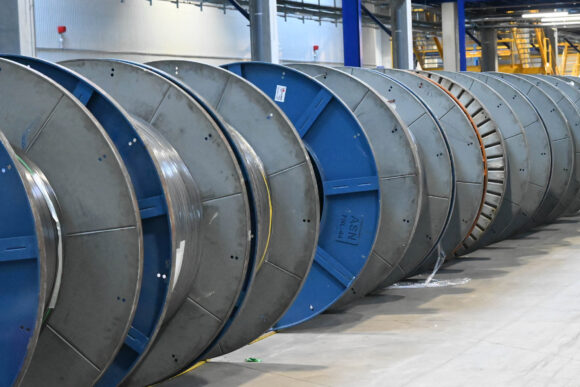
Photograph: Reels of submarine fiber optic cable shielding. Photo credit: Denis Charlet/AFP/Getty Images
This article is republished from The Conversation under a Creative Commons license. The Conversation is an independent and nonprofit source of news, analysis and commentary from academic experts. The original article can be accessed here.
