
Close Menu
  • Home
  • Life Insurance
  • Auto Insurance
  • Home Insurance
  • Health Insurance
  • Business Insurance
  • Travel Insurance
  • Specialized Insurance
  • Insurance Tips & Guides
Facebook X (Twitter) Instagram
Insure GenZInsure GenZ Friday, May 22
  • About Us
  • Contact Us
  • Disclaimer
  • Terms & Conditions
  • Privacy Policy
Facebook X (Twitter) Instagram
Subscribe
  • Home
  • Life Insurance
  • Auto Insurance
  • Home Insurance
  • Health Insurance
  • Business Insurance
  • Travel Insurance
  • Specialized Insurance
  • Insurance Tips & Guides
Insure GenZInsure GenZ
Home»Health Insurance»A Look at the High Unemployment Hardship Exception to Medicaid Work Requirements Based on Unemployment Data from February 2025 to January 2026
Health Insurance

A Look at the High Unemployment Hardship Exception to Medicaid Work Requirements Based on Unemployment Data from February 2025 to January 2026

AwaisBy AwaisMay 18, 2026No Comments2 Mins Read1 Views
Facebook Twitter Pinterest Telegram LinkedIn Tumblr Copy Link Email
Follow Us
Google News Flipboard
A Look at the High Unemployment Hardship Exception to Medicaid Work Requirements Based on Unemployment Data from February 2025 to January 2026
Share
Facebook Twitter LinkedIn Pinterest Email Copy Link

The 2025 reconciliation law will—for the first time—require adults who are enrolled in Medicaid though the Affordable Care Act (ACA) expansion, along with those in partial expansion waiver programs in Georgia and Wisconsin, to meet work requirements or qualify for an exemption as a condition of eligibility starting in January 2027 in most states.

States may adopt an optional hardship exception to Medicaid work requirements for individuals living in counties with unemployment rates at or above 8%, or at least 1.5 times the national average unemployment rate. A recent KFF survey found that most states plan to adopt this exception, which will exempt both Medicaid applicants and enrollees in counties with unemployment rates that meet the specified thresholds. However, four states, Indiana, Iowa, Missouri, and Oklahoma, do not plan to adopt the exception.

An update to a previous KFF analysis of county unemployment rates, using 12-month average unemployment rates from February 2025 through January 2026, and county-level Medicaid expansion enrollment estimates that:

  • 1.4 million expansion enrollees, or 7.5% of expansion enrollees, live in counties that meet the high unemployment threshold and may qualify for the hardship exception in the 27 states that plan to adopt the exception and in the 12 states that had not made a decision on adoption at the time of the KFF survey. 
  • Among the states that are planning to adopt or may adopt the exception, 133 counties in 22 states meet the high unemployment thresholds, representing 7% of counties in expansion states and states with partial expansion waiver programs. No counties meet the thresholds in 16 states, and DC does not meet the thresholds. 
  • Nine in ten expansion enrollees who are in counties that meet the high unemployment criteria and could be exempt from the work requirements live in five states—California, New York, Michigan, New Jersey, and Oregon.
  • Among the states that do not plan to adopt the hardship exception, two counties in Iowa and Missouri meet the high unemployment thresholds, and approximately 3,300 expansion enrollees in those counties may have qualified for the high unemployment hardship exception if the states had decided to adopt the exception. In Indiana and Oklahoma, there are no counties that meet the thresholds.

Nebraska began enforcing work requirements on May 1, 2026, the first state to implement the new requirements. Although the state indicated it would adopt the high unemployment hardship exception, no counties in the state currently meet the thresholds. 
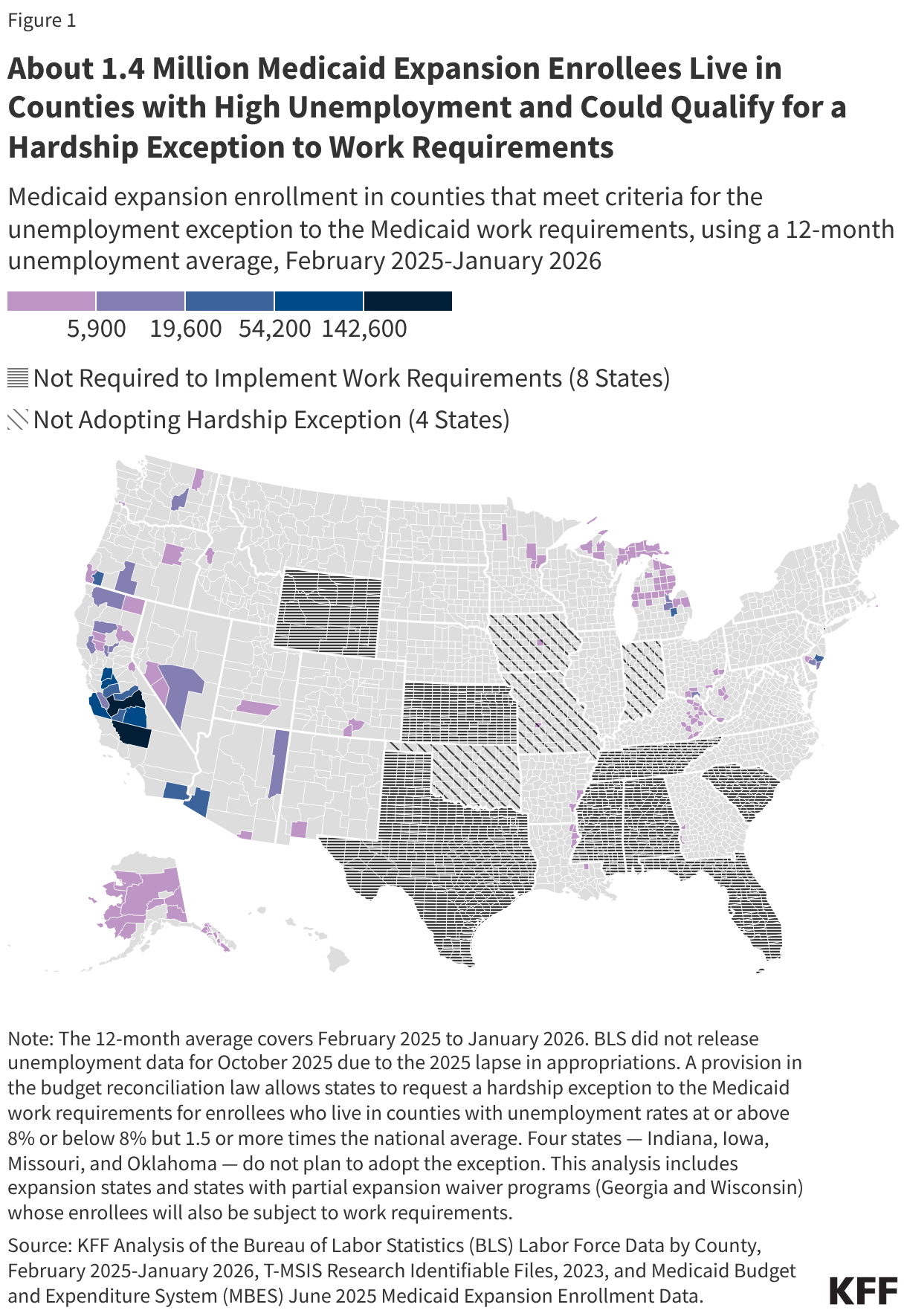
About 1.4 Million Medicaid Expansion Enrollees Live in Counties with High Unemployment and Could Qualify for a Hardship Exception to Work Requirements (Choropleth map)

States are waiting for federal guidance on how to implement this hardship exception, including what data will be used to identify counties that meet the thresholds and what additional information states must submit. This analysis uses the most recent available county-level unemployment data from Bureau of Labor Statistics (BLS) and is consistent with the methods used to determine whether any counties qualify for the high unemployment exemption waiver from SNAP work requirements. However, the guidance, which CMS is expected to release in early June, may require a different method.

KFF’s interactive Medicaid work requirements tracker includes new county-level unemployment data by state, showing which counties meet the high unemployment thresholds and how many expansion enrollees in those counties may be exempt from work requirements.

based Data Exception February Hardship high January Medicaid requirements Unemployment Work
Follow on Google News Follow on Flipboard
Share. Facebook Twitter Pinterest LinkedIn Telegram Email Copy Link
Awais
  • Website

Related Posts

Quorum Health to transition to nonprofit system through deal with Healthside Partners

May 22, 2026

The U.S. President’s Emergency Plan for AIDS Relief (PEPFAR)

May 22, 2026

3 Medical Routines That Older People May Not Need

May 22, 2026
Leave A Reply Cancel Reply

Our Latest Blogs

Catastrophe bond issuance in H1 2026 now projected at $16.3bn, could rise further

May 22, 2026

Quorum Health to transition to nonprofit system through deal with Healthside Partners

May 22, 2026

Meta Settles First Case Over School Costs Tied to Youth Mental Health: Court Filing

May 22, 2026

The U.S. President’s Emergency Plan for AIDS Relief (PEPFAR)

May 22, 2026
Recent Posts
  • Catastrophe bond issuance in H1 2026 now projected at $16.3bn, could rise further
  • Quorum Health to transition to nonprofit system through deal with Healthside Partners
  • Meta Settles First Case Over School Costs Tied to Youth Mental Health: Court Filing
  • The U.S. President’s Emergency Plan for AIDS Relief (PEPFAR)
  • New York Issues Cybersecurity Tips for a ‘Heightened Threat’ Climate With AI

Subscribe to Updates

Insure Genz is a modern insurance blog built for the next generation. Subscribe it for more updates.

Insure Genz is a modern insurance blog built for the next generation. We break down complex topics across categories like Auto, Health, Business, Life, and Travel Insurance — making them simple, useful, and easy to understand. Whether you're just getting started or looking for expert tips and guides, we've got you covered with clear, reliable content.

Our Picks

Catastrophe bond issuance in H1 2026 now projected at $16.3bn, could rise further

May 22, 2026

Quorum Health to transition to nonprofit system through deal with Healthside Partners

May 22, 2026

Meta Settles First Case Over School Costs Tied to Youth Mental Health: Court Filing

May 22, 2026

The U.S. President’s Emergency Plan for AIDS Relief (PEPFAR)

May 22, 2026
Most Popular

Catastrophe bond issuance in H1 2026 now projected at $16.3bn, could rise further

May 22, 2026

Quorum Health to transition to nonprofit system through deal with Healthside Partners

May 22, 2026

Meta Settles First Case Over School Costs Tied to Youth Mental Health: Court Filing

May 22, 2026

The U.S. President’s Emergency Plan for AIDS Relief (PEPFAR)

May 22, 2026
  • About Us
  • Contact Us
  • Disclaimer
  • Terms & Conditions
  • Privacy Policy
© 2026 Insure GenZ. Designed by Insure GenZ.

Type above and press Enter to search. Press Esc to cancel.