


Expanding biofuel demand is a “powerful catalyst” to restore profitability to American farms, according to a new study, as harvests balloon and lawmakers consider broadening the market for corn-based ethanol.
Climbing crop yields are creating persistent surpluses thanks to better technology, yet at the same time demand is stagnating, according to research by S&P Global Energy. The scenario will lead to reduced cropland and dropping farmer profits, according to the study.
“Without new markets, sustained surpluses are likely to place downward pressure on prices, erode farm incomes, weaken rural economies, and discourage long-term investment and innovation,” the study said.
Expanding biofuel demand would allow agricultural production to remain strong, serving as a “reliable long-term supplier” of corn, ethanol and other products to domestic and international markets, the report said. About 83% of the net increase in corn demand since 2000 has been attributed to ethanol expansion, according to the study.
The conclusion comes after the US in March finalized its most aggressive biofuel blending mandates to date. While the requirements were welcomed by farm groups, they left conventional biofuel volumes — mostly corn ethanol — largely unchanged. Current blending levels also fall short of those requirements.
Many believe the easiest way to fill the gap would be to expand the market for corn-based ethanol by allowing year-round, nationwide sales of higher-ethanol E15 gasoline.
Yet efforts to authorize permanent E15 sales have failed for more than a decade, largely due to opposition from much of the oil industry, which has argued that biofuel blending mandates impose significant costs on refiners.
“Somebody’s going to benefit from this in every state,” Senator Chuck Grassley, a Republican from Iowa, said about E15 legislation at a Tuesday event launching the report. “But we’ve got to move, and it’s almost too late now if we don’t get some action.”
The politics have become even more complicated recently. A proposal currently making its way through Congress pairs E15 expansion with limits on exemptions from biofuel-blending requirements for small refineries — a provision that has drawn support from some large oil companies but sparked fierce resistance from smaller operators. That split within the refining sector is now a major obstacle for E15.
The US House of Representatives passed the legislation to expand sales of E15 last month. It now needs to pass in the Senate, where it faces an uphill battle, then be approved by President Donald Trump.
Corn ethanol will probably remain the dominate biofuel pathway through 2050, according to the study, because it’s scalable, can be efficiently produced and is compatible with existing fuel and agricultural infrastructure.
E15 is just a piece of the solution, researchers said at the event. Sustainable aviation and maritime fuel also present an opportunity for agriculture.
“Biofuels are not just an energy solution — they’re an economic engine that could transform farming’s future,” Maryland farmer Chip Bowling, vice chair of US Farmers & Ranchers in Action, said in a release accompanying the report.
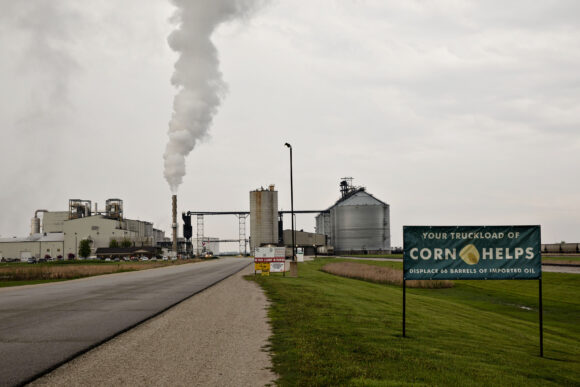
Photo: Steam rises from a stack at an ethanol biorefinery in Gowrie, Iowa. Photographer: Daniel Acker/Bloomberg
Copyright 2026 Bloomberg.
Topics
Agribusiness
Interested in Agribusiness?
Get automatic alerts for this topic.
