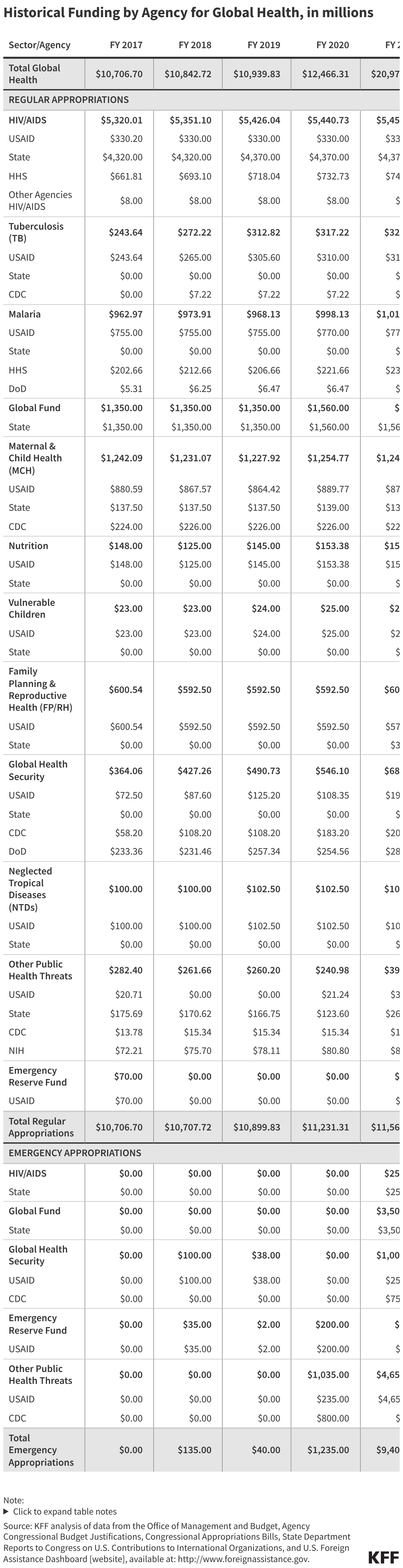

This fact sheet provides a historical overview of U.S. funding for global health by program area over the past decade. Funding totals are based on amounts specified by Congress in annual appropriations bills, as well as some amounts that are determined at the agency level. Since the beginning of the second Trump administration, the U.S. global health response has undergone significant change, including a restructuring of how foreign assistance is provided, elimination of the U.S. Agency for International Development (USAID), the main implementing agency for U.S. global health efforts, and cancellation of most awards to organizations implementing programs. The full impact of these changes to foreign assistance, including whether all the funding appropriated by Congress for global health will be fully spent by the administration, is not yet clear. See our Budget Tracker for more detail on historical funding, Budget Summaries for the latest on ongoing appropriations discussions, and Country-Level Funding Tracker for detail on country-specific appropriated (planned) funding, obligations, and disbursements for global health.
The U.S. Government has been the largest donor to global health in the world and its funding has included support for both disease (HIV, tuberculosis, malaria, and neglected tropical diseases) and population (maternal and child health, nutrition, and family planning and reproductive health) specific activities as well as global health security. Most U.S. funding for global health has been provided by Congress for bilateral efforts (approximately 80%). Of the multilateral share, the majority is provided to The Global Fund to Fight AIDS, Tuberculosis and Malaria (Global Fund). The U.S. investment in global health grew significantly in the early 2000s, largely due to the creation of new initiatives including the President’s Emergency Plan for AIDS Relief (PEPFAR) and the President’s Malaria Initiative (PMI), with spikes in funding in some years due to emergency supplemental funding for disease outbreaks, including Ebola and COVID-19. When this emergency funding is excluded, total support reached a peak level of $12.9 billion in FY 2023 but has declined each year since.1 In FY 2026, global health funding totaled $11.3 billion, its lowest level (through regular appropriations) since FY 2020.
Figure 1
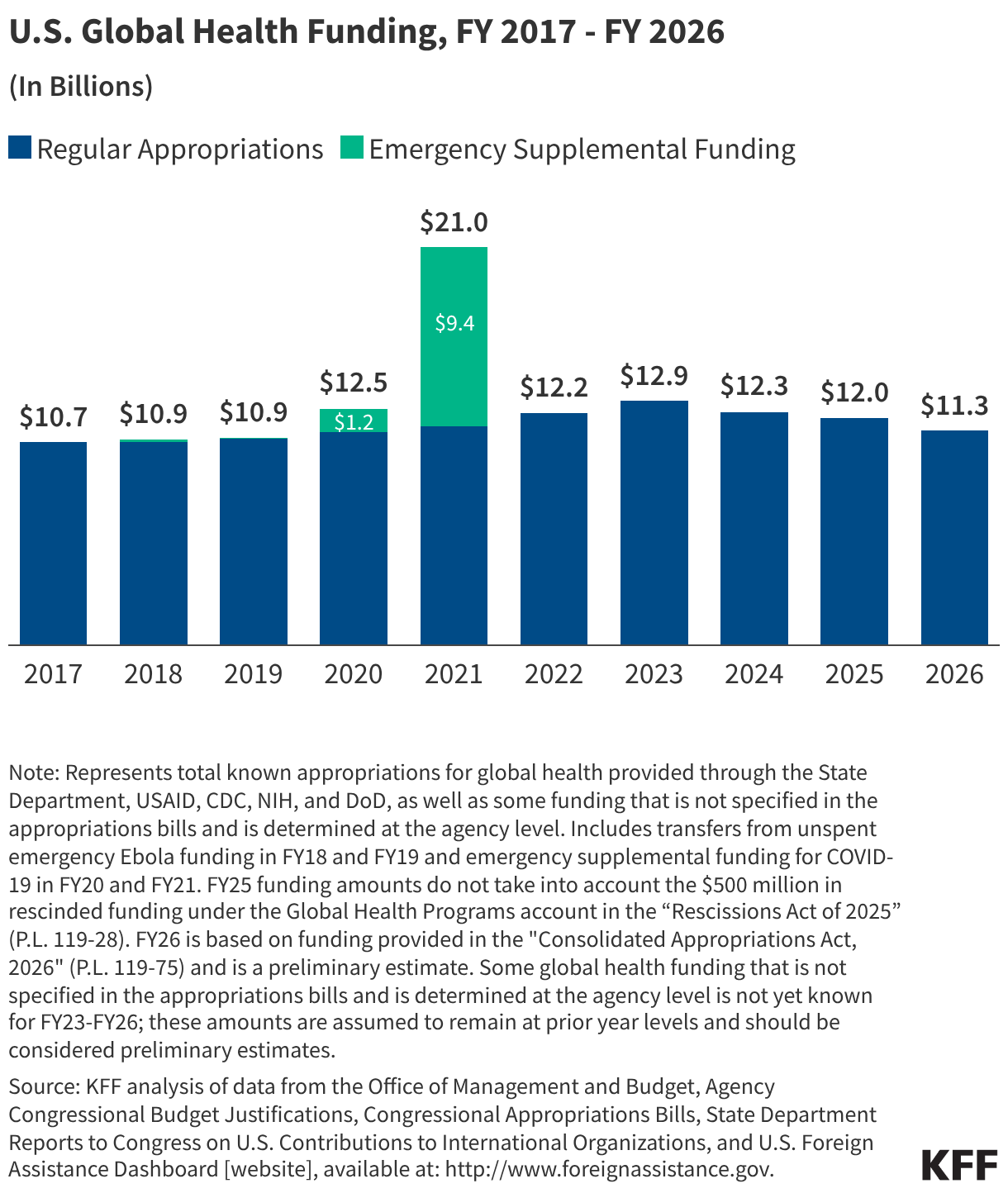
Figure 2
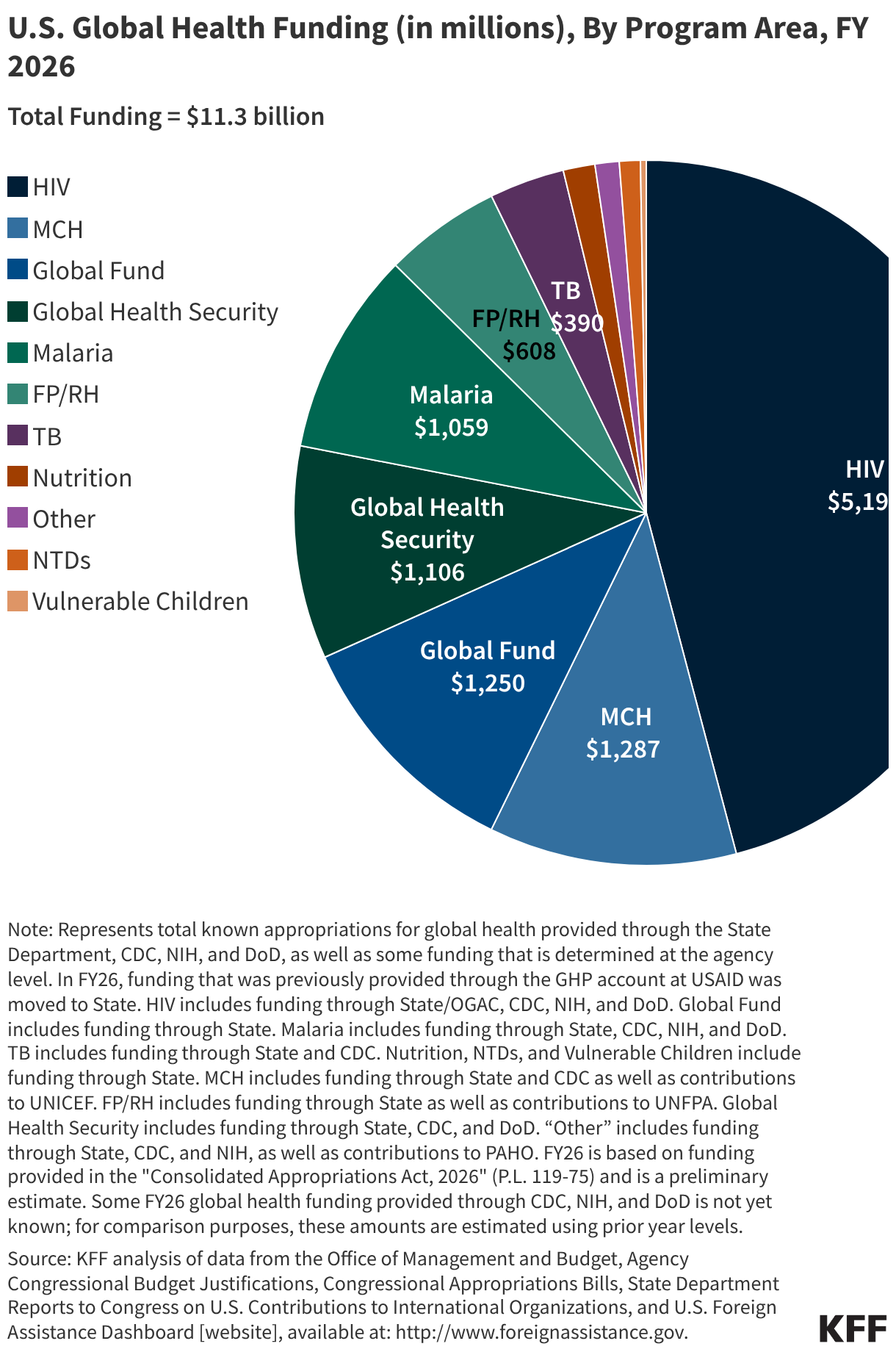
Table 1