

It’s never been so expensive for Americans to buy a steak or hamburger, but cutting those costs requires ranchers like Stephanie Hatzenbuhler to raise more cattle — and that’s not an easy ask.
For a host of reasons, Hatzenbuhler and other ranchers across the country are reluctant to grow the national herd — now its smallest in more than 75 years — and until they do so, demand will outweigh supply, and beef prices will likely remain high.
Adding cattle makes sense for some ranchers, but others are struggling to stay afloat with the cattle they have, Hatzenbuhler said.
“They’re good times, and they’re bad times,” she said. “It’s a combination of both.”
Why is the beef herd so small?
Hatzenbuhler will make her choices as cows give birth to about 700 calves this spring on her family’s Diamond J Angus ranch on more than 2,000 wind-swept acres (809 hectares) near Mandan, North Dakota. Does she opt to increase her herd, or does she offset the new arrivals by selling an equal number of cattle to be slaughtered?
The national herd size isn’t the only factor that determines what beef costs at the grocery store. Still, the dwindling number of cattle is a key reason the average price of all uncooked ground beef in the U.S. was $6.86 per pound in March, 3 cents off the record high set in February, according to federal statistics. That price in March is up nearly 48% from March 2021.
The U.S. cattle herd reached a high of 132 million head in 1975, according to the U.S. Department of Agriculture, and that figure has gradually fallen to 86 million this year.
Thanks to changes in cattle genetics and feeding techniques, ranchers now produce far more meat from each animal, so despite the much smaller herd, the country’s beef production hit a record 28.4 billion pounds in 2022, said Tim Petry, a North Dakota State University livestock marketing specialist. About 26 billion pounds of beef are expected in 2026.
About 2.5 billion pounds of beef were exported to other countries in 2025, and the tight remaining supply, along with the high demand, has caused record prices.
Ranchers acknowledge the higher prices, but they face plenty of challenges weighing against growing herds, especially from drought.
Drought limits land for grazing
Dry conditions have persisted across much of cattle country, with about 63% of the U.S. cattle herd in drought areas, according to the USDA. Some areas have also seen giant wildfires that left no grass for grazing.
“You’ve got to have rain. You’ve got to have grass to keep cows on because they’re out on pastures for over half the year, and so that’s been the dilemma, is we had forced liquidation of cows,” Petry said.
This time of year, as calves arrive, ranchers decide whether to retain young cows called heifers and calves for breeding herds, and a big factor is pasture conditions, said Bernt Nelson, an American Farm Bureau Federation economist.
Feed is the highest cost for ranchers, and due to drought in spots like Texas and Oklahoma, they have had to truck in supplies from elsewhere. Those extra costs make it hard to increase a herd.
“When these pasture conditions deteriorate, and water becomes an issue, some of these states have to go as far as to haul hay, haul water from other regions of the country that have grass and easy access to water, and that adds a significant cost to operations,” Nelson said.
Even if ranchers opted to raise more cattle, it takes 15 to 24 months for a calf to mature before it can be slaughtered.
Role of meat processors in beef prices
Ranchers often blame the concentrated meat processing systems — primarily driven by four companies — for high beef prices, but the picture is complicated.
In a statement and market updates, the Meat Institute, a meat processors trade group, noted that retailers and food service companies, not packers, set prices for consumers. And the organization said livestock producers were “earning record profits” while packers were losing money.
The Meat Institute also argued that the concentration ratio hasn’t “changed appreciably” over the past 30 years.
“Rhetoric about beef industry concentration implies that consolidation in the beef packing sector is ongoing and that market power is becoming increasingly concentrated. That is not the case,” the group said.
John Robinson, a spokesman for the National Cattlemen’s Beef Association, said he sees many reasons for high prices, and in some cases, meat processors are responsible, but that “it’s far more complicated than most people will give it credit for.”
A pest forces border closure
Another driver of high prices is the closure of the U.S.-Mexico border to livestock imports to slow the spread of a flesh-eating parasite called the New World screwworm. The closures that began in late 2024 have stopped about 1 million cattle from being hauled from Mexico into the U.S., said Warren Rusche, an extension feedlot specialist at South Dakota State University.
The border closure particularly affects cattle feedlots and ranchers who graze cattle in the southern plains.
President Donald Trump has called for increased beef imports from Argentina, but the country’s expanded quota would be only a tiny percentage of U.S. beef production, Rusche said.
Are ranchers getting rich?
Hatzenbuhler, the North Dakota rancher, isn’t getting rich, but for ranchers who own their land and equipment, she said it’s a good time to raise cattle. It’s not as good for people looking to break into the business, given the high cost of everything from equipment to fertilizer and the difficulty of finding workers.
“If you’re a young guy and want to get in, it’s probably not the time to do it, but if you’re kind of established and been doing this for a while, you’re doing good,” she said.
California rancher Mike Williams said he wouldn’t discourage someone from getting into ranching but would caution them, “don’t get too far upside down.”
“I would say that we’re finally maybe getting a fair price,” Williams said. “I think people are starting to realize the value of beef, and they’re finding that they’re willing to pay maybe a little more than they have in the past for the quality of the product that they’re getting.”
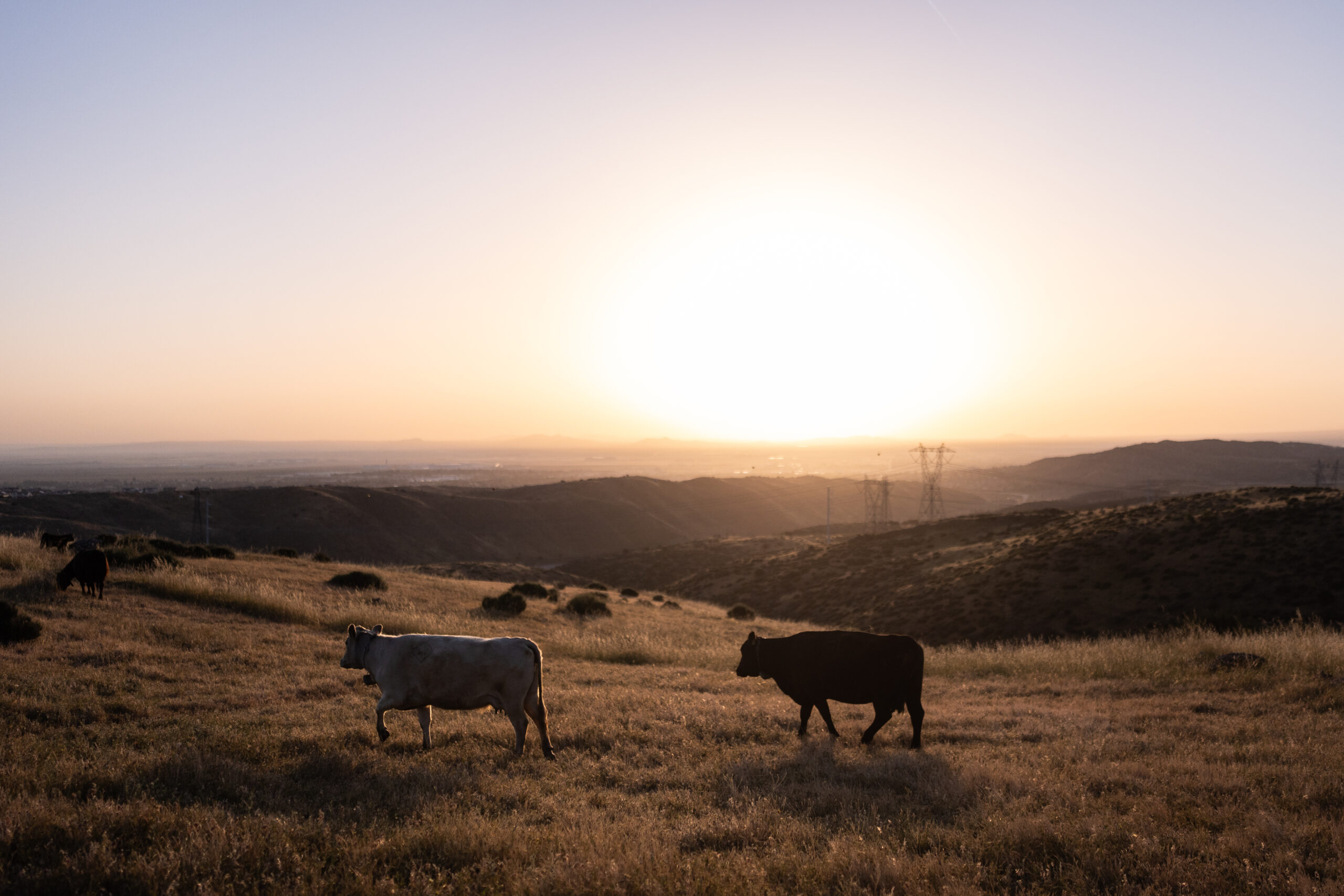
Photo: Cattle roam on a hillside at sunrise on the Diamond W Cattle Company ranch in Palmdale, Calif., Friday, April 3, 2026. (AP Photo/Jae C. Hong)
Copyright 2026 Associated Press. All rights reserved. This material may not be published, broadcast, rewritten or redistributed.
Topics
USA
Catastrophe
Natural Disasters
Wildfire
