


As the 2026 hurricane season blows in today and a state-funded wind-mitigation program remains as popular as ever, a Florida entrepreneur named John Smith wants a word.
The My Safe Florida Home program, providing matching grants for window and door protections, is ripping off taxpayers and is installing hurricane shutters that can’t be easily removed in case of a fire inside the home, Smith said in recent interviews and court filings.
“People are dying because of the shutters. That’s what is so incredible,” Smith said.
Smith, of Winter Park, is founder and president of StormStoppers, which employs a lightweight, lower-cost, reinforced plastic material that is mounted to window and door frames with Dual-Lok fasteners—similar to a heavy-duty type of Velcro: Easy to install. Easy to remove from the inside if a fire breaks out.
“Just open the window and push,” Smith said.
He notes that his “plywood alternative” is every bit as effective as the bolt-on, corrugated steel shutters that the My Safe Florida Home program helps pay for. The company says the StormStopper product has withstood the flying-debris “missile test” and 143-mph winds generated at Florida International University’s famous Wall of Wind testing laboratory.
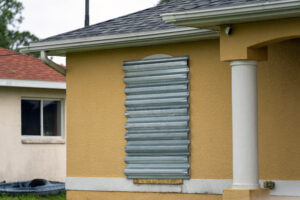
But the product is not approved or funded by state agencies that oversee the Florida wind-retrofit grant program. After years of failed efforts to change the rules, Smith and his company last year filed a lawsuit against the Florida insurance commissioner and the state’s chief financial officer. The suit charges that the state agencies have fostered unfair, monopolistic trade practices and are violating fire and safety codes by providing a product that can’t be removed from inside: The state-approved metal shutters are bolted to a house from the outside of the structure.
“All ‘opening protection’ systems sold and installed in Florida must meet (Section) 24.2.2.3.3 of the Life Safety Code, which requires occupants to be able to remove the opening protection from inside of windows in living areas and sleeping rooms ‘without any tools, keys or special effort,’” reads the amended lawsuit complaint, filed in March in Leon County Circuit Court.
In addition to monetary damages, the suit asks that a judge declare that StormStoppers hurricane panels meet Florida Building Code requirements, making them eligible for the My Safe Florida Home grant program. The program funding could reach thousands more homeowners if his less-expensive polycarbonate panels were approved, Smith said.
The My Safe Florida Home program has provided more than $385 million in grants for some 40,000 homeowners (who enjoy discounts on their homeowner premiums) since it was relaunched in 2022. The program and installation contractors have indicated that metal shutters are safe because, in most cases, homes that install window and door protections must leave at least one door uncovered—to allow emergency egress during a fire.
But Smith argues that a fire could block that exit, trapping residents inside their homes when seconds count.
He and his lawsuit point to news articles from around Florida, as well as affidavits from victims’ family members, that appear to show that at least 15 people have suffered fatal or near-fatal injuries because they were unable to escape homes with steel hurricane shutters.
In Palm Beach Gardens in 2017, fire crews had to cut through metal storm shutters to rescue a man. In Port Charlotte, firefighters were delayed in November 2025 because they had to spend time removing the metal shutters, WINK News reported.
The local fire marshal urged people with metal storm shutters to keep them off the house if a storm is not approaching. “Make sure that you know two ways out of your house,” Charlotte County Fire Marshal Scott Morris told the news station.
Smith said that with his StormStopper polycarbonate sheets, homeowners don’t need to leave an opening unprotected. The last panel to be installed before a storm can be fastened from inside the home, pulled into place with special handles. Visibility is another issue with heavy metal shutters, he contends. His panels are translucent, allowing some daylight to filter in to let people see inside if the lights goes out.
The heads of Florida’s Office of Insurance Regulation and the state Department of Financial Services, which oversee different aspects of the home-hardening program, have both asked the Leon County judge to dismiss Smith’s lawsuit. Among other arguments, they say that the suit fails to state a proper claim for relief, the state’s Life Safety Code doesn’t seem to apply to single-family homes, and that there’s nothing the agencies can do to force a change in the state building code. The DFS motion to dismiss can be read here.
The case is still pending.
Two Florida engineers who have studied hurricane-resistant materials told Insurance Journal that the StormStopper panels may, in fact, stop wind-borne debris from breaking windows, and may keep hurricane winds from penetrating a home and causing uplift—for a few years, anyway.
The concern among engineers is that, over time, the adhesive used to attach the Velcro-like fastener strips can deteriorate in weather conditions and under the relentless effects of ultraviolet sunlight.
“Depending on the material and exposure, that may happen in as few as five years or as many as 20,” said David Grindley, a forensic and structural engineer based in Lakeland, Florida.
But metal shutters usually are attached with long screws that attach deep into the studs of a house, or are set with epoxy resin into concrete, a method that is likely to last much longer, the engineers said.
Smith, who pitched the StormStopper system on the Shark Tank TV show in 2014, countered that his panels’ fastener systems, glued on with a special adhesive and primer from 3M, like any outdoor material, require some maintenance. But the fastener glue should have a useful life of five to six years—longer if UV-resistant Dual Lock fasteners are used.
Top photo: Smith demonstrating the StormStopper panels in a YouTube video.
Topics
Lawsuits
Catastrophe
Natural Disasters
Florida
Hurricane
