


A Kentucky food-coloring manufacturer made a number of missteps and was not equipped to prevent the 2024 runaway chemical reaction that killed two workers and caused millions of dollars in damage to the plant and surrounding neighborhoods.
That was the conclusion from the U.S. Chemical Safety and Hazard Investigation Board, which this week released its final report on the Givaudan Sense Colour explosion in Louisville.
“This tragic incident was a catastrophe waiting to happen,” Chemical Safety Board (CSB) Chairman Steve Owens said in a statement. “The reactor’s pressure relief system was not designed to release pressure from a reaction like this, and Givaudan did not recognize the potential for a runaway reaction to happen.”
The CSB, an independent, nonregulatory federal agency that investigates incidents, explained that a reactor, used to produce caramel coloring for food products, had been relocated to the site from an older facility. In 2021, the reactor was modified and installed in the Louisville plant.
But the retrofit was not as safe as it could have been, the board said.
The two workers killed in the November 2024 blast were in a control room that was just 40 feet from the reactor—a control room that was not built to be blast-resistant. The 2,000-pound reactor shell flew almost the length of a football field and landed against a home. Other debris was shot into the surrounding neighborhood.
“The … company did not understand the severe reactive hazards associated with the sugar ingredients used in its caramel coloring process,” the report noted. “As a result, critical safeguards, including the emergency relief system, were incapable of preventing this catastrophic reactor rupture.”
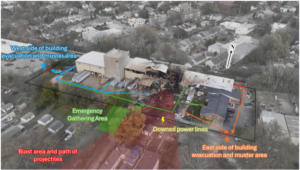
Among other problems, a vent pipe in Reactor 6 failed, allowing pressure and temperature to rise abnormally, the CSB report explained. That led to a runaway reaction of the caramel-coloring sugar ingredient.
Sugar is usually considered a fairly benign, tasty material. But it can be highly reactive in certain conditions and can cause massive fires or explosions, the American Chemical Society has explained. In perhaps the most famous sugar facility explosion, the Imperial Sugar Refinery in Port Wentworth, Georgia, blew up in 2008, killing 14 people and injuring 38 others, the CSB reported at the time.
Altogether, the Givaudan Louisville explosion caused $30 million in damage to the plant and another $10 million to nearby homes and businesses, the CSB said. The food-color facility has since been shut down and demolished.
The CSB recommended that Givaudan, a Swiss company that makes flavorings, colorings and fragrance products, ensure that a new production plant be built well away from residential areas. The company should also institute third-party reactivity testing on sugar ingredients, perform facility hazard analyses, develop comprehensive process-safety management systems, improve emergency pressure relief systems, establish operator alerts, and train workers on safe operating limits.
Additionally, the board reiterated its earlier recommendations that the U.S. Environmental Protection Agency and the U.S. Occupational Safety and Health Administration strengthen federal oversight of catastrophic reactive chemical hazards. The CSB has urged EPA to revise its Accidental Release Prevention Requirements to explicitly address reactive hazards. The board also is recommending again that OSHA expand the Process Safety Management (PSM) standard to better address reactive hazards.
Those recommendations may be unlikely to happen in the wake of ongoing federal cutbacks in funding and enforcement for EPA, OSHA and other federal agencies.
The CSB board members are appointed by the president, subject to Senate confirmation. The board explained that it does not issue citations or fines but makes safety recommendations to companies, industry organizations, labor groups, and regulatory agencies such as OSHA and EPA.
The full report can be seen here.
Top photo: The damaged Givaudan Color Sense plant in Louisville in 2024. (AP Photo/Dylan Lovan)
Read More: Head of Kentucky Plant Says Company Will Cover Damages After Blast
Runaway Reaction Likely Caused Fatal Explosion at Food Color Plant, Board Says
Topics
Catastrophe
Interested in Catastrophe?
Get automatic alerts for this topic.
