


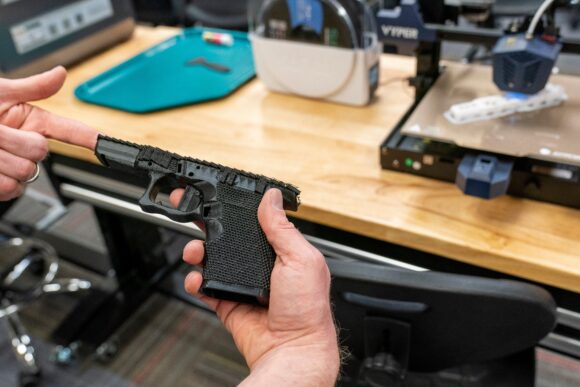
A first-of-its-kind law in New York could force 3D printers sold for homes and business to come equipped with technology blocking them from making guns.
The new requirement, also under consideration in California, attempts to thwart the latest technique for producing untraceable “ghost guns” that have turned up in crimes. But there are questions about whether the technology can work and concerns about its effect on personal privacy and constitutional rights.
About one-third of U.S. states already have taken steps to ban or regulate build-it-yourself firearms that lack serial numbers and evade the background checks required to purchase guns from federally licensed dealers. What makes the new effort unique is that it targets the equipment used to produce the firearms, not the people who make them.
The blocking technology being pushed in two of the nation’s most populous states has the potential to set industry standards for 3D printers. It also could serve as a model for other Democratic-led states wanting to add to their gun regulations, which often already ban certain semiautomatic weapons and allow firearms to be temporarily confiscated from people deemed to pose a threat to themselves or others.
More privately made guns are being used in crimes
Three-dimensional printers have become increasingly common over the past couple of decades.
Since 2012, the number of 3D printers worldwide has grown from an estimated 30,000 to over 3 million while the industry’s value has multiplied from around $2 billion to $26 billion annually, said Bill Decker, executive chairman of the Association of 3D Printing. Though high-end printers cost thousands of dollars, some 3D printers now can be bought for as little as several hundred dollars.
The devices can make toys, prosthetic limbs and even airplane parts. They also can make firearms — or the pieces necessary to assemble them — using digital designs available online. Homemade guns that lack serial numbers often are called “ghost guns,” because they are hard for law enforcement officers to trace.
Firearms made with 3D printers are increasingly being used in crimes, according to a U.S. Department of Justice report released last year. The number of privately made guns recovered in crimes and submitted to federal authorities rose from about 1,600 in 2017 to nearly 27,500 in 2023, though the report didn’t specify how many came from 3D printers.
In a high-profile New York case, police say a 3D-printed gun likely was used to kill UnitedHealthcare’s CEO in 2024.
How 3D printers could refuse to make gun parts
A New York law signed last month and a bill in the California Legislature both would direct panels of experts to come up with standards for firearm blueprint detection algorithms. The technology would analyze every design submitted for 3D printing, compare it to a digital library of firearm parts, and reject those that are similar.
Though the study process would start now, the mandate that 3D printers come equipped with firearm blocking technology wouldn’t begin until 2029 — or later, in New York’s case, if the study group determines it’s not yet feasible.
The concept is a bit like a smartphone app that identifies trees or flowers from an uploaded photo, said Solomon Diamond, an associate engineering professor at Dartmouth College who was among several experts at a recent online seminar about the legislation.
For 3D printers, one possible method could use a geometric analysis of shapes, dimensions and other structural features to reject print projects that closely resemble firearm parts.
“Geometric search is mature, it’s deployed, it is ready to be applied to this problem,” said Julian Chultarsky, a technical account manager at Physna, a Columbus, Ohio-based company that develops such technology.
Could 3D printers block both too little and too much?
The Association of 3D Printing supports the legislation in New York and California, but “it’s not going to work,” Decker said. “It’s more of a political statement than anything else.”
Criminals still will come up with ways to make guns from 3D printers, either by altering their designs or taking their printing projects elsewhere, Decker said.
The more aggressive the technology becomes, the more likely that it also blocks unintended items, said Rory Mir, director of open access and technology community engagement at the Electronic Frontier Foundation, a nonprofit digital rights group. Some harmless pipes might look like gun parts, or an S-shaped wall hanger might resemble an auto sear trigger used to modify a semiautomatic weapon into a machine gun.
“These sort of censorship algorithms don’t work, and they wind up capturing and blocking a lot of lawful speech,” Mir said.
If print instructions are submitted for a cloud-based artificial intelligence search, it also risks the privacy of people’s artistic and proprietary creations, Mir said.
Does the right to bear arms extend to making them?
Gun safety advocates say 3D printers have created a new pathway for people who cannot legally purchase firearms — like children or convicted felons — to nonetheless obtain them. Eleven states already generally prohibit 3D-printed guns, and six additional states require them to receive serial numbers, according to Everytown for Gun Safety.
Blocking the actual 3D printing of firearms could make it harder for people to ignore such laws.
“3D printing really is the new frontier of the fight against ghost guns,” said Samuel Levy, director of policy advocacy at Everytown for Gun Safety.
The National Rifle Association might partly agree with that assertion, though it disagrees with the policy.
“Despite desperate fear-mongering campaigns, homemade firearms are nothing new — they are a proud, time-honored American tradition dating back to the founding of our Republic,” John Commerford, executive director of the NRA Institute for Legislative Action, said in a statement. He added that “these measures only restrict responsible Americans — who do follow the law — from participating in constitutionally protected activities.”
Photo: A handgun frame that has been printed on a 3D printer is held for a photograph at the Bureau of Alcohol, Tobacco, Firearms, and Explosives (ATF), National Services Center, March 2, 2023, in Martinsburg, W.Va. (AP Photo/Alex Brandon, File)
Copyright 2026 Associated Press. All rights reserved. This material may not be published, broadcast, rewritten or redistributed.
Topics
New York
