


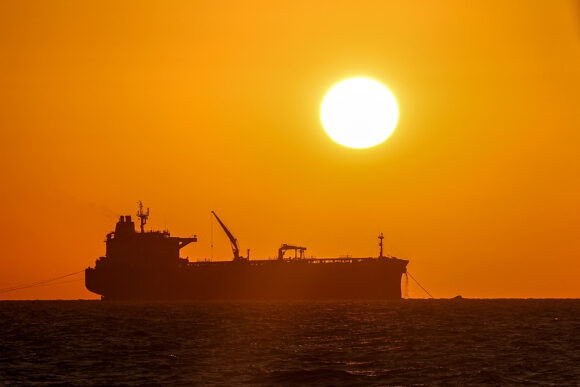
Ecologists are concerned that the war in the Middle East risks creating an environmental disaster, as satellite images show that the number of oil slicks in the Persian Gulf has increased significantly since the beginning of the conflict in the region in late February.
“If it disperses towards a coastal system, that’s going to have detrimental impacts to any bird species, fishing resources and communities that are dependent on them,” said Liz Atwood, a senior scientist at the Plymouth Marine Laboratory, a UK-based research center.
Experts said the slicks could be the result of attacks on ships or on oil and gas infrastructure, or caused by technical problems during loading and unloading operations of fuel.
The Strait of Hormuz, the narrow passage that links the Persian Gulf to the Arabian Sea, has been effectively shut for most of the past three months, leaving hundreds of vessels trapped and unable to transit into the open ocean. Several ships have been struck with projectiles and fragments from intercepted drones and missiles since the conflict began. Onshore energy facilities have also been attacked across the region, increasing the risk of spills.
“When there are attacks on oil tankers or infrastructure on land, like refineries, the possibility that there is a spill is much higher,” said Juan Peña, chief executive officer at Orbital, a Spain-based company specializing in detecting oil spills through satellite images including from the European Union’s Earth observation agency Copernicus.
While physically verifying incidents in the region remains challenging due to the ongoing conflict, non-profits and private companies have been using satellites to track events.
The spills that have been observed so far go from a few dozen barrels of oil to larger incidents that would typically lead to cleanup operations anywhere else in the world. The largest spills detected so far originated in Iran’s Kharg Island, Iran’s main oil export facility — one on May 6, which Orbital estimated had a volume of between 300 and 3,000 barrels of oil, and another on May 16, with a volume of 200-2,000 barrels.
Orbital’s ranges are wide because it’s impossible to know the exact amount of oil released in the Persian Gulf just with satellite images, Peña said.
Another slick originated in the island of Lavan and has now reached Shidvar, an uninhabited island on Iranian waters that’s a natural reserve, home to numerous bird species and corals. While the cause of the spill, first reported in the New York Times, remains unknown, it occurred between April 9 or 10, soon after a strike on the Lavan oil refinery, according to Orbital’s analysis of satellite data.
A third, smaller incident took place on May 4 in the strait of Hormuz. Following media reports that ADNOC-owned tanker Barakah was attacked, a slick of 33.2 square kilometers with an estimated volume of 25 to 230 barrels of oil was released to sea in the same area, Orbital’s analysis shows.
The size of the spills are not enormous compared to major disasters, but even so “it is a very large amount of oil,” Peña said. “It’s in Iranian waters and we don’t know if there are any operations on the way to clean it up — there is no evidence that there has been one.”
During the first Gulf war in 1991, 11 million barrels of oil were spilled into the sea, according to a 2018 research paper published in the journal Environment and Natural Resources Research. The resulting oil slick extended across the Kuwaiti and northern Saudi coastlines, polluting soil and groundwater in both countries. Up to 10,000 tons of fish were found to be unsuitable for consumption and 30,000 birds died, according to the paper.
The waters of the Persian Gulf are cluttered with more than 260 sunken ships from previous wars, according to a 2004 report by the United Nations Development Program. Many of the wrecks still hold petroleum products, propellants, toxic chemicals and unexploded devices that routinely leak into the sea and pollute it, the report found.
While media attention often focuses on large spills, the cumulative impact of smaller events can have an even larger impact on ecosystems, Atwood said. It can be hard to make a case for dealing with slicks during a time of war, she said. “You realize you’re a very small fish — ecology isn’t the most important thing on the table.”
However, marine ecosystems in the Gulf are being studied by ecologists because the corals there are able to withstand high sea temperatures, making them key to understanding the impacts of global warming in other parts of the world.
“This is where the rest of the planet, or parts of it, are heading towards,” she said. “It’s an area that we should be protecting because it potentially holds the keys for how we’re going to deal with very hot, heatwave-like conditions within the next hundred years.”
Photo credit: Jack Guez/AFP/Getty Images
Related:
Copyright 2026 Bloomberg.
Topics
Energy
Oil Gas
Interested in Energy?
Get automatic alerts for this topic.
