


Introduction
The Trump administration has made policy changes to restrict immigration into the U.S., including efforts to end Temporary Protected Status (TPS) designations for many countries, pauses and restrictions on the issuance of new visas, and significantly increased immigration enforcement. These actions could have negative implications for the U.S. workforce, which includes significant shares of immigrant workers, particularly in certain industries including health care. Immigrant workers include naturalized citizens as well as noncitizens, including lawfully present and undocumented immigrants.
This issue brief provides data on immigrants’ role in the U.S. workforce, including in health care and other key industries, based on KFF analysis of Current Population Survey (CPS) basic monthly data and American Community Survey (ACS) one-year data for U.S. workers 18 years and older by citizenship status. Key takeaways from this analysis include:
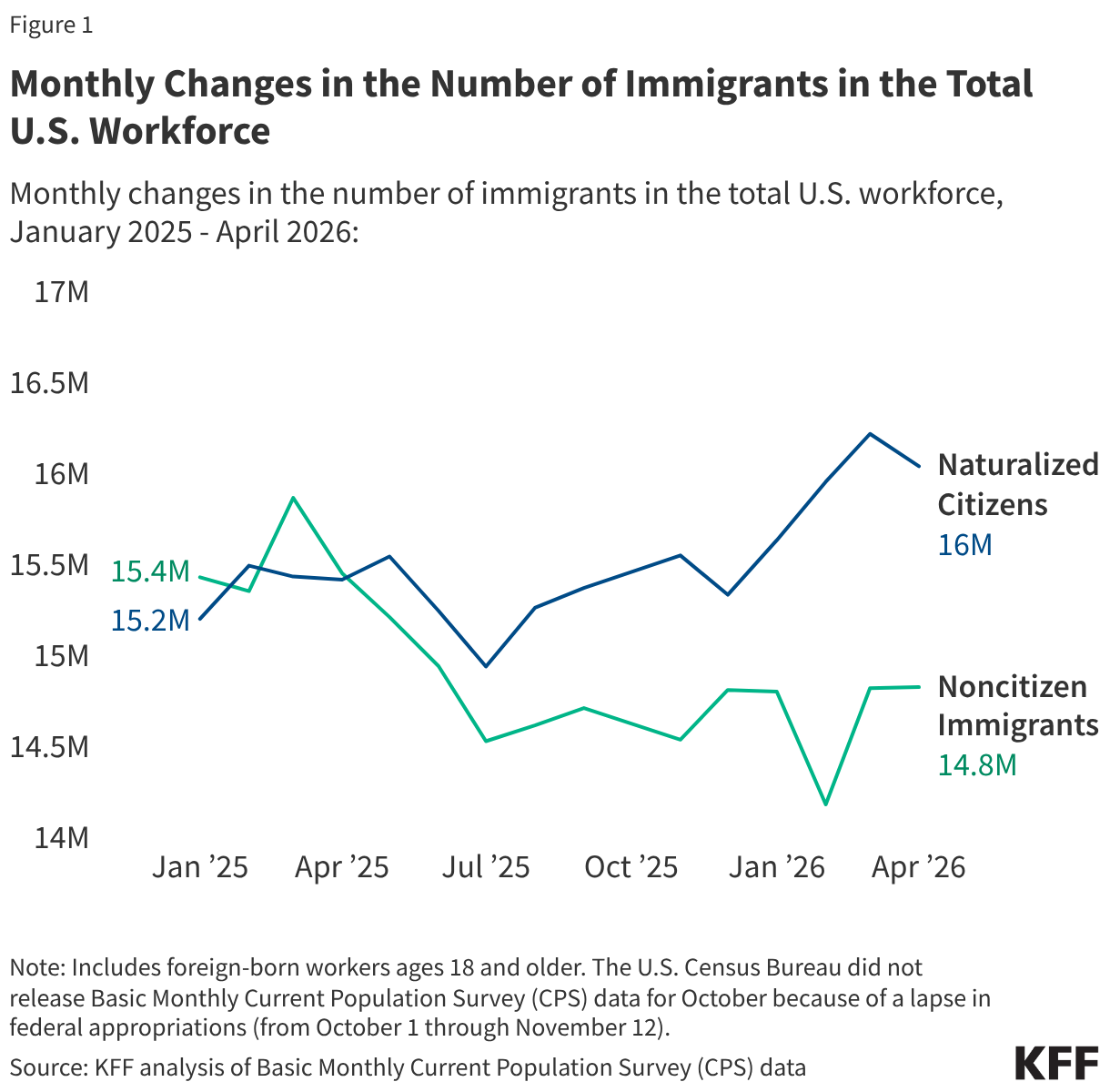
While the total number of immigrant workers in the U.S. held largely steady between January 2025 and April 2026, the number of noncitizen immigrant workers declined by about 600,000, or 4%, from 15.4 million to 14.8 million. This was offset by an increase in the number of naturalized citizen workers of over 800,000, or about 6%, from about 15.2 to 16.0 million. The number of U.S.-born workers increased by about 1% between January 2025 and April 2026 (125.6 to 126.7 million). Within the health care industry, there was an overall increase of 1% or about 130,000 workers from 19.4 to 19.6 million, which reflected increases among U.S-born (16.0 to 16.1 million) and noncitizen immigrant workers (961,000 to 1.2 million) that offset a decline among naturalized citizen workers (2.5 million to 2.3 million).
Immigrants accounted for about one in five (19%) or close to 31 million of the total U.S. workforce as of 2024. Within health care, immigrants accounted for 17% of the workforce, including 28% of physicians and surgeons and 30% of direct care workers in long-term settings. In hospitals, immigrants accounted for similar shares of clinical staff and non-clinical staff and played a particularly large role as physicians and surgeons (30%). Top countries of origin for immigrant health care industry workers include Philippines (12%), Mexico (11%) and India (7%). In hospitals, immigrants also play an outsized role in certain non-clinical occupations, including building cleaning and maintenance workers (29%). Immigrants, particularly noncitizen immigrants, also accounted for disproportionate shares of agriculture (33%); construction (26%); and food services, maintenance, and personal care service workers (23%).
Continued reductions in the number of immigrants could impact the U.S. economy and key industries, especially as the 65 and older population in the U.S. grows and there are fewer replacement workers available. Reduced immigrant participation in the health care workforce, including the long-term care workforce, could exacerbate existing worker shortages and negatively impact the health and well-being of Americans.
Recent Trends in the Immigrant Workforce
While the total number of immigrant workers in the U.S. held largely steady between January 2025 and April 2026, the number of noncitizen immigrant workers declined by about 600,000 or 4% from 15.4 million to 14.8 million. This was offset by an increase in the number of naturalized citizen workers of over 800,000, or about 6%, from about 15.2 to 16.0 million. The number of U.S.-born workers increased by about 1% between January 2025 and April 2026 (125.6 to 126.7 million). Within the health care industry, there was an overall increase of 1% or about 130,000 workers from 19.4 to 19.6 million, which reflected increases among U.S-born (16.0 to 16.1 million) and noncitizen immigrant workers (961,000 to 1.2 million) that offset a decline among naturalized citizen workers (2.5 million to 2.3 million).
Immigrants’ Role in the U.S. Health Care Workforce
Changes in the immigrant workforce may have important implications given the role that immigrants play, particularly in certain industries including health care.
Immigrants account for about one in five workers in the U.S. As of 2024, immigrants accounted for about 19%, or close to 31 million, of the total U.S. workforce over age 18 based on KFF analysis of ACS data. Naturalized citizens accounted for roughly 10% of workers and noncitizen immigrants accounted for another 9% of total workers.
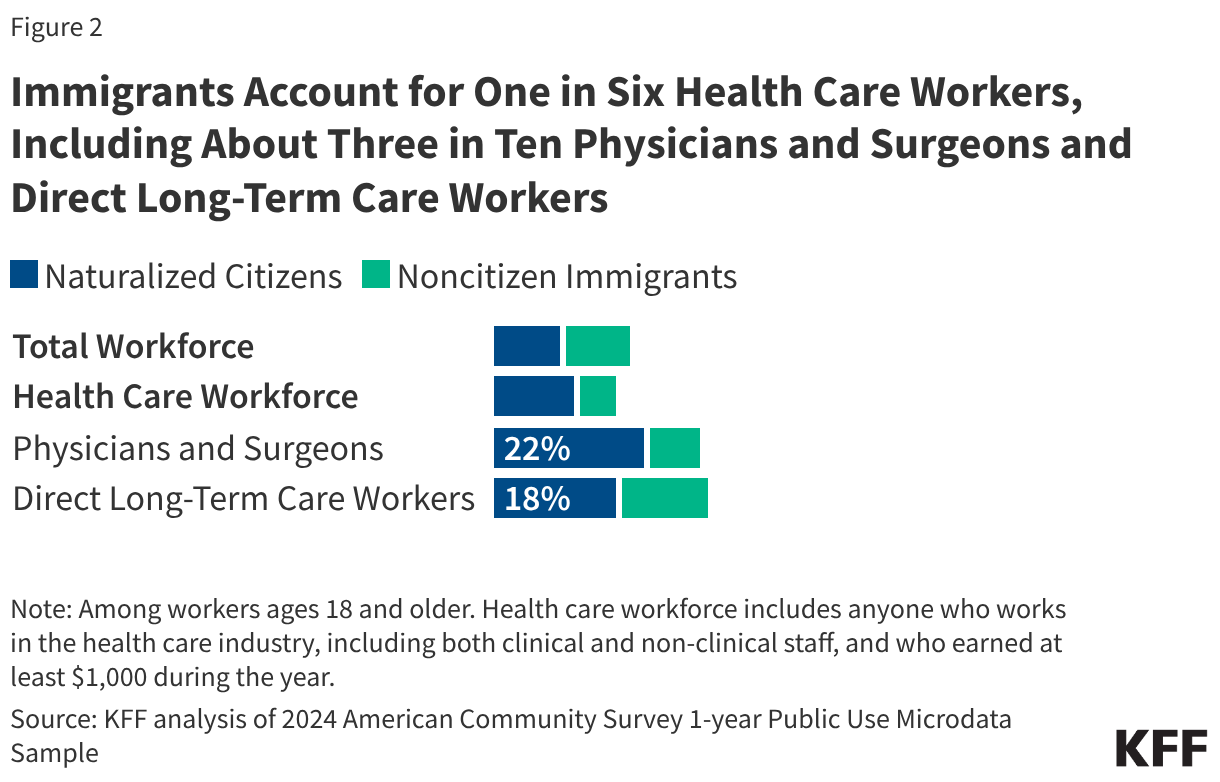
Within health care, immigrants make up about one in six workers overall and account for even larger shares of physicians and surgeons and direct care workers in long-term settings. Immigrants accounted for 17%, or about 3.3 million, of the health care workforce overall and about three in ten physicians and surgeons (28%) and direct care workers in long-term care settings (30%) (Figure 2). Among physicians and surgeons, 22% were naturalized citizens and 7% were noncitizen immigrants. Among direct long-term care workers, 18% were naturalized citizens and 12% were noncitizen immigrants.
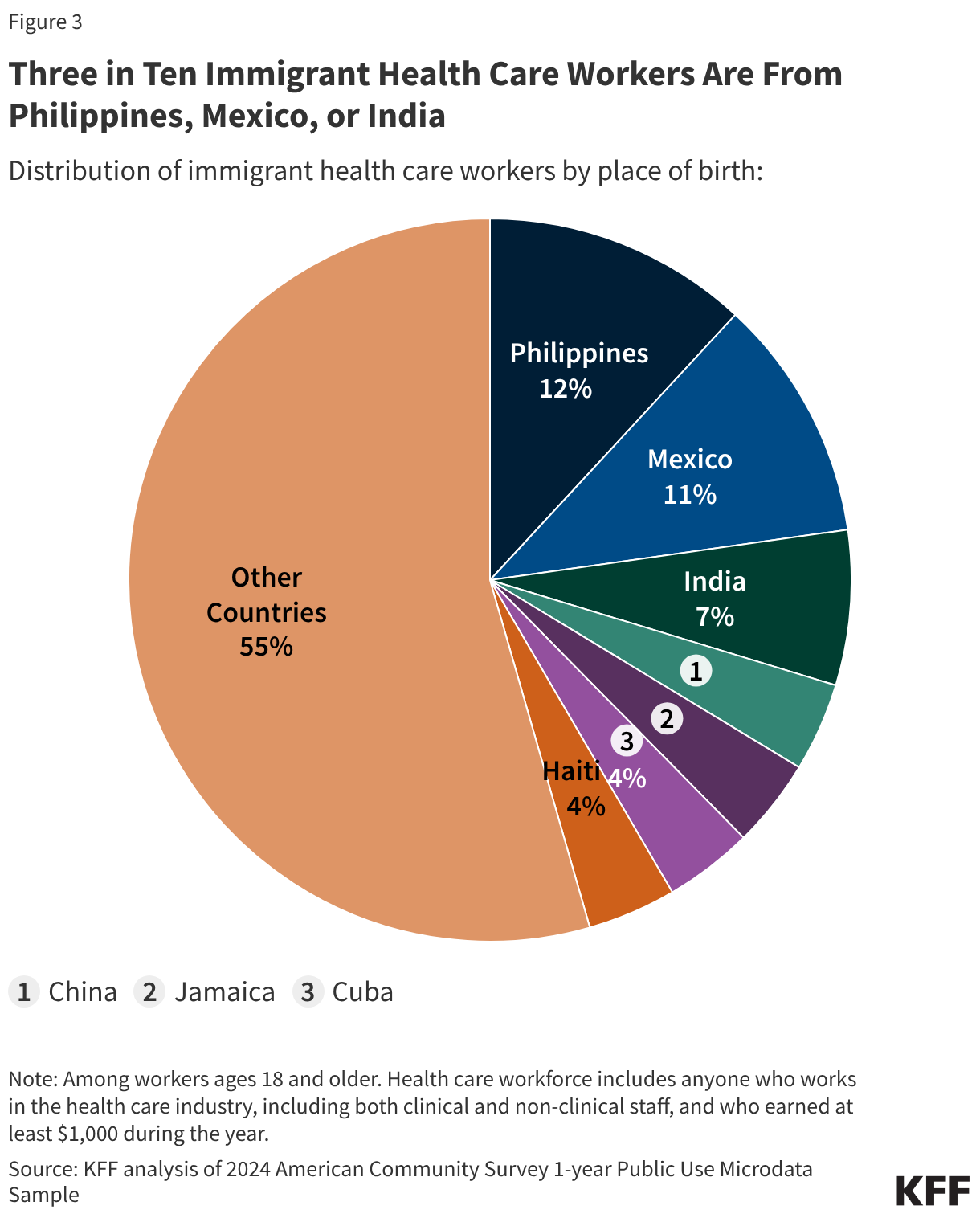
Three in ten immigrant health care workers are from Philippines (12%), Mexico (11%) or India (7%) (Figure 3). China, Jamaica, Cuba, and Haiti contribute another 4% each of immigrant health care workers. Among immigrant physicians and surgeons, one in five (21%) are from India, 6% from China, 5% each from Canada and Pakistan, and 4% are from Philippines. Among immigrant direct long-term care workers, one in seven (14%) are from Mexico, 7% each are from Dominican Republic and Philippines, and 6% each are from Jamaica, China, and Haiti.
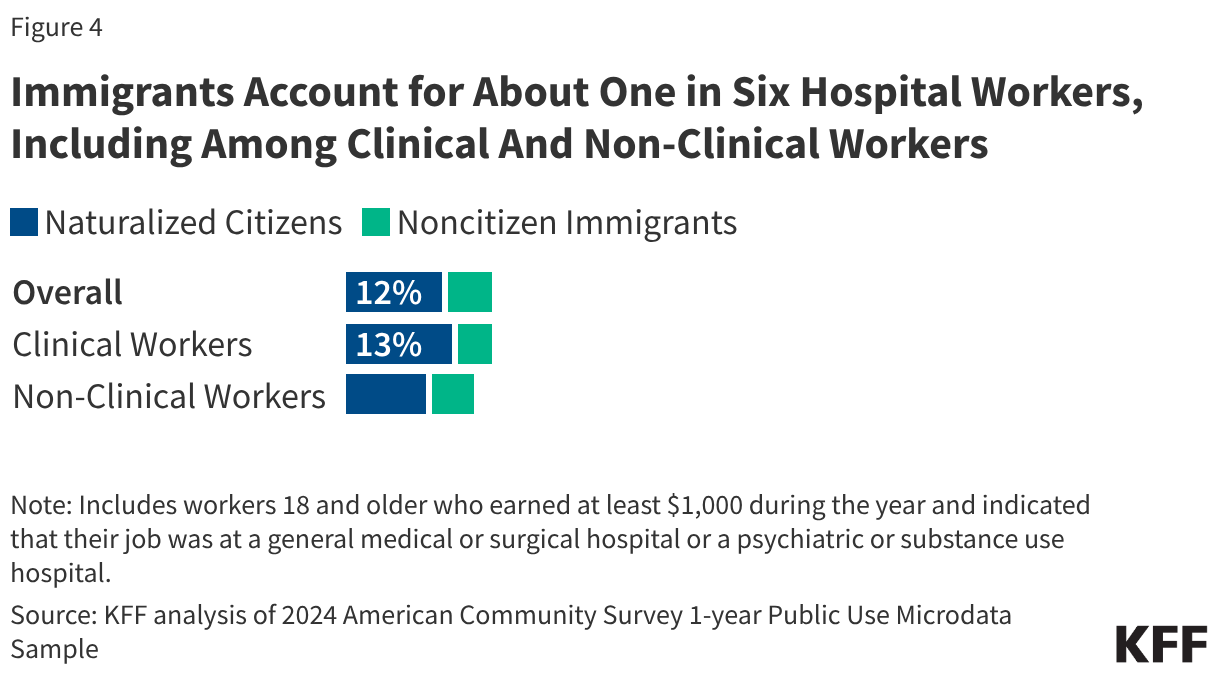
In hospitals, immigrants accounted for one in six (17%), or about 1.4 million, workers as of 2024. This includes 12% of hospital workers who are naturalized citizens and 5% who are noncitizen immigrants (Figure 4). Immigrants made up similar shares of clinical (17%) and non-clinical (15%) workers in U.S. hospitals. Clinical workers include physicians, surgeons, nurses, etc., and non-clinical workers include office workers, food service workers, cleaning and maintenance workers, and other non-clinical workers. Among immigrant hospital workers, 16% are from Philippines, 9% are from Mexico, 8% are from India, and 4% each are from China and Jamaica.
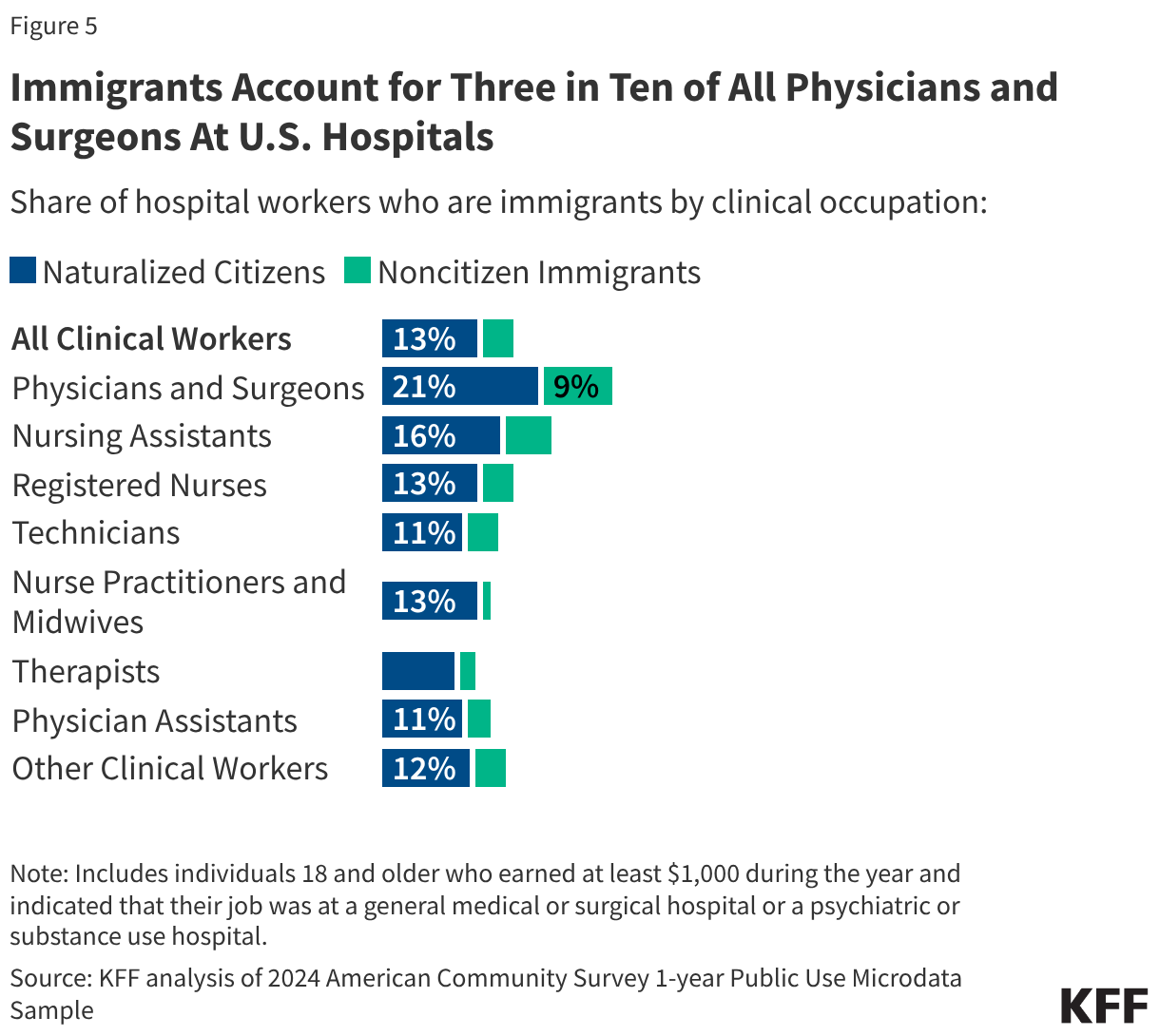
Within hospitals, immigrants made up three in ten (30%) physicians (Figure 5). This includes over one in five (21%) who are naturalized citizens and another 9% who are noncitizen immigrants. Immigrants also made up over one in five (22%) nursing assistants, about one in six registered nurses (17%), and about one in seven technicians (15%) and nurse practitioners and midwives (14%) at U.S. hospitals. Immigrants also play an outsized role in certain non-clinical occupations in hospitals, such as building cleaning and maintenance workers.
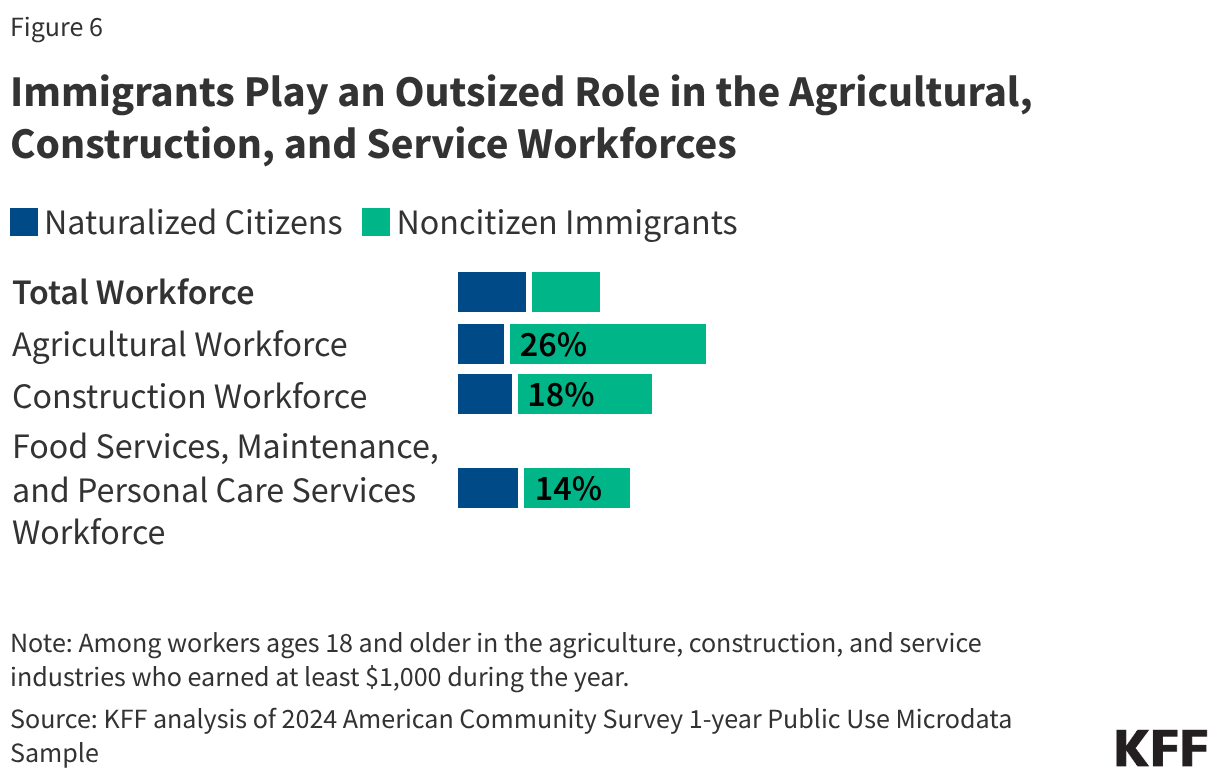
Immigrants, particularly noncitizen immigrants, also play an outsized role in other key industries including agriculture, construction, and service. As of 2024, immigrants made up one in three (33%) agricultural workers, of whom 26% were noncitizen immigrants and 7% were naturalized citizens; about a quarter of (26%) construction workers, of whom 18% were noncitizen immigrants and 8% were naturalized citizens; and about a quarter (23%) of food services, maintenance, and personal care service workers, of whom 14% were noncitizen immigrants and 9% were naturalized citizens (Figure 6).
Methods
Data sources: This brief is based on KFF analysis of federal survey data, namely the Basic Monthly Current Population Survey (CPS) and the American Community Survey 1-year Public Use Microdata Sample. These surveys are nationally representative household surveys conducted by the U.S. Census Bureau. While Basic Monthly CPS data are available on a monthly basis, ACS PUMS data are available on a yearly basis. Basic Monthly CPS data have a significantly smaller sample size than yearly ACS and yearly CPS data. Due to the smaller sample size, results may be more sensitive to potential decreases in survey participation among immigrants due to immigration-related fears.
Identifying citizenship status: Naturalized citizens are those who indicate becoming a U.S. citizen by naturalization; and noncitizen immigrants are those who say that they are not a U.S. citizen. Noncitizen immigrants include lawfully present and undocumented immigrants.
Identifying workers across different industries: Health care, agriculture, construction, and service workers are identified as individuals 18 years of age or older who report working either full-time or part-time in one of the aforementioned industries and who earned at least $1,000 during the year. Industries are classified based on Census codes that correspond with the North American Industry Classification System (NAICS). Codes 0170 through 0290 correspond to the agriculture industry; 0770 corresponds to the construction industry; 7970 through 8290 correspond to the health care industry; and 8680 through 9070 correspond to the food services, maintenance, and personal care services industries.
Identifying hospital and direct long-term care workers: Hospital workers are individuals 18 years or older who report working either full-time or part-time and indicate that their job was at a general medical or surgical hospital or a psychiatric or substance use hospital and who earned at least $1,000 during the year. Direct long-term care workers are individuals 18 years or older who report working either full-time or part-time, earned at least $1,000 during the year, and whose occupation is home health aide, personal care aide, or nursing assistant and who indicate working in home health care, nursing care facilities, residential care facilities, or individual and family services.
