

Created in 1999 and formally launched in January 2000, Gavi, the Vaccine Alliance (Gavi) is an independent public-private partnership and multilateral funding mechanism that “aims to save lives and protect people’s health by increasing coverage and equitable and sustainable use of vaccines.” Gavi’s main activities include supporting low- and middle-income countries’ access to new and underused vaccines for vulnerable children through financial support, technical expertise, and market-shaping efforts, such as negotiating with manufacturers, to help lower the cost of procuring vaccines. Gavi operates in five-year funding cycles, with a revised strategy and goals for each cycle. Each five-year strategy is accompanied by a vaccine investment strategy, which determines which vaccines will be made available to countries.
Gavi’s current five-year strategy, for the 2026-2030 period, which is its sixth strategy, includes four core goals:
- introduce and scale-up vaccines,
- strengthen health systems to increase equity in immunization,
- improve sustainability of immunization programs, and
- ensure healthy markets for vaccines and related products.
The current strategy emphasizes reducing the number of ‘zero-dose’ children with the goal of reaching no zero-dose children by 2030, in alignment with Immunization Agenda 2030; prioritizing programmatic and financial sustainability of country immunization programs; supporting targeted countries that have phased out of Gavi support or have never been eligible for Gavi support to maintain immunization progress; and providing more tailored approaches for Gavi countries to reach under-vaccinated populations, such as those living in remote or conflict settings, by encouraging countries to adopt strategies that reduce potential barriers to vaccination.
In addition to Gavi’s role in routine childhood immunizations, Gavi was one of the organizations leading COVAX, a multilateral effort that supported the equitable development, procurement, and delivery of COVID-19 vaccines globally that began in 2020 and ended in 2023. Gavi’s role in COVAX was to facilitate the procurement and delivery of COVID-19 vaccines, with particular emphasis on low- and middle-income countries. Provision of COVID-19 vaccines and funding support to countries was integrated into Gavi’s regular programming from 2024-2025 (COVID-19 vaccine support has been discontinued).
Organization
Gavi’s Secretariat, with its main headquarters in Geneva and an office in Washington, D.C., carries out the day-to-day operations of the partnership. Gavi does not have program offices or staff based in recipient countries but rather relies on country health ministries and World Health Organization (WHO) regional offices to implement programs. Gavi is led by a Chief Executive Officer (CEO), currently Sania Nishtar.
The 28-member Gavi Board sets Gavi’s funding policies and strategic direction, and monitors program implementation. It includes 18 “representative” seats, nine seats for independent individuals, and one ex-officio non-voting seat for Gavi’s CEO. The 18 representative seats, as specified in Gavi’s statutes, are as follows: donor country governments (5), implementing country governments (5), the WHO, the United Nations Children’s Fund (UNICEF), the World Bank, and the Gates Foundation, and one seat each for civil society groups, the vaccine industry in industrialized countries, the vaccine industry in developing countries, and technical health/research institutes. Additionally, several Board committees guide and advise the Board and the CEO on Gavi activities under their purview. The U.S. government was represented on Gavi’s Board as the Board member for the donor country government constituency until the end of 2025. With the suspension of U.S. support, the U.S. lost eligibility to hold a seat on the Gavi Board.
Funding
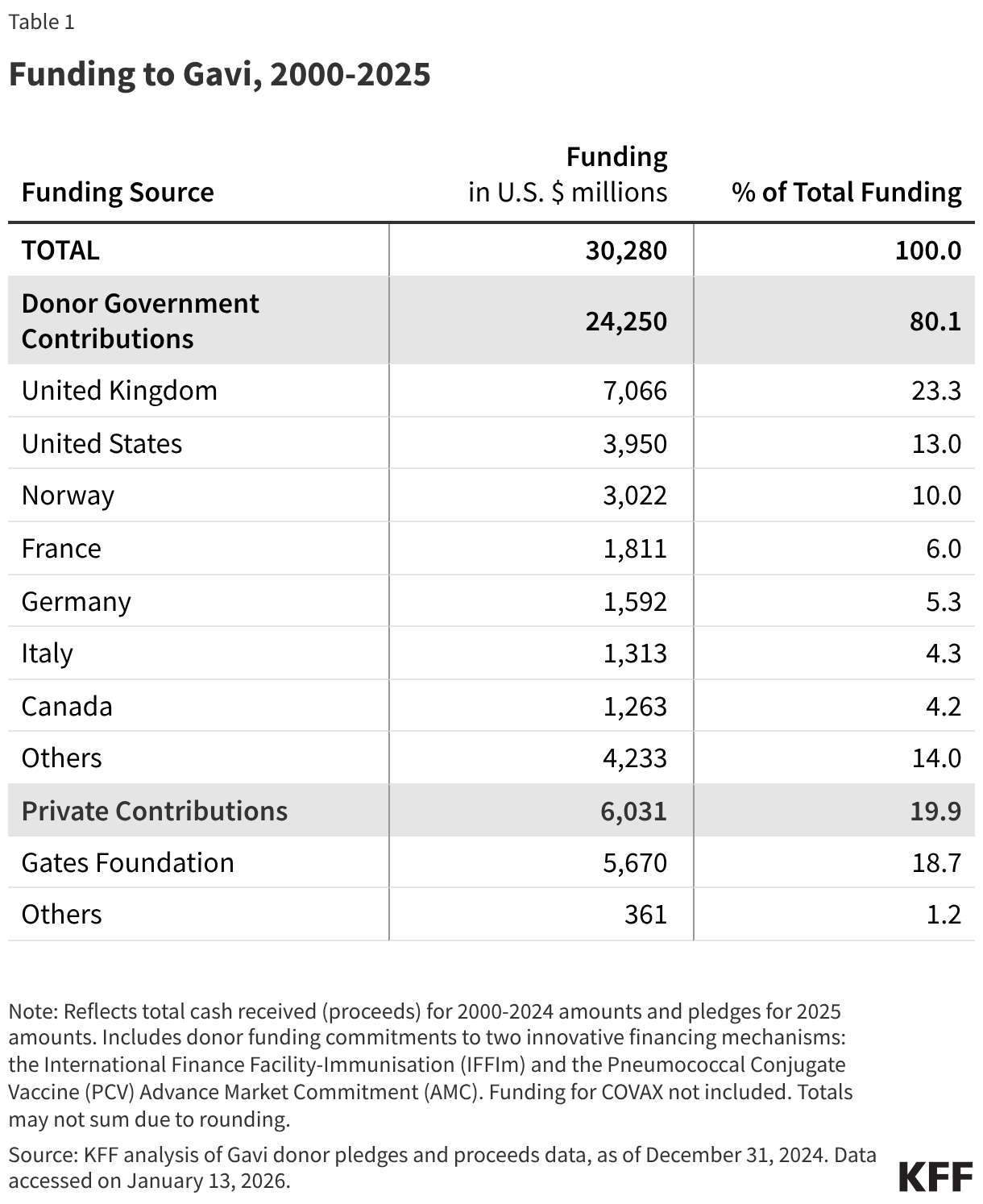
Since its 2000 launch, Gavi has received approximately $30 billion in financing, not including funding for COVAX (see Table 1).1 Approximately four-fifths (80%) of Gavi’s funding came from contributions provided by donor governments and private organizations and individuals. The top three government donors were the United Kingdom, the U.S. and Norway, while the largest private donor was the Gates Foundation.
Donors support Gavi through direct contributions as well as funding commitments to innovative financing mechanisms, the proceeds of which help support Gavi’s overall financing. These innovative financing mechanisms include the International Finance Facility-Immunisation (IFFIm) and the Pneumococcal Conjugate Vaccine (PCV) Advance Market Commitment (AMC). The IFFIm was created in 2006 and uses donor funding commitments to back the issuance of special bonds in capital markets, essentially providing “up-front” financing to Gavi. The PCV AMC began in 2010, and though it ended in 2020, it supported accelerated access to pneumococcal vaccines through up-front funding commitments from donors and continues to do so through contracts with manufacturers that extend until 2029. The U.S. does not provide support to either of these mechanisms.2
In addition to financing Gavi’s regular activities, donors pledged additional resources to support the Gavi COVAX Advance Market Commitment (COVAX AMC), a financial mechanism within COVAX that supported low- and middle-income countries through procurement and distribution of COVID-19 vaccines; through 2024, Gavi received $12.6 billion from donor governments, private philanthropy, and innovative financing mechanisms for the COVAX AMC for vaccine procurement, delivery, and logistics.3