

A joint legislative panel took more than four hours of testimony on a proposal to rescind and amend controversial flood rules approved on Gov. Phil Murphy’s last day in office.
The discussion was spurred by a resolution sponsored by Senate President Nicholas Scutari that would declare the regulations out of step with legislative intent and give the Department of Environmental Protection 30 days to amend them and allow the legislature to invalidate them by passing a second resolution.
“The PACT rules and the REAL rules have tremendous implications for New Jersey citizens, businesses, and New Jersey’s environment,” said Senate Environment and Energy chairman Bob Smith (D-Middlesex), referring to the regulations by an acronym.
The joint panel, which also included members of the Assembly Environment and Solid Waste Committee, did not vote on the resolution Wednesday, but Smith said he would share the meeting’s transcript with the legislature’s other members, raising the possibility of action in a few weeks’ time. Gov. Mikie Sherrill’s signature is not required for either resolution to take effect.
The Protecting Against Climate Threats Resilient Environment Landscape — or, more succinctly, PACT REAL — rules raised elevation requirements for new and significantly improved construction, created new wetlands protection and stormwater management rules, and expanded state flood maps beyond those drafted by FEMA, among other changes.
Business and development groups had opposed the rules in the years they spent under consideration by the department, fearing they would add costs to housing construction in a state in sore need of more dwellings and limit development altogether in some communities.
Some local officials have chafed at its restrictions over worries that it would slow growth or prevent them from meeting affordable housing obligations imposed by state law. On Wednesday, that group included the mayor of New Jersey’s second-largest city.
“With respect to the lobbyists here today, I didn’t ask them for an opinion on this. I very much went to our city planners first,” said Jersey City Mayor James Solomon, a Democrat elected in a nonpartisan race in December. “Their conclusion was in their current form the rules would impose serious unworkable burdens on development, rehabilitation across Jersey City.”
Though the rules included exemptions, city planners worried they were too unclear to be reliable and would risk the viability of major projects in a city that has seen a population swell and housing crunch in recent years, Solomon said.
Advocates have countered that ignoring climate risks carries its own costs, especially in New Jersey as severe storms grow more common and more damaging.
“Yes, there’s an increased cost to comply with new regulations for building elevation, for example, but if you break down those costs over the life of the structure and you look at the reduction in building damages, what you’d begin to see is that those costs essentially offset and essentially overtake the damage side of the equation,” said Mark Mauriello, a former DEP commissioner who now works in real estate development.
Flood risks also factor into municipal finance, said Daniel Garrett, an assistant professor of finance at the Wharton School.
Though pension payments and historically large reserves were the driving forces behind the credit rating upgrades New Jersey has received in recent years, rating agencies have also pointed to steps the state has taken to guard against climate risks.
New Jersey coastal communities that failed to protect against floods and other weather events already paid more to issue bonds than communities that took steps to guard against them, Garrett said.
“Investors require a higher return for bearing this climate risk,” he said.
New Jersey’s practice of not letting its municipalities declare bankruptcy would mean the state would be forced to take on a municipality’s debts if its property tax base disappeared in the wake of a destructive storm, Garrett said.
That debt could be increasingly burdensome as federal disaster assistance, especially to Democratic states, grows increasingly slim.
Ray Cantor, deputy chief government affairs officer for the New Jersey Business and Industry Association, said the group believed a two-foot elevation requirement would be an acceptable standard, arguing forecasts of sea level rise were not reliable.
“Real people, real businesses, real communities will be impacted. There will be people who won’t be able to build their homes, businesses who won’t be able to locate down the shore or rebuild to meet current economic needs,” he said.
The approved PACT REAL rules require new or significantly improved construction be raised at least 4 feet off the ground, down from 5 feet under a previous proposal. The requirement is meant to guard against sea level rises predicted between now and the 22nd century.
Smith, who said he believed the rules matched legislative intent, said the timing of the rules’ approval on Murphy’s final day in office had harmed them.
“I’m around long enough to recognize the power of the issue of ramming and jamming. You’re hearing from stakeholders — and also from legislators — feeling that they were ill-used and abused,” he said following the hearing, gesturing to where some Republican members sat that day.
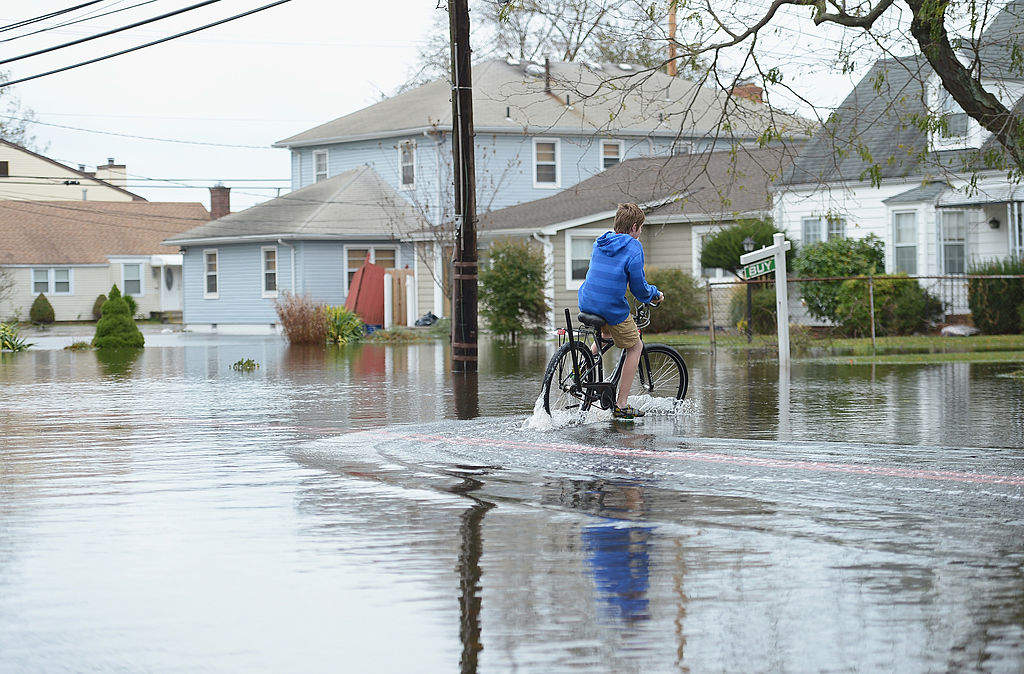
TOP PHOTO: POINT PLEASANT BEACH, NJ – OCTOBER 30: A young boy rides a bike through Hurricane Sandy floodwaters on October 30, 2012 in Point Pleasant Beach, New Jersey. The storm left around 2.5 million people in the state without power, claimed entire boardwalks, and flooded and evacuated towns on and off the New Jersey shore. (Photo by Michael Loccisano/Getty Images).
Published with permission from April 23, 2026 edition of New Jersey Monitor and the author, Nikita Biryukov. New Jersey Monitor is part of States Newsroom, the nation’s largest state-focused nonprofit news organization.
Topics
Trends
Legislation
Flood
New Jersey
